Most people judge B2B SEO services by whether you rank for the obvious category terms your whole market wants. That scoreboard is weak.
Broad terms rarely tell you who arrived or why. A good B2B SEO firm links your positions in search to qualified enquiries, sales conversations and assisted opportunities, and doesn’t report positions alone. So what is B2B SEO? It is search work that brings buyers to your sales team already knowing what they need.
The better opportunity sits in the specific searches buyers type once they know their problem, use case or industry constraint. Those buyers arrive ready to talk.
Take a flower shop for example. A sign reading “Flowers” draws everyone who has ever owned a vase, while an order for “peonies, birthday bouquet, delivered Friday before 3pm” tells the florist what to make, when, and for whom.
In this context, the long tail means the specific orders your buyers place, and a B2B SEO strategy means building a page for each order.
The same applies to you. A page built for “inventory software” tells your team nothing. A page built for “inventory software for multi-location homewares retailers” tells sales exactly who to call and what they need.
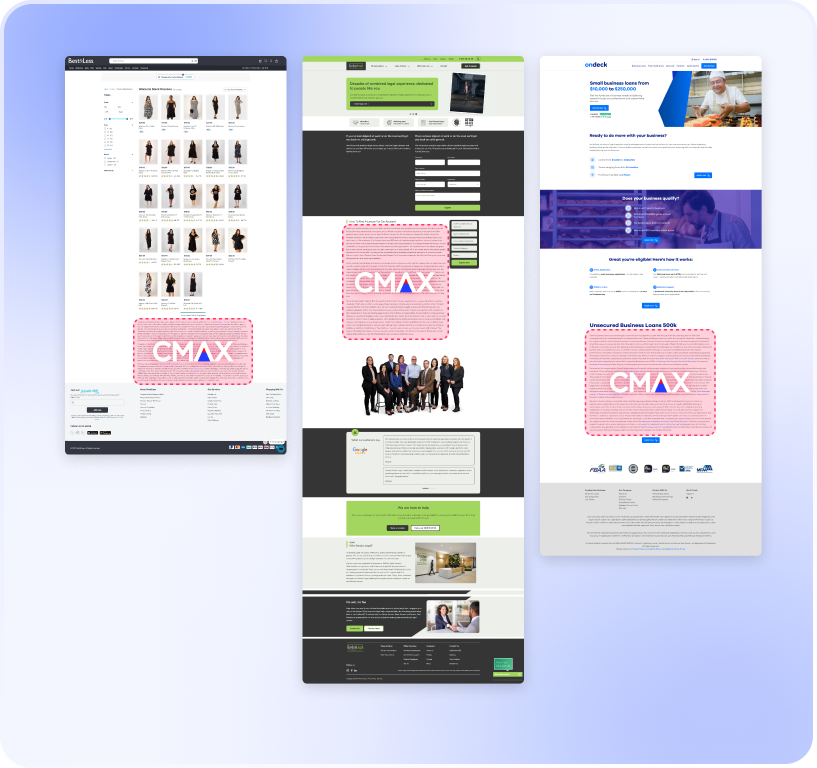
CMAX is the Agentic SEO Platform. Our agents build the long-tail pages that match how your buyers actually search, so the visitors you get are buyers your sales team can talk to.
B2B SEO services are built to capture the long tail your buyers actually search.
Long-tail queries drive qualified entry points.
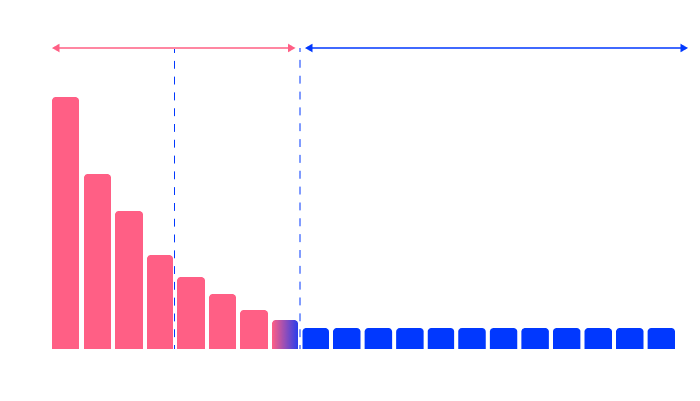
For complex sales journeys, B2B SEO services create entry points around use cases, industry constraints and implementation questions. Ranking for a handful of category terms gives you no pipeline plan. Over 90% of search and AI demand is in the long tail. Effective B2B SEO targets that demand directly, and so do we.
B2B journeys are longer and multi-person.
Effective B2B lead generation gives operations, finance, legal and marketing stakeholders their own pages for their own questions. Strong B2B lead generation services turn recurring sales objections into use-case, comparison and implementation pages before calls begin.
If an objection comes up regularly on calls, a page that people can find in search should answer it first. That is what B2B lead generation SEO does. When you compare B2B lead generation companies australia, ask which pages each of your stakeholders would land on.
The right service mix connects technical SEO, content depth, and internal linking.
Technical SEO and content work together.
Technical SEO gets Google onto your pages. Once technical faults are fixed, B2B SEO services build substantive answers buyers can evaluate. Google uses links to find new pages to crawl and as a signal for page relevancy.
A technically sound site with thin answers still loses to a slower site with better ones. Strong programmes for SEO for B2B saas pair site health with pages that answer real buying questions: integrations, alternatives, and industry or regulatory fit.
Internal linking strengthens topic coverage.
A single sales page signals one answer. A connected cluster signals a topic. A B2B content marketing strategy uses Dynamic Internal Linking and Full Body SEO to connect related pages, so buyers move from a broad service page into use cases, comparisons or implementation detail.
Good B2B content marketing also follows Google’s advice: every page you care about has at least one inbound internal link, and the anchor text guides both buyers and Google.
Agentic deployment supports scale and freshness.
Programmatic publishing builds templated pages and stops. In a programme covering SEO for SaaS, the goal is a broad content surface kept fresh, not a one-off publication run. Our agents keep long-tail content current as Search Console data shows demand changing.
Pipeline-focused reporting shows whether SEO is supporting sales conversations.
Search Console links queries to demand.
Search Console, Google’s free tool, shows which searches your site appears for, alongside clicks, impressions, CTR and the specific pages ranking. A B2B SEO company can read Search Console next to analytics, attribution and CRM data. That connects topic coverage to qualified enquiries, sales conversations and assisted opportunities.
Compliance-ready teams need controlled workflows.
CMAX is trained on human-reviewed, client-approved content. That matters in financial services, healthcare, legal, education, SaaS and regulated ecommerce, where loose claims carry real risk, and it applies to programmes such as SEO for insurance. Compared with US providers, a B2B marketing agency Australia must handle Australian spelling and local regulatory requirements when approving regulated content. The same applies to any B2B marketing australia programme.
Speed claims should be tied to method.
Most SEO programmes run by conventional agencies, using outdated methods, make clients expect results in six months. CMAX’s methods allow clients to start seeing clicks in 6 to 8 weeks. We define effective B2B SEO services as connected long-tail coverage, sustained deployment, and refresh cycles informed by performance data.
Should B2B SEO content be gated or ungated?
Ungated content does more for SEO for B2B companies. Google’s index is its library of known pages, and it can only index what it can read. Gate deeper assets like original research, calculators and implementation guides. Keep the search answer ungated, with the gated asset as the next step. This is the job B2B SEO services do for your funnel.
Why should B2B SEO be part of an ABM strategy?
ABM works better when target accounts find useful answers before sales or paid media reach them. Technical evaluators, budget owners, procurement and executives search differently, so one landing page rarely covers the account. SEO broadens account coverage. ABM sharpens follow-up.
Should B2B SEO be handled in-house or by an agency?
In-house teams know the product, customers and approvals best, so they should own messaging and sign-off. For specialised programmes, a B2B saas SEO agency can add scale, technical depth, long-tail coverage, linking, freshness and reporting. If your current model can’t explain how SEO supports qualified pipeline, it isn’t enough.
B2B SEO Services Support Qualified Pipeline
B2B SEO services work better when they cover the specific searches buyers make before they talk to sales. Teams often lose pipeline because useful long-tail coverage is missing. Few competitors have stronger optimisation on head terms than you do.
Our platform helps teams expand useful content across the long tail, connect it through internal linking, and keep it current as demand shifts. As a B2B SEO agency Australia teams can work with locally, CMAX also serves US programmes that need different spelling and currency conventions. Pipeline then comes from detailed use cases, comparisons, implementation questions and industry constraints, not one broad service page.
We can tie programmes such as SEO for fintech back to sales-focused reporting. You judge performance by contribution to conversations and pipeline, not rank snapshots alone.
You can’t fix a gap you can’t see. The review shows which searches your buyers make that your site doesn’t yet answer.
If you’re curious as to how you’re performing on AI, book in a Missing Customer Map review with our Growth Team.
Author
Jeremy Tang
Founder and CEO of CMAX
Jeremy Tang is the Founder and CEO of CMAX. With over 2 decades of experience in business consulting and digital marketing, he has successfully driven seven startup businesses, six of which achieved $1 million in revenue from zero in less than 16 months, 5 of which grew to multi-million dollar a year ventures without any external funding. Jeremy's expertise lies in streamlining business processes through technology and leveraging digital (in particular SEO) for business growth. He resides in Australia, travels extensively, and draws inspiration from his global experiences.