Most SEO copywriters can get a page to rank. The harder part is whether that page matches what the searcher actually needs at that stage of their decision, and whether the copy moves them toward a real conversion action or just fills space around keywords. When those two things pull apart, you end up with traffic that looks good in a dashboard but never turns into pipeline. The gap usually sits in how intent is mapped, how proof is placed, and how the page earns the next step. CMAX works across these same dynamics at scale for enterprise teams building long-tail SEO programmes.
The Right SEO Copywriter Improves Fit Between Search Intent and Conversion Goals
Query Intent and Conversion Fit
The best SEO copywriters close the gap between what a searcher asks and what the page delivers. A page can rank on page one and still generate no revenue. That happens when the query signals early research, comparison, or problem diagnosis, and the page responds by pushing a demo request, a quote form, or a purchase before the visitor has enough detail to decide.
Someone searching “how to evaluate SEO copywriters” is weighing options. Serving them a hard-sell landing page at that moment creates friction, not conversions. The right SEO copywriter reads the intent behind a query and matches the page’s offer to where the visitor actually sits in their decision process. That alignment is what turns ranked traffic into qualified pipeline.
Natural Keyword Use
Keyword placement is a signal, not a strategy. Good SEO copy uses target terms where they confirm relevance to the searcher and the search engine, then builds the rest of the page around the language buyers actually use to describe their problem, their constraints, and the outcome they want.
The result reads like a direct, useful answer. A writer who treats keywords as a checklist produces copy that sounds assembled rather than written, and readers notice. The page may hold a ranking, but it loses the reader’s confidence before they reach the call to action. Strong SEO copywriters close that gap by writing for the person asking the question first, with keyword placement following naturally from that discipline.
Strong SEO copywriting combines research, persuasion, and editorial control.
Query mapping by buyer stage
Research quality shows up before a single word is written. SEO friendly copywriting begins when a skilled SEO copywriter separates informational, comparison, and transactional queries into distinct groups, then assigns each group to the right page type, proof elements, objections to address, and next step. A visitor searching “how does X work” needs a different page architecture than one searching “best X for enterprise teams” or “X pricing.” Treating every keyword as if it belongs on the same page dilutes all three. The editorial controls that distinguish strong method from weak, such as intent segmentation, proof matching, and structured next steps, are what SEO copywriting best practices codify into a repeatable process. SEO copywriters working in modern content teams increasingly need to grasp the relationship between AI and SEO to make informed decisions about where automation supports and where human editorial judgement must lead.
Buyer-led conversion structure
Conversion-focused copy earns trust through structure, not persuasion tactics. The headline sets the exact promise the query implies. Each section answers the next logical question a buyer would ask at that stage. SEO copywriters match the call to action to the level of commitment the visitor is actually ready to make: a low-friction resource offer for early-stage readers, a direct quote or demo request for those with a clear purchase intent. When the section order mirrors how someone evaluates an offer, the page stops feeling like a pitch and starts functioning as a decision tool.
Human review for AI workflows
AI-assisted drafting accelerates production, but it introduces specific failure modes that require human review to catch. Factual drift, repeated phrasing across sections, unsupported claims, and gaps between what the searcher asked and what the page is selling are all common outputs from unreviewed AI drafts. Human editorial control is the checkpoint that keeps the copy accurate, on-brand, and aligned with the original search intent rather than a plausible-sounding approximation of it. SEO copywriters who work within AI-assisted workflows should also know how AI SEO services handle draft generation, quality control, and intent alignment so they can apply the right level of human review at each stage.
Evidence matters more than promises when you assess capability.
Usefulness over keyword density
Google’s guidance explicitly favours helpful, reliable, people-first content. That shifts the hiring test. What separates capable SEO copywriters is whether they improve message match and decision support, not term frequency. The stronger signal is whether a writer sharpens the clarity of claims and moves the reader closer to a decision. A page that answers the right question at the right moment outperforms one that simply loads terms into headings and meta descriptions.
Long-tail revenue proof point
Scale and specificity together produce measurable commercial outcomes. In one CMAX engagement, a B2B omnichannel hospitality retailer added 5,000 long-tail product pages and drove over $1M per month in incremental SEO revenue within 8 months. The mechanism is straightforward: many high-intent searches sit outside a small set of head terms, and those queries only convert when a dedicated page matches them precisely. A writer who can produce that kind of targeted, intent-matched copy at volume is a different hire from one optimising a handful of category pages.
Before-and-after page review
Ask any candidate to submit an original page alongside its rewrite. That comparison reveals more than a portfolio piece alone. Look for whether search-intent fit improved, whether claims got sharper, whether proof moved closer to the decision point, and whether the path to action became clearer. When reviewing an AI SEO assisted rewrite, apply the same lens: did the restructured page better match intent and strengthen conversion logic? Writers who only insert more terms without restructuring the argument are visible immediately in this format.
SEO copywriters can demonstrate capability through before-and-after page reviews and measurable conversion improvements, and organisations operating at scale may also examine how an enterprise SEO company structures content production, editorial controls, and performance reporting across large page sets.
A practical hiring process makes trade-offs easier to compare.
SEO copywriter hiring self-assessment checklist
Subjective hiring decisions get expensive fast. A standard checklist forces every candidate to be judged against the same commercial objective, research method, and editorial controls, so trade-offs between writers become visible rather than felt. For businesses investing in SEO Australia, tying each checklist criterion to a measurable commercial goal prevents vague comparisons from creeping into the shortlist. The same discipline applies in specific markets such as SEO Sydney and SEO Melbourne, where local competition sharpens the need for precise evaluation criteria.
Work through these questions before shortlisting:
- Conversion tie-in. Is the target page connected to a specific action, demo request, quote, enquiry, or purchase, or is the goal left open?
- Query grouping. Are target queries separated by buyer stage and page purpose, or treated as one mixed keyword list handed to the writer?
- Objection coverage. Does the sample copy address the blockers that typically stall decisions, pricing uncertainty, implementation effort, approval friction, proof of results?
- Read-aloud test. Does keyword usage hold up when the copy is read aloud, or does it break into awkward phrasing that signals stuffing over substance?
- Evaluation-led structure. Are headings and section order built around how a buyer weighs the offer, or arranged purely for ranking coverage?
- Proof point rationale. Can the writer explain why each proof point sits where it does and what specific question it answers for the reader at that moment?
- AI review discipline. If AI-assisted drafts are part of the workflow, does the review process cover fact-checking, tone control, claim discipline, and search-intent alignment?
A writer who can answer the last question with a concrete process, not a general assurance, is worth a closer look.
SEO copywriters are typically evaluated on writing quality and intent alignment, whereas an enterprise SEO consultant is usually assessed on technical strategy, site architecture, and cross-channel programme governance, making the two roles complementary rather than interchangeable in a hiring process.
Will Reporting Connect Rankings to Qualified Traffic and Real Conversion Actions, Instead of Treating Visibility Alone as Success?
Better Paid Test Briefs
A vague brief produces output that is hard to judge fairly. When a paid test defines the primary query, the likely search intent behind it, the page goal, the claims that must stay intact, the source material to draw from, and the editing standard expected, you have a clear basis for comparison across candidates.
Without those parameters, one writer might optimise for keyword density while another prioritises conversion flow. Both could look credible on the surface. A tight brief removes that ambiguity and makes it easier to see whose instincts align with commercial outcomes.
Reporting That Reflects Business Impact
Ranking movement is a leading indicator, not a result. A page that climbs from position 12 to position 4 has done something useful only if the traffic it gains is qualified and the visitors take the intended next step.
Useful reporting ties ranking changes to qualified organic sessions, engagement signals, and conversion actions at the page level. That means tracking whether a rewritten page attracts visitors who match the buyer profile, how far they move through the decision path, and whether assisted or direct conversions increase.
A page judged solely on visibility can look like a win while delivering no pipeline. Holding SEO copywriters to conversion-connected metrics keeps the work accountable to the outcome the business actually needs.
The Best Hiring Decision Depends on Operating Model and Oversight
Freelance, Agency, or In-House Fit
The right model depends on what your team actually needs day-to-day.
Freelancers work well for lower publishing volumes, specialist pages that need deep subject knowledge, or overflow when internal capacity runs short. The trade-off is coordination overhead and limited built-in review layers. For teams seeking an SEO copywriter Perth professionals can brief locally, a freelancer with regional expertise may cover that gap.
Agencies suit teams that need broader production capacity alongside structured editorial and quality control systems. If your programme involves multiple page types, ongoing briefs, and consistent output, an agency’s review infrastructure tends to absorb that load more reliably than a solo hire. As a leading SEO copywriting Sydney option, an agency model often handles broader production across multiple verticals.
SEO copywriters are often one component of a broader content system, which is why some organisations evaluate whether partnering with an AI SEO agency better suits their production scale and oversight requirements than hiring individual writers.
In-house SEO copywriters make sense when your content requires close, daily access to product knowledge, legal sign-off, or internal approval workflows. An SEO copywriter Melbourne teams rely on for daily collaboration may suit this model well in regulated industries, complex product lines, and fast-moving commercial calendars, because the cost of briefing an external writer on every update outweighs the cost of the hire.
Method and Judgement Over Promises
No hiring model removes the need to assess how a writer or team actually works.
The safest way to choose between SEO copywriters is to compare repeatable research methods and measured outcomes. The stronger choice is the one that can walk you through a repeatable research and editing method, explain the specific decisions made on a page, and share measured outcomes tied to traffic quality or conversion movement. Anyone who leads with ranking guarantees is telling you something useful: they’re not the right hire.
SEO copywriters focused on complex purchase cycles may be one part of a wider engagement, and buyers with high-volume or multi-channel needs sometimes assess whether a B2B SEO agency offers the research infrastructure and editorial oversight their programme requires.
Ask for the process behind the result. If they can’t describe it clearly, the result probably can’t be repeated.
How to maintain brand voice in scaled SEO content?
Document everything before production starts. Approved terminology, claim boundaries, example phrases, messaging priorities, and editing rules all need to be written down and shared with every writer or workflow involved. Without that reference, voice drift is almost inevitable once volume increases or a second writer joins the process.
Can AI-generated SEO copy lead to Google penalties?
AI use alone is not the core issue. Search risk comes from publishing thin, inaccurate, duplicated, or mass-produced pages that fail to satisfy the query or add anything new.[1] A well-reviewed AI-assisted page that answers a specific query accurately carries far less risk than a poorly researched human-written page that says nothing useful.[2]
SEO copywriters who want their content to remain discoverable should also consider how AI search engines surface and summarise results, since answer-style formatting and clear entity signals are becoming increasingly relevant to visibility.
Do long-tail keywords convert better than short-tail?
Long-tail queries often convert better when the query reveals a clearer need, a comparison point, a location, a product constraint, or a buying signal. Broad terms with mixed intent and weak commercial direction rarely deliver the same conversion rate because the visitor pool is too varied and the page cannot serve all of them well.
How to balance AI efficiency with SEO copywriting quality?
Use AI for draft acceleration, pattern handling, and first-pass structure. Require human review for factual accuracy, brand fit, search-intent match, and conversion logic. The split keeps production moving without letting quality controls slip.
What are the best KPIs for long-tail SEO growth?
The most useful KPIs combine coverage with business impact: indexed pages, qualified organic sessions, assisted conversions, conversion rate by page cluster, and the performance gap between long-tail pages and broader category pages. Ranking alone tells you very little about whether the right visitors are arriving and acting.
The 90% of Search Traffic Most Teams Never Reach
Most SEO strategies focus on a handful of high-competition keywords and ignore everything else.
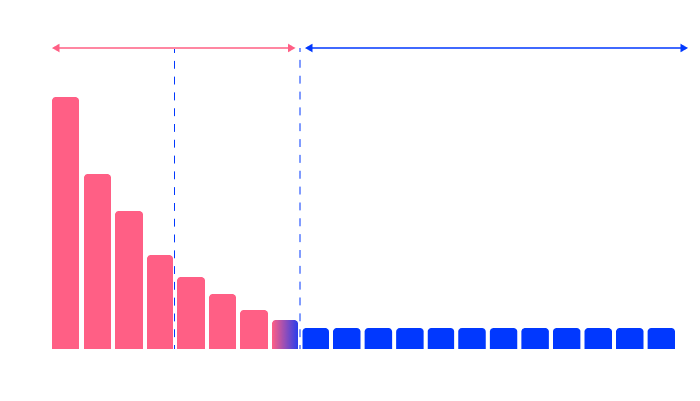
CMAX is an agentic SEO platform built to target the long tail, the thousands of specific, high-intent phrases that make up over 90% of search and AI demand. Our AI agents deploy and continuously update content at a scale and speed manual teams or traditional SEO copywriters simply can’t match, with results visible in as little as six weeks. Two lines of code connect CMAX to your site; from there, every new page works like another thread in a growing net, capturing traffic other strategies leave on the table.
If your content ranks but doesn’t reach the audiences actually ready to convert, we should talk.
References [1] – https://developers.google.com/search/docs/essentials/spam-policies [2] – https://developers.google.com/search/docs/fundamentals/creating-helpful-content
Author
Jeremy Tang
Founder and CEO of CMAX
Jeremy Tang is the Founder and CEO of CMAX. With over 2 decades of experience in business consulting and digital marketing, he has successfully driven seven startup businesses, six of which achieved $1 million in revenue from zero in less than 16 months, 5 of which grew to multi-million dollar a year ventures without any external funding. Jeremy's expertise lies in streamlining business processes through technology and leveraging digital (in particular SEO) for business growth. He resides in Australia, travels extensively, and draws inspiration from his global experiences.