SEO for insurance companies and agents looks like one discipline, but the operational reality splits early. A national insurer coordinating product pages across states and compliance teams faces a fundamentally different set of constraints than a local agent trying to rank for suburb queries and earn reviews. The priorities diverge at governance, content scale, and local trust, and treating them as interchangeable usually stalls both. CMAX works across both models, particularly where programmatic scale and location architecture need to coexist with compliance workflows.
Insurance SEO Splits at Company and Agent Level
The way SEO for insurance companies and agents plays out depends on whether you operate at company or agent level. A national insurer and a suburban broker both want to rank for insurance queries, but the mechanics that get them there share little overlap.
Whether you are approaching SEO for insurance from a governance perspective or a local trust angle, the foundational question of how to structure SEO for my website remains the practical starting point for both audiences.
Company SEO Needs Governance
Insurance companies publishing at scale face a structural problem: multiple teams, multiple states, multiple product lines, and no single person watching every page. Without central rules governing templates, approval workflows, internal linking, and location architecture, product pages drift. One team publishes coverage language that contradicts another’s. Location pages duplicate. Policy explanations go off-brand or, worse, off-compliance.
Governance is what keeps scale from becoming a liability. When the publishing model has clear rules for how product pages, state pages, and regional pages are built and approved, the organisation can expand coverage without creating the kind of conflicting or duplicate content that weakens rankings and introduces regulatory exposure.
Agent SEO Needs Local Trust
An individual agent’s SEO priority sits closer to the ground. The searcher looking for a local insurance agent typically wants someone they can call, visit, or verify before requesting a quote. That intent shapes everything.
Appearing in nearby searches, earning recent reviews, and demonstrating clear suburb or service-area relevance carry more weight here than broad product architecture. For anyone focused on SEO for insurance brokers, a well-optimised Google Business Profile and a consistent name, address, and phone number across directories can do more for visibility than a technically sophisticated site with no local signals.
The starting point differs because the searcher’s decision process differs.
Local Signals Carry Different Weight for Each Model
Local Signals Matter More for Agents
For an individual agent, local signals often determine whether a searcher ever reaches the website at all. Google Business Profile categories, review volume and recency, and consistent name, address, and phone details across directories shape map pack visibility before a searcher compares any website content. When the query carries local intent, “car insurance agent near me” or “home insurance broker Parramatta”, the local listing is the first filter, and agents who haven’t maintained those signals lose the click before the content race even starts.
Review acquisition carries particular weight here. A profile with recent, specific reviews signals active local presence to both the algorithm and the searcher. Consistent NAP details across citations reinforce that signal. Neither requires a large team to execute, but both require a deliberate, ongoing process rather than a one-time setup. How SEO for insurance companies and agents plays out at the local level relies on many of the same visibility principles studied by a real estate SEO agency, including Google Business Profile optimisation, suburb-level landing pages, and consistent citation data.
Enterprise Local Pages Support Broader Authority
For enterprise insurers, location pages serve a different function. A standalone location page that reads like a disconnected microsite adds little. Location pages perform best when they’re built into a wider product and brand architecture, each page reinforcing service availability, policy relevance, and internal linking back to core product and category pages.
Structured location data amplifies this when it’s consistent with the broader site hierarchy. The goal is a location layer that strengthens domain authority and product coverage, not one that fragments it across dozens of thin, loosely connected pages.
Content Scale Creates Different Operational Risks
Scale Increases Duplication and Compliance Risk
When multiple teams publish pages for similar products, states, and suburbs, the problems compound quickly. Near-duplicate copy dilutes ranking signals across pages that should each hold distinct search value. Mismatched search intent means a product page written for broad policy research ends up competing with a location page built for quote-ready local searches. Stale regulated wording is the sharpest risk: approved policy language changes, but pages published months earlier may not reflect those changes, leaving live claims that no longer match current coverage terms.
At scale, these are structural outcomes of a publishing model that lacks clear ownership and version control. Compliance workflow is what makes SEO for insurance companies and agents operationally different from standard SEO. Similar duplication and governance pressures affect SEO for it companies, where multi-product catalogues and regional landing pages create overlapping content that search engines struggle to differentiate. Organisations running SEO for B2B companies face comparable challenges when dozens of service pages target closely related queries without clear content boundaries.
Compliance Workflow for Insurance SEO
Insurance content needs a documented workflow before pages go live at volume. That workflow should define who drafts, who checks product accuracy, who reviews regulated claims, and when approved language can be reused without triggering a full legal review on every local variation.
A practical workflow maps claim sensitivity by page type. Regulated product claims, exclusions, and eligibility language belong in an approved wording library so teams pull from vetted copy rather than rewriting from memory. Service-area pages stay scoped to local service copy and do not drift into coverage statements that require compliance sign-off.
SEO for insurance companies and agents faces compliance content challenges similar to those managed by a healthcare SEO agency, where regulated claims, approved wording libraries, and version-controlled templates are equally critical to safe publishing at scale.
Legal or compliance review applies to policy-specific claims, product comparisons, and any wording that could change how a reader interprets their coverage. Templates and reusable blocks carry version records so teams can trace exactly which wording appeared on which page set. When policy terms or laws change, every page drawing from the same approved block gets rechecked, not just the most recent one.
The Right Framework Depends on Organisational Reality
Judge Company SEO on Operating Model
Traffic targets are a poor starting point for an insurance company’s SEO assessment. When selecting an SEO company Australia matched to organisational reality, the first question should be whether the publishing model can expand product and location coverage without creating duplicate pages or stalling on compliance approvals. If it cannot, hitting a sessions target means little.
The more useful diagnostic looks at governance first: are there clear templates, approval workflows, and location architecture rules in place? Can teams add a new state page or product variant without conflicting coverage language appearing across the site? Those operational questions determine whether growth is repeatable or fragile. Reputable SEO agencies Australia will evaluate governance, location architecture, product coverage, and approval workflow maturity before recommending a growth plan. A company that scores well on those dimensions has the infrastructure to scale. One that does not will hit a ceiling regardless of how strong its existing rankings are. Working with established Australian SEO companies that have experience in regulated industries can accelerate the governance audit and template design process.
SEO for insurance companies and agents shares some operational parallels with the scalable content frameworks discussed by a saas SEO agency, particularly around template governance and multi-page architecture.
Judge Agent SEO on Local Lead Signals
For an individual agent, the equivalent diagnostic starts with local lead signals. Map visibility, review acquisition, local page relevance, and lead attribution tell you whether nearby search demand is converting into calls, form fills, and quote enquiries from the areas the agent actually serves.
Rankings on broader product terms are a secondary concern. An agent ranking well for suburb and near-me queries, generating consistent reviews, and tracking which local pages produce contact actions has a functioning local SEO model. An agent optimising for category terms without a clear line back to enquiries from their service area is measuring the wrong thing.
The framework follows the operating model. Match the diagnostic to the business type before drawing any conclusions about performance.
How long does insurance SEO take to work?
The timeline for SEO for insurance companies and agents depends on four variables: how competitive the target queries are, the site’s existing authority, how quickly content clears compliance approval, and how much high-intent content is already live when the work starts. Early movement in indexing, local visibility, or long-tail rankings can appear within weeks. Meaningful lead impact takes longer. A site with approved templates and a functioning review workflow moves faster than one where every page waits on legal sign-off.
How to measure ROI for insurance SEO?
Connect organic sessions and map views to quote starts, calls, form fills, and bound-policy revenue where your attribution allows. Rankings are a diagnostic signal. Revenue is the outcome. Reporting rankings to a CFO without tying them to pipeline is how SEO loses budget.
Local vs national SEO for insurance agencies?
Agencies serving a defined area need local SEO first: map visibility, reviews, and suburb-level pages. Firms writing business across multiple regions also need national product pages to capture policy research, comparison queries, and non-local searches that happen before a buyer selects a provider.
How to scale insurance SEO content?
Scale more safely with reusable templates, approved claim libraries, and clear page rules for products, locations, and search intent. A sole trader needing professional indemnity insurance Australia sole trader coverage illustrates why niche long-tail pages convert better than generic product pages. Publishing large batches of pages that differ only by place name creates thin content and compliance exposure simultaneously.
How does AI search impact insurance SEO?
AI search raises the value of precise, well-structured, policy-specific content. Answer engines pull from source pages that state coverage distinctions, local service details, and trust signals clearly enough to summarise without changing the meaning. Vague or generic copy gets passed over; specific, accurate copy gets cited.
SEO for insurance companies and agents is increasingly shaped by developments in AI and SEO, particularly as answer engines begin surfacing policy-specific content in response to coverage queries.
As SEO for insurance companies and agents evolves, knowing how AI search engines retrieve and summarise structured content is becoming a practical concern for compliance-conscious publishing teams.
One Playbook Won’t Fit Two Business Models
Insurance companies and independent agents compete for the same keywords, but their SEO priorities are fundamentally different.
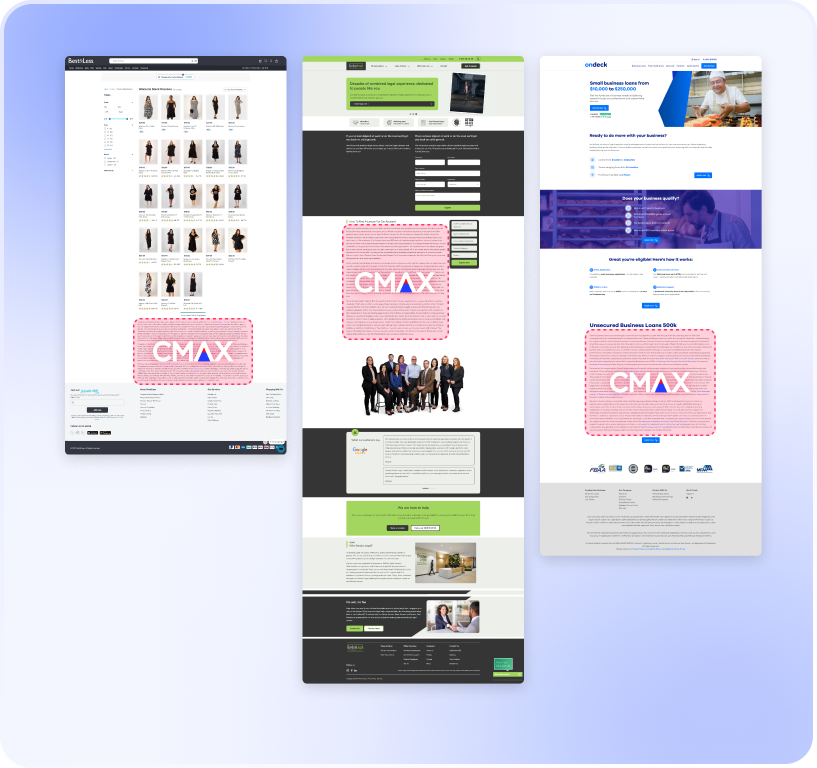
A national insurer needs scalable governance across hundreds of location pages, compliant product content, and coordinated authority signals. An independent agent needs hyper-local visibility, Google Business Profile, reviews, citations, and service-area pages that convert in a specific geography. CMAX is the agentic SEO platform built for exactly this kind of scale problem: our AI agents deploy and continuously update content for the thousands of long-tail queries your customers actually search, across both search and AI surfaces.
Whether you’re managing multi-location coverage or focused local campaigns, results start showing in six weeks.
Author
Jeremy Tang
Founder and CEO of CMAX
Jeremy Tang is the Founder and CEO of CMAX. With over 2 decades of experience in business consulting and digital marketing, he has successfully driven seven startup businesses, six of which achieved $1 million in revenue from zero in less than 16 months, 5 of which grew to multi-million dollar a year ventures without any external funding. Jeremy's expertise lies in streamlining business processes through technology and leveraging digital (in particular SEO) for business growth. He resides in Australia, travels extensively, and draws inspiration from his global experiences.