Every AI SEO company you evaluate will claim scale, speed and results, but the labels hide real differences in what you’re actually buying. Some sell a platform your team runs. Some run a managed service. Some only automate content production and leave technical SEO, measurement and quality control to you. Knowing where those boundaries sit before you shortlist saves months of misaligned expectations. CMAX is one provider in this space that publishes its scope, controls and attributed proof for exactly that kind of comparison.
AI SEO Companies Vary More Than Their Labels Suggest
The term “AI SEO company” covers a wide range of setups, and the differences between them are operational, not cosmetic.
What an AI SEO company actually delivers starts with grasping how AI and SEO intersect as disciplines, covering content production, technical health, and measurable discovery rather than automation alone.
Agency, Platform, or Hybrid
Before evaluating any provider, confirm which model you’re actually buying. An AI SEO company may operate as a managed service, a self-serve platform, or a hybrid of both. A managed service means the provider owns strategy, publishing, QA, and reporting. A platform means your team operates the system, with the provider supplying the tooling. A hybrid splits those responsibilities in some combination.
That distinction changes who is accountable for what. If rankings stall or pages don’t index, the answer to “whose problem is this?” depends entirely on which model you signed up for. Get that in writing before the conversation goes further.
Capability Beyond Content Automation
Page generation is one part of the work. A credible AI SEO company should be able to explain, specifically, how it handles content production at scale, technical SEO, long-tail keyword discovery from real search behaviour, and measurement tied to business outcomes.
Those are four separate capability areas. A provider strong in content production but silent on crawling, indexing, internal linking, or commercial attribution is offering automation, not a full SEO programme. Ask each provider to walk through all four. Vague answers in any one area are a signal worth taking seriously.
Real capability shows up in scope and controls.
Scope Boundaries of AI SEO
A genuine AI SEO company defines exactly what it does, what it needs from the client, and what sits outside its direct control. Without that clarity, buyers can’t separate operational capability from category-level marketing. A credible AI SEO company should define the full scope of its AI SEO services-covering content production, technical SEO, long-tail discovery, and measurement, so buyers can distinguish operational capability from a marketing label.
Content production. The provider creates or coordinates page creation at scale from approved source inputs. Publishing more pages doesn’t by itself produce indexing, rankings, or qualified conversions, volume is an input, not an outcome.
Technical SEO. The provider may manage templates, internal linking, canonicals, structured data, and page rules. Server performance, CMS constraints, engineering dependencies, and release approvals can still sit with the client.
Discovery at scale. The provider should show how it surfaces long-tail, location, and query-pattern opportunities from real search behaviour. Not every discovered keyword merits a page, and not every opportunity reflects enough demand to justify production.
Quality control. The provider should document source inputs, editorial review, and publishing governance. Regulated claims, legal wording, and brand-sensitive messaging still require client sign-off before pages go live.
Measurement. The provider should report against a dated baseline, a defined page set, and a specific business outcome. Seasonality, competitor movement, and overlap with paid or brand demand can all influence the final readout, a credible provider names those variables rather than ignoring them.
Whether evaluating a SEO company Australia buyers find through directories or a provider sourced through referrals, the same scope questions apply. Ask any shortlisted provider to walk through each boundary explicitly. For a SEO company geelong teams recommend locally, the same rigour holds: vague answers at this stage reliably predict operational friction later.
AI Answer Visibility, What a Provider Can and Cannot Control
The discipline of AI search engine optimisation covers page clarity, entity signals, and machine-readable structure. A provider can improve the signals that make a page more useful to AI systems: clearer question-and-answer structure, precise entity references, and machine-readable markup. What no provider can do is instruct Google AI Overviews or third-party chatbot systems to cite a specific page. Any vendor claiming otherwise is overstating their reach.
An AI SEO company can strengthen page structure and entity signals to improve the likelihood that content is surfaced by AI search engines, though no provider can guarantee a specific citation in any generated answer.
Controls That Support Scale
Scale without controls produces pages that are difficult to audit and harder to fix. Quality at scale depends on three things: traceable source material, enforceable publishing rules, and human review checkpoints. Together, those controls give a team a clear line of sight into how pages are built, what approved them, and when they were last updated before large batches go live.
Without that infrastructure, a high page count becomes a liability. Errors replicate across templates, regulated claims slip through without sign-off, and there is no reliable way to isolate which pages are underperforming or why.
Google Policy as Baseline
Google’s published helpful-content guidance and SEO fundamentals apply to AI-assisted pages the same way they apply to any other content.[1] AI involvement in production is neither a ranking signal nor a penalty trigger on its own. What Google evaluates is whether the page is useful, original, and accurate.
Providers should assess their output against that published standard before publication. Weak editorial control is the actual risk, and Google’s documentation is the right benchmark to apply. That baseline applies to any AI SEO company claiming scale.
Buying criteria separate scalable systems from content automation.
Technical SEO at Scale
Unlike a provider that stops at page generation, an AI SEO company with technical depth can show how large page sets are linked, templated, canonicalised, marked up, monitored, and maintained after launch. That walkthrough is where real capability separates from a content volume claim. Scale problems almost always surface in implementation detail: broken internal link patterns, missing canonical rules, unstructured markup, or templates that degrade as the page count grows. A provider who can answer those questions with specifics has built for scale. One who pivots to output numbers has not.
For a SEO company Sydney buyers are shortlisting, technical SEO ownership and measurement method are the criteria that separate scalable systems from content automation. When comparing delivery models side by side, knowing what an AI SEO agency is expected to own, strategy, publishing, QA, and reporting, helps clarify which criteria matter most on a shortlist.
Measurement That Proves Impact
Impressions and ranking positions tell you something moved. They do not tell you whether the work changed commercial performance. Measurement becomes decision-grade when it is tied to a start date, a defined page cohort, a comparison period, and a business metric: qualified leads, applications, or revenue. Without those anchors, a result can reflect seasonality, brand demand, or paid overlap as easily as it reflects the SEO programme. Require that structure before accepting any performance claim.
As an AI SEO services Sydney provider deploying templated page sets at scale, a platform addresses different problems than an enterprise SEO consultant engaged to audit architecture, govern standards, and advise on complex technical decisions across a large organisation.
Integration, Approvals, and Timeline
Speed claims need operational context to mean anything. A provider should be able to name the required inputs, identify which stakeholders hold approval authority, and specify the engineering lift involved before a single page goes live. CMAX clients typically begin seeing results within 6 weeks, but that timeline depends on inputs, approvals, and integration scope being defined upfront. Operational friction, not the publishing system, usually determines how fast a programme actually launches.
Verified Proof and Next Steps Reduce Selection Risk
Finance Proof Point
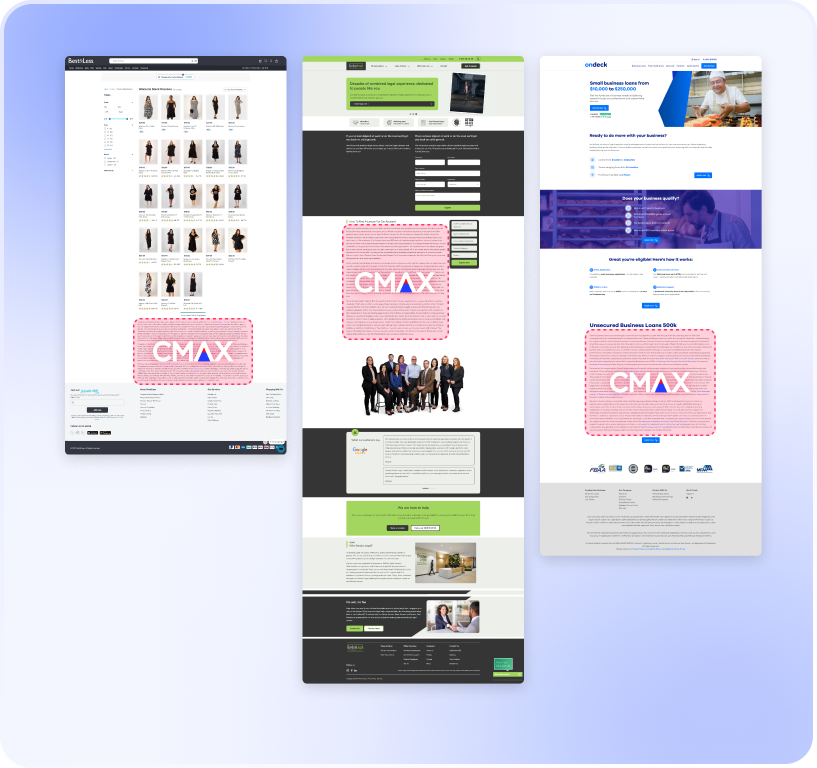
One CMAX engagement with a fintech lender illustrates what long-tail coverage at scale can produce. As an AI SEO company Melbourne businesses can evaluate against attributed proof, this finance case shows what programmatic depth looks like in practice. The lender entered the programme with roughly 1,000 pages, concentrated on head terms that had already plateaued. By May 2023, the site had grown to 15,000+ pages, expanding into suburb-level and long-tail query patterns that the original architecture had left uncovered. Over 12 months, SEO traffic grew 6X and loan applications grew 6X alongside it.
Traffic growth without application growth would indicate a targeting problem. Both moving together, tied to a defined page cohort and a dated start point, is the kind of attributed proof that holds up when a CFO asks what the programme actually delivered. For a SEO company Melbourne buyers are comparing, that dual metric is the standard worth demanding.
Buyers evaluating AI SEO providers are often testing exactly this: whether broader long-tail coverage, page architecture, and measurable reporting are real operational capabilities or a label applied to basic content automation. A result with a baseline, a scope, a timeframe, and a business outcome answers that question directly. Providers offering AI SEO services Melbourne teams can audit should be able to present comparable attributed cases on request.
An AI SEO company focused on programmatic scale operates differently from a B2B SEO agency built around account-based targeting and sales-cycle alignment, so buyers should confirm which model matches their pipeline and audience before shortlisting.
Shortlist Comparison Checklist
When comparing providers, score each one against the same criteria rather than letting the strongest pitch win by default. The criteria that separate credible providers from category-level marketing claims are scope limits, quality controls, technical ownership, reporting method, and attributed proof with a named outcome. Scoring providers this way is how buyers identify the best SEO company Australia shortlists actually support.
Soft claims become easier to challenge when every provider on the shortlist has to answer the same questions in the same format. Cross-referencing SEO company reviews on independent platforms adds a layer of third-party validation that internal scoring alone cannot provide.
How to appear in AI answers?
Pages are more likely to be reused in AI-generated answers when they use clear question-and-answer structure, precise terminology, and machine-readable context. Those signals help systems identify exactly what a page covers and when it is relevant to a query. No provider can guarantee citation in Google AI Overviews or chatbot outputs, but structured, entity-clear pages give the systems more to work with.
How to measure AI SEO ROI?
Measuring what an AI SEO company actually delivered starts with isolating the pages launched through the programme. Set a dated baseline before launch, and track business outcomes alongside visibility metrics. Qualified leads, applications, or revenue tell a clearer story than impressions alone. A comparison period and a defined page cohort are what turn a ranking report into a result a CFO can act on.
An AI SEO company operating at enterprise scale shares many of the same accountability requirements as any enterprise SEO company-dated baselines, defined page cohorts, attributed proof, and clear reporting against business outcomes.
How to avoid AI content penalties?
For readers still clarifying what is SEO services at a foundational level, the core principle here is straightforward: review AI-assisted pages for factual grounding, originality, duplication risk, and brand or compliance accuracy before publication. Weak editorial control is the common failure point, not AI assistance by itself.
How to scale AI content for local SEO?
Each page needs to reflect a real location pattern, service variation, or search-intent difference. Suburb pages that only swap place names without adding distinct value are harder to justify and harder to rank. Providers offering SEO for it companies or other industry-specific verticals should apply the same location-relevance test to every template.
How to transition to AI SEO?
For teams still defining what is SEO business value looks like internally, start with one defined page set, documented source inputs, approval rules, and a measurement plan. That gives the team a controlled way to test workflow fit before extending the model across the wider site.
Most AI SEO Companies Talk Scale, CMAX Deploys It
CMAX is an agentic SEO platform built for one job: capturing the long-tail search traffic most businesses never reach.
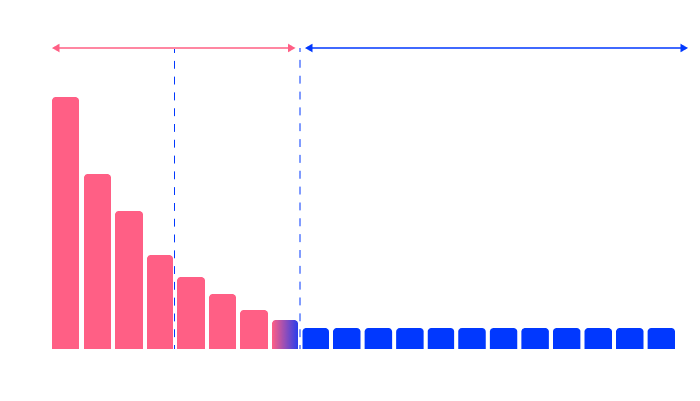
Over 90% of search and AI demand sits in long-tail queries, the thousands of specific ways buyers look for what you sell. CMAX targets those queries programmatically, deploying and continuously updating content with just two lines of code. Where traditional approaches stall at dozens of pages, CMAX operates at thousands, with early results typically visible within six weeks of launch.
That distinction matters when you’re evaluating an AI SEO company. The difference between a label and a platform is whether it can show you the mechanism, the timeline, and the measured outcome, not just the promise.
References [1] – https://developers.google.com/search/docs/fundamentals/creating-helpful-content
Author
Jeremy Tang
Founder and CEO of CMAX
Jeremy Tang is the Founder and CEO of CMAX. With over 2 decades of experience in business consulting and digital marketing, he has successfully driven seven startup businesses, six of which achieved $1 million in revenue from zero in less than 16 months, 5 of which grew to multi-million dollar a year ventures without any external funding. Jeremy's expertise lies in streamlining business processes through technology and leveraging digital (in particular SEO) for business growth. He resides in Australia, travels extensively, and draws inspiration from his global experiences.