Most teams exploring AI powered SEO hit the same wall: the technology can produce content faster, but nobody has clearly defined which tasks it should own and which ones still need a person. That lack of boundaries is where quality breaks down, pages underperform, and internal confidence in the approach stalls. The line between automation and human judgement is practical, not philosophical, and it shifts depending on the task. CMAX works within that boundary, pairing scalable content production with the editorial and strategic controls that keep large programmes measurable.
AI-Powered SEO Is a Workflow, Not a Shortcut
What AI-Powered SEO Includes
AI powered SEO combines query research, clustering, brief creation, page production logic, internal-link recommendations, and performance analysis into a single repeatable system. Each component feeds the next: research surfaces demand, clustering organises it into addressable topics, briefs translate those topics into production-ready inputs, and performance analysis closes the loop by flagging what needs updating.
The way AI and SEO interact across every stage of the workflow, from query research and clustering through to performance analysis and content refresh, defines what AI SEO looks like in practice.
That integration is what separates AI powered SEO from using an AI writing tool on an ad hoc basis. A single tactic produces a handful of pages. A connected workflow produces coverage at a scale that a human team, working manually, cannot sustain without sacrificing quality or speed.
How Teams Divide Responsibilities
The division of labour is deliberate. AI handles high-volume, rules-based tasks: grouping similar queries, generating draft variants from approved inputs, and flagging pages that have gone stale and need a refresh. These are tasks where volume and consistency matter more than case-by-case judgement.
People handle everything else. Which keyword groups deserve their own page, which claims are accurate enough to publish, and where brand positioning or legal exposure makes automation the wrong call — those decisions stay with the team. When teams adopt SEO and AI as a connected workflow, AI accelerates the repeatable work while the editorial and strategic layer determines whether that work is worth publishing.
The workflow only holds up when both sides of that division are clearly defined before production begins.
The real difference appears in execution boundaries.
AI tasks vs human judgment
The practical boundary in AI powered SEO comes down to repeatability. If a task follows consistent rules and produces a reliable output at scale, AI can own it. If the task requires weighing intent, assessing risk, or making a call that affects brand or legal standing, a person stays in the loop.
That boundary plays out across four distinct areas. The clearest way to see where AI-powered SEO adds value is to examine what AI for SEO actually handles at scale, such as query clustering, draft generation, and update flagging, versus where human judgement remains the deciding factor.
Query clustering. AI groups thousands of keywords by pattern and similarity. Humans then decide whether those groups reflect one coherent intent, several competing intents, or no content opportunity worth pursuing. A cluster that looks clean in a spreadsheet can still point to a search that no page should target. Most AI powered SEO tools handle the grouping step reliably, but the editorial filter still belongs to a person.
Draft generation. AI produces drafts from approved inputs at a pace no editorial team can match manually. Humans verify product details, factual claims, and any wording that could overstate what the page can actually support. The approved inputs matter as much as the review.
Page expansion. AI scales coverage across products, locations, and use cases. Humans stop pages that would target the same intent twice, add no differentiated value, or produce thin coverage across thousands of URLs. Volume without distinction creates indexing problems, not rankings.
Internal linking and update suggestions. AI surfaces recommendations based on structure and relevance signals. SEO AI tools flag link and freshness candidates automatically, while humans prioritise those changes by commercial importance and crawl efficiency, checking whether a link strengthens the path for a user or simply adds to link count.
Each layer keeps automation where it performs and human judgment where the stakes are too high to automate.
AI Powers Monitoring of Rankings and Content Decay, Humans Interpret Whether a Drop Points to Stronger Competitors, Cannibalisation, Weak On-Page Experience, Indexing Friction, or a Mismatch Between the Page and the Query
AI can surface a ranking drop. It cannot tell you what caused it.
Monitoring tools flag when a page loses positions, when traffic to a URL falls below a threshold, or when a cluster of pages stops earning impressions. That signal is useful. But the diagnosis requires someone who can read the full picture: a competitor published a stronger page, two of your own URLs are splitting the same intent, the page experience is weak on mobile, Googlebot is hitting crawl friction, or the query evolved and the page no longer fits what searchers actually want. Each of those causes points to a different fix. Treating them the same way wastes time and compounds the problem.
At scale, AI powered SEO depends heavily on the quality of SEO content writing that feeds each template, because even the most sophisticated monitoring and update logic cannot compensate for source copy that lacks originality, factual grounding, or clear search-intent alignment.
Human Checks That Stay Essential
Search intent mapping, factual validation, and policy-sensitive edits stay human because liability does not disappear when production scales.
On pages where a wrong claim, a missing nuance, or a weak disclosure can harm trust or create compliance exposure, the volume of content published is irrelevant to the risk carried by each individual URL. A healthcare page that overstates a benefit, a financial page that omits a required caveat, a product page that misrepresents a specification, these are predictable failure points when review processes are not built into the production model from the start.
Human review at this level is a structural requirement, not a quality-control afterthought applied once content is live.
Measurable impact depends on method, not output volume.
How to compare performance fairly
Page count is the wrong scorecard. A programme that publishes 10,000 pages targeting overlapping queries can produce worse organic outcomes than one that publishes 500 pages targeting distinct, commercially useful searches.
Measuring the impact of AI powered SEO requires the same rigour applied to any SEO marketing programme, tracking indexed coverage, ranking distribution, non-brand traffic, and conversion quality across a consistent timeframe rather than counting pages produced. A well-defined AI powered SEO strategy shapes which metrics are tracked and how the programme is structured before any content is published.
A valid before-and-after comparison holds the timeframe constant and tracks five metrics: indexed pages, ranking distribution across head and long-tail terms, non-brand organic traffic, conversion quality, and the speed at which pages are updated after content or product changes. Each metric answers a different question. Indexed pages confirm crawl health. Ranking distribution shows whether new coverage reached queries the site previously missed. Non-brand traffic isolates SEO performance from brand momentum. Conversion quality checks whether the traffic arriving from new pages actually converts. Update speed measures whether the programme can maintain accuracy at scale, not just launch at scale.
Catalogue-scale proof point
In one CMAX engagement, a B2B omnichannel hospitality retailer added 5,000 long-tail product pages and reached $1M+/month in incremental SEO revenue within 8 months, with a 255% organic traffic increase over 12 months. What made AI powered SEO measurably different here was the targeting of distinct long-tail queries rather than the repackaging of existing content across thousands of near-duplicate pages.
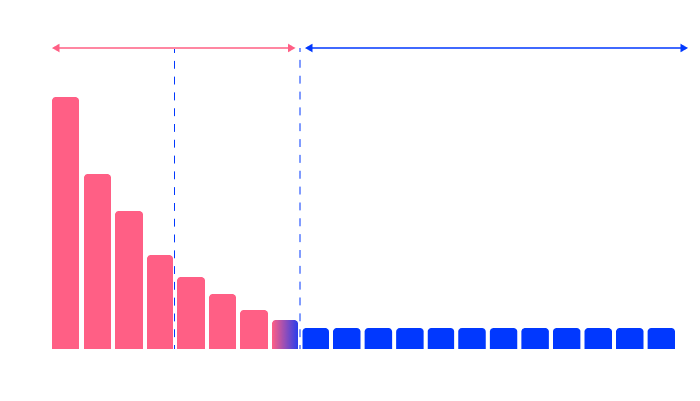
The mechanism behind that result applies directly to enterprise sites with large catalogues or broad service sets. Based on CMAX’s platform data, head terms capture a fraction of real search demand. The remainder sits in long-tail queries where purchase intent is high and competition is lower.[1] Covering that demand at scale, with pages that target distinct queries rather than repackaging the same content, is where the measurable gap between AI powered SEO services and conventional SEO programmes tends to open up.
Quality and Indexing Risks Still Shape Outcomes
Why Lightly Edited Copy Fails
Google’s guidance on helpful content centres on usefulness, originality, and people-first value.[2] Pages that reuse generic wording, offer no original evidence or experience, or fail to answer a distinct query better than existing competitors will underperform regardless of how efficiently they were produced.
The volume problem is real: at scale, lightly edited AI output tends to converge on the same phrasing, the same structure, and the same surface-level answers. When thousands of pages share that pattern, they compete with each other as much as with external sites. Thin differentiation at the page level becomes a crawl and ranking liability at the domain level.
The quality controls that protect an AI powered SEO programme are the same ones that determine whether SEO AI output meets the originality and usefulness standards that search engines use to evaluate pages at scale.
Process Controls That Reduce Risk
A workable AI powered SEO process does not treat publication as the finish line. Source-controlled briefs keep generation anchored to approved inputs, so pages start from accurate, differentiated material rather than open-ended prompts. Review thresholds tied to page risk mean that a product page with pricing claims or a category page targeting high-commercial-intent queries gets closer editorial scrutiny than a low-stakes informational variant.
Scheduled updates close the loop. Stale facts, duplicate intent, weak differentiation, and low-value pages are predictable failure modes at scale. Catching them before they spread across thousands of URLs requires a systematic refresh cycle, not a one-time audit. Teams that build this into the operating model treat content quality as an ongoing process rather than a launch-day checklist.
An effective strategy ends with an honest takeaway.
What measurable improvement looks like
AI-powered SEO delivers a real difference when three things happen together: useful search coverage expands to reach queries that were previously out of scope, the time required to publish or refresh pages shortens without cutting editorial review, and qualified organic conversions improve in efficiency rather than just in volume.
Page count is not the measure. A programme that adds thousands of URLs but targets overlapping intent, thin coverage, or queries with no commercial value produces activity, not results. The signal worth tracking is whether new pages reach distinct searches, rank across a broader distribution, and contribute non-brand traffic that converts at an acceptable rate.
Where human-led SEO still matters
Automation handles volume. Human judgement handles consequence.
Brand positioning, subject-matter expertise, legal review, and trust-sensitive publication decisions cannot be delegated to a generation model, because the question those decisions answer is not how a page should read. It is whether the page should exist at all.
On pages where a wrong claim creates compliance exposure, where a missing disclosure weakens trust, or where the brand’s authority rests on demonstrated expertise, human oversight is the control that keeps scale from becoming liability. That does not change as production volume increases. If anything, it becomes more critical, because errors that would be caught on a single page can propagate across hundreds of URLs before anyone notices.
This AI SEO guide has outlined where automation adds value and where human judgement remains essential. AI powered SEO is meaningfully different when it expands useful search coverage, shortens production cycles without removing editorial review, and lifts qualified organic conversions.
As AI powered SEO matures, teams also need to consider how their pages are structured and discovered by AI search engines, since generative and conversational interfaces increasingly surface content differently from traditional results pages.
Does Google penalise AI content?
Google does not treat AI use alone as the deciding factor.[3] What triggers poor performance is scaling pages without originality, usefulness, or adequate human review. AI-assisted content that answers a distinct query with accurate, specific information can rank. Generic output published at volume, without editorial checks, is what creates the problem.
How to maintain brand voice with AI SEO?
Brand voice holds up when AI works from approved messaging, terminology, examples, and page patterns rather than generating from scratch. Human editors then check whether the final copy reads consistently across templates, updates, and page types. Without that review layer, voice drift compounds across thousands of URLs. Teams looking for AI SEO Brisbane should evaluate whether the provider enforces brand-voice controls at this level before signing on.
Is AI SEO safe for regulated industries?
It can be, with tighter controls. Teams in regulated industries should limit generation to approved source material and require human review for any claims, disclosures, or wording that could trigger legal or policy issues. The liability attached to a published page does not reduce because AI produced the draft. Businesses exploring AI SEO Melbourne should confirm that any provider they engage applies these same compliance safeguards to locally targeted campaigns.
What is the difference between agentic and programmatic SEO?
Programmatic SEO publishes pages at scale from structured rules and datasets.[4] Agentic SEO goes further: the system can also analyse performance, decide next actions, and trigger updates with less manual prompting between each step.
How to measure AI SEO success?
Track indexed coverage, ranking spread, non-brand visits, conversion quality, and refresh speed before and after rollout. Content volume alone cannot show whether the additional pages reached distinct, commercially useful searches.
When teams ask how to measure the success of AI powered SEO, the answer mirrors what practitioners expect from any rigorous AI SEO programme, indexed coverage growth, ranking spread, and qualified organic conversions tracked before and after rollout.
Two Lines of Code, Thousands of Long-Tail Keywords
CMAX is an agentic SEO platform built for programmatic scale.
Our AI agents deploy, monitor, and update content across the thousands of long-tail queries that represent over 90% of search and AI demand, the traffic most teams lack the bandwidth to capture manually. Integration takes two lines of code, results typically surface within six weeks, and every page is designed to meet the same quality and crawlability standards search engines reward. Where conventional platforms stop at content generation, CMAX continuously optimises what’s already live so performance compounds rather than plateaus.
If you’re evaluating what AI powered SEO looks like in practice, we’re a good reference point for where automation ends and human strategy still matters.
References [1] – https://ahrefs.com/blog/long-tail-keywords/ [2] – https://developers.google.com/search/docs/fundamentals/creating-helpful-content [3] – https://developers.google.com/search/docs/appearance/ranking-systems-guide [4] – https://developers.google.com/search/docs/essentials/spam-policies
Author
Jeremy Tang
Founder and CEO of CMAX
Jeremy Tang is the Founder and CEO of CMAX. With over 2 decades of experience in business consulting and digital marketing, he has successfully driven seven startup businesses, six of which achieved $1 million in revenue from zero in less than 16 months, 5 of which grew to multi-million dollar a year ventures without any external funding. Jeremy's expertise lies in streamlining business processes through technology and leveraging digital (in particular SEO) for business growth. He resides in Australia, travels extensively, and draws inspiration from his global experiences.