SEO location pages only rank when each one gives Google and customers a real reason to trust it for that market.
Planning the markets first also prevents internal competition. That problem has a name, keyword cannibalization SEO, and it happens when several pages chase the same intent with no clear lead page.
A practical local SEO guide separates useful market evidence from templates that swap one city name for another.
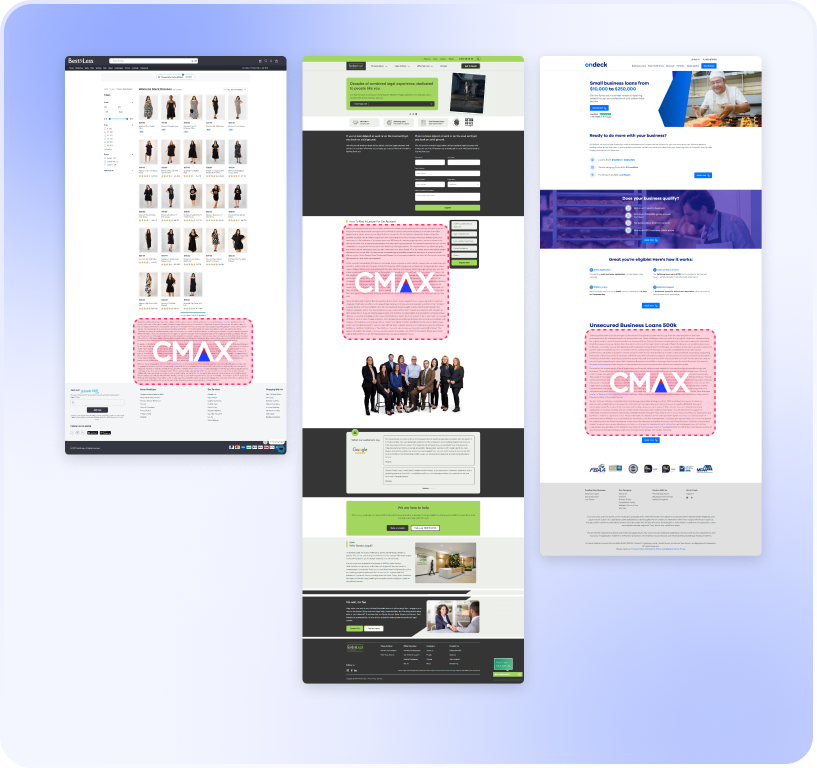
Too many location pages are one template with a new city dropped in. Google calls that pattern out directly in its spam guidance.
Try this test. If a customer could remove the suburb or city from the page and still have no idea which market it serves, that page has no ranking opportunity.
The fix is detail. Each page carries something that couldn’t be copied across to the next location.
CMAX has worked through this challenge with retail and service brands scaling location pages across Australia. Compared with US campaigns, local SEO Australia work must reflect Australian spelling and state names on every market page.
Real local evidence makes a location page work
Prove local relevance
Location pages target searches like “cookware delivery Brisbane”. That page needs delivery cut-offs and local access conditions for Brisbane.
Effective local SEO for tradies replaces repeated city templates with job photos, response windows and service details from the relevant area.
Google states that local results are shaped primarily by relevance, distance and prominence. machine learning SEO can help analyse whether business information is complete and detailed across a large page set.
A local SEO guide for small businesses uses the same test: is the market still clear without the city name?
Avoid thin doorway pages
A weak location page reads the same as 50 others with only the city name swapped. Google defines doorway abuse as pages made to rank for specific, similar searches.
That explicitly includes substantially similar, city-targeted pages that funnel users to one destination.
Among the most useful local SEO tips is this one: remove the city name and see whether the remaining evidence still identifies the market. If it doesn’t, the page is too thin.
Strong location pages carry details that make each market different
Add market-specific details
Useful local detail describes how the business operates in that area. A retailer can strengthen SEO location pages with warehouse proximity, nearby showrooms, delivery cut-offs, bulky-item access details and the suburbs covered.
State licensing limits, clinic availability and warehouse proximity give a local SEO ranking effort evidence that can’t be copied between markets. The local SEO hero in your business is usually the branch manager who already knows these details.
These details help buyers decide faster. They can also strengthen product pages SEO by connecting availability, fulfilment and access information to real market differences.
Add local proof and trust
Each local SEO landing page becomes more credible with area reviews, case examples, local project photos, area-specific FAQs, staff coverage, and answers about delivery access or callout fees. The strongest trust signals answer the questions that block a sale: “Do you deliver to my suburb by Friday?”, “Is there a callout fee for this area?”, “Have you handled this regulation in my state?” or “Can I collect from a nearby location?”
Scalable systems keep coverage broad without cannibalisation or duplication
Build a clear location hierarchy
Start with the commercial map. A scalable local SEO content strategy maps state, city, suburb, district and branch coverage before templates enter production.
Unlike branch profiles, SEO location pages can follow that hierarchy based on search demand, service reality and local proof. Templates can speed production, but each page still needs unique local inputs.
Without them, it starts to resemble the substantially similar pages Google flags in its spam policies. For the build steps, see location pages SEO.
Use connected, fresh coverage
A connected local SEO strategy links each market page to relevant services, nearby areas, category pages, branch information and proof content. Any local SEO strategy 2026 plan should treat those links as part of the build.
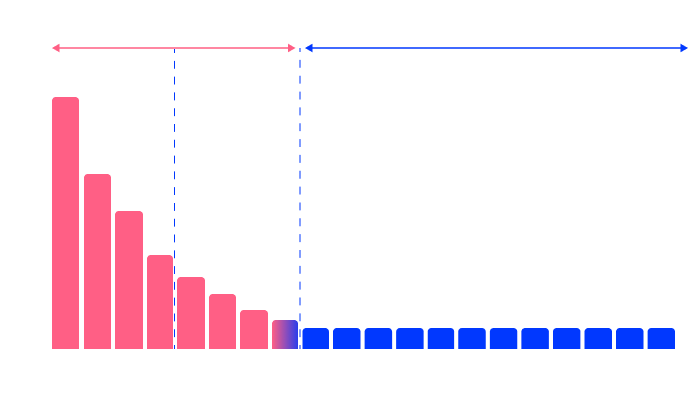
We approach this through our Agentic SEO Platform, using Dynamic Internal Linking to help Google read page relationships and Full Body SEO to support broader, fresher coverage across the long tail. The long tail is the large set of specific searches that each bring few visits and together make up most of the demand.
Consolidate weak overlaps
If two pages target the same intent and neither carries distinct evidence, merging is usually stronger than publishing both. Effective SEO location pages are organised around distinct demand, proof and conversion value.
Within multi location SEO, one clearer page reduces internal competition and gives Google a stronger signal to crawl, rank and connect.
Frequently Asked Questions (FAQ)
How many location pages is too many?
There’s no fixed number. Ten weak city pages can be a problem.
Hundreds of local SEO pages can make sense for a national brand that has distinct evidence for each market it covers.
The test is usefulness. Each page needs local evidence, a clear role in the site hierarchy and a reason for that market to have its own answer.
Without those, a large set of near-identical pages can drift into doorway territory.
Can one page rank for a service in several cities?
Yes, when search intent is broad and the service is delivered the same way across a wider area. One “Sydney delivery” page may cover nearby suburbs if pricing, cut-offs and access conditions are consistent.
Separate pages make more sense when customers in each city need different proof, constraints, regulations or availability. For regional service coverage, product led SEO still supports a split that follows real differences in customer need.
A spreadsheet of place names is no basis for a split.
Should my Google Business Profile link to the location page or the homepage?
Google says a profile representing a specific location should link to a website that represents that individual business location, and not to URLs that redirect users to landing pages other than those of the actual business. The question of “What is local SEO marketing?” gets practical here: the profile must link to the page for its actual location.
In practice, link to the branch page for a branch, the city page for a service-area location, or the homepage only when no better local page exists.
Local Evidence Makes SEO Location Pages Work
SEO location pages scale when each one gives Google and customers something specific to work with. Our approach is a scalable SEO strategy example: distinct market evidence, broad coverage and clearly connected pages, so useful searches are covered with purpose.
Rather than relying solely on SEO blog writing services, CMAX helps brands expand coverage through content built around real market differences and kept fresh and connected across the site. Breadth works best when distinct local proof, clear page relationships and fewer thin overlaps back it up.
The quickest way to see which of your markets have a page that earns its place is to look at them side by side. That’s a short diagnostic, with no pitch attached.
If you’re curious as to how you’re performing on AI, book in a Missing Customer Map review with our Growth Team.
Author
Jeremy Tang
Founder and CEO of CMAX
Jeremy Tang is the Founder and CEO of CMAX. With over 2 decades of experience in business consulting and digital marketing, he has successfully driven seven startup businesses, six of which achieved $1 million in revenue from zero in less than 16 months, 5 of which grew to multi-million dollar a year ventures without any external funding. Jeremy's expertise lies in streamlining business processes through technology and leveraging digital (in particular SEO) for business growth. He resides in Australia, travels extensively, and draws inspiration from his global experiences.