Most SEO content gap analysis starts with a tool export and ends with a spreadsheet no one acts on. The gap between “keywords they rank for that you don’t” and “pages worth building” is where the method usually breaks down. The difference sits in how you choose competitors, how you sort what the export actually means, and whether you validate opportunities against live search results before committing resources. CMAX works with enterprise teams turning exactly these prioritised gaps into pages at scale.
Competitor choice determines whether the gap is useful.
Comparable search competitors
A useful SEO content gap analysis begins with choosing the right competitors, not the biggest ones. Useful gap analysis starts with sites that compete for the same query intent, audience problem, and page type. A blog post, a category page, a product page, and a landing page can all rank for the same topic while serving entirely different search jobs. Pull a competitor whose pages serve a different job than yours, and the gaps you surface won’t translate into actionable decisions. The comparison has to be like-for-like at the page-type level before it’s worth running at all.
SERP overlap over market share
Brand recognition is not a reliable proxy for SEO relevance. A well-known brand with strong market share but little overlap in the queries and page types you need to win tells you almost nothing about where your own gaps are. The better comparator is a site that repeatedly appears in the same search results across your core topic clusters. Repeated SERP co-occurrence signals that the site is competing for the same intent and audience, which makes its keyword and topic footprint a meaningful benchmark. Among all SEO strategies, getting competitor selection right is one of the most foundational steps. Prioritise that overlap signal over industry reputation when selecting who to measure yourself against.
Gap analysis works when keywords are grouped by meaning.
Four gap types, four actions
A raw keyword export treats every gap as the same problem. It isn’t. Keyword gaps, topic gaps, intent gaps, and quality gaps each point to a different decision, and conflating them produces a content plan that wastes budget on the wrong fix. This is where SEO content gap analysis shifts from a raw export to a decision framework.
A keyword gap means a specific term is missing from your rankings entirely, so the response is a net-new page targeting that query. A topic gap means a subject area exists on your site but critical subtopics are absent, so the response is expansion within an existing URL or a supporting cluster page. An intent gap means you rank for a query but your page serves the wrong search job, so the response is a rewrite, not a new URL. A quality gap means coverage exists and intent is correct, but the page is thin, outdated, or outclassed by what currently ranks, so the response is a substantive update.
Sorting gaps into these four categories before any prioritisation work cuts the shortlist to decisions that are actually actionable. Once those decisions are made, SEO content creation turns each validated gap into a brief with a clear page action attached.
Filter exports in decision order
Large exports become useful only when filtered in a deliberate sequence. Remove irrelevant terms first: anything outside your topic clusters, audience, or commercial scope. Then sort the remainder by intent, ranking difficulty, and business fit, in that order.
Scoring difficulty before confirming relevance and intent wastes time. A term with a low difficulty score means nothing if the searcher’s goal has no connection to what the business sells. Confirm fit first, then assess how hard the gap is to close. During an SEO content gap analysis, filtering a large keyword export by intent and business fit naturally surfaces a concentration of SEO longtail opportunities that competitors rank for but that remain unaddressed on your site. The filtered output then feeds into SEO and content creation as an ongoing workflow, connecting each prioritised gap to a production schedule.
SERP evidence separates real opportunities from noisy exports.
Competitor-first evidence rundown
A large keyword export will always contain noise. The real test of any SEO content gap analysis is whether the opportunities survive contact with the live SERP. The gap between a term appearing in a tool and a term worth acting on is closed by checking the live SERP directly, not by sorting a spreadsheet.
A defensible shortlist requires four checks against each candidate opportunity:
Page type match. Confirm whether the ranking page is a guide, category page, product page, or landing page. A competitor’s category page ranking for a transactional term tells you something different than a blog post ranking for the same query. Your response needs to match the page type the SERP is rewarding.
Intent alignment. Compare the search intent the competitor’s page satisfies against the intent your current pages serve. An intent mismatch on your side is a rewrite problem, not a new-page problem.
Subtopic and modifier coverage. Scan the top-ranking pages for subtopics, modifiers, and use cases that recur across multiple results. A modifier appearing on three or four ranking pages is a signal; one appearing on a single outlier page is noise.
Repeated SERP overlap. A keyword earns a place on the shortlist when the same competitor appears for it across your core topic clusters, not as a one-off result in an isolated query. Recurrence across clusters is the filter that separates a real gap from export noise.
Run these four checks before assigning any term to a page action. The evidence either holds or it doesn’t.
Emerging areas such as LLM SEO add new ranking surfaces that traditional exports may not capture. When validating SERP evidence during an SEO content gap analysis, it is worth noting how ranking dynamics are shifting under SEO for AI search, where answer-engine visibility may signal a gap even before traditional rank trackers catch it.
Review Whether Your Existing Page Needs a New URL or a Substantial Update
CMAX Proof Point
A keyword-gap export is a list until someone decides what to build. That decision, new page or updated URL, is where most gap analyses stall.
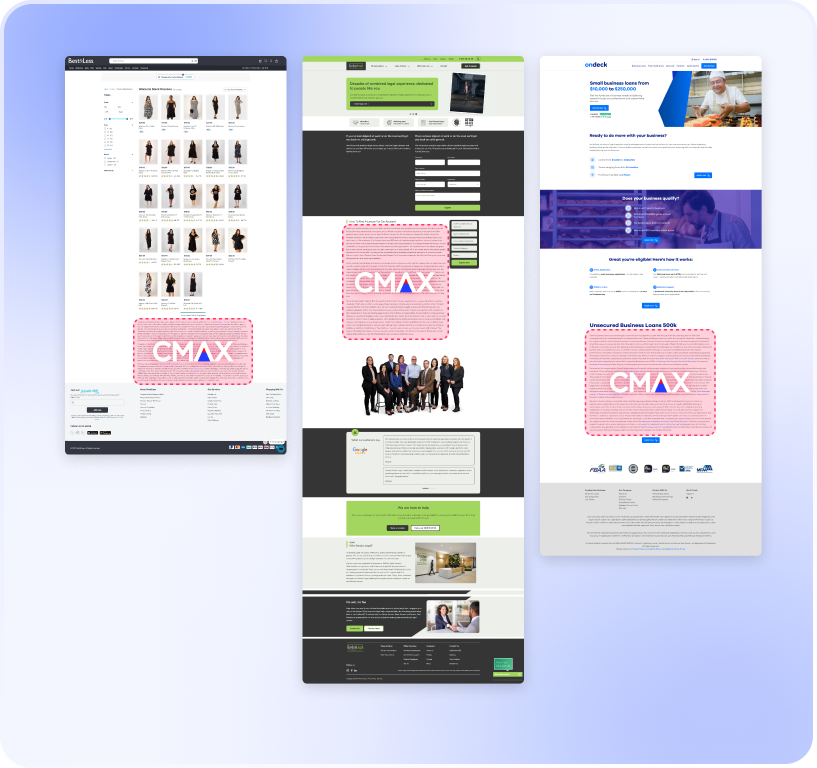
One CMAX engagement with a B2B omnichannel hospitality retailer shows what happens when the decision gets made at scale. The team mined SEO and Google Ads data together, identified catalogue-scale long-tail demand, and launched 5,000 product pages targeting that demand. In that engagement, organic traffic grew 255% in 12 months.
A rigorous SEO content gap analysis translates directly into measurable SEO website traffic gains when identified gaps are mapped to prioritised page creation rather than left as unactioned exports.
The mechanism is worth noting. The growth came from turning a large keyword-gap export into prioritised page creation, not from refining a spreadsheet. Long-tail gaps at catalogue scale require page volume that manual workflows can’t sustain, which is why the retailer’s data-to-page pipeline had to run programmatically.
An SEO content gap analysis that spans catalogue-scale exports will often reveal that the highest-volume unaddressed demand sits at the intersection of transactional intent and product pages SEO, where new URLs rather than updates are the correct response.
The same logic applies at any stage of gap analysis. Once you’ve validated that a gap represents a genuine search opportunity, the next question is whether your site has a URL that already holds some relevance or ranking signal for that topic. If it does, content optimisation for SEO through a targeted update is usually faster to move than a new page. If the gap maps to a topic your site hasn’t touched, a new URL is the only path. Leaving either decision unmade converts a real opportunity into a static export that ages out before anyone acts on it.
For existing pages that rank but underperform, SEO optimisation of on-page elements and content depth can close the gap without spinning up a new URL, turning SEO content gap analysis into measurable page-level growth.
The Final Shortlist Should Map Directly to Page Actions
New Pages Versus Updates
The output of a SEO content gap analysis should be a shortlist that maps every validated gap to a specific page action. Once you have validated gaps against live SERPs, every item on that shortlist needs a single, clear assignment: create a new page or revise an existing one.
Missing topics, queries your site has no URL targeting, almost always justify new pages. There is no existing signal to build on, so a new URL is the right vehicle.
Intent mismatches, thin sections, and outdated coverage are a different problem. If a URL already holds some relevance, earns impressions, or carries internal authority, a substantial update to that page will typically outperform launching a competing URL. Splitting authority across two pages targeting the same intent rarely helps either one rank.
The decision rule is straightforward: check whether a relevant URL already exists before you commission anything new. The end result should be a prioritised SEO content plan that assigns each gap to a page action.
A well-executed gap analysis increasingly intersects with AI in search engine optimisation, particularly when prioritising which gaps to close first based on algorithmic signals and content scoring.
Override Weak Tool Signals
Difficulty scores are estimates. When a third-party score and the live SERP disagree, the SERP wins.
Manual SERP review tells you what page types are actually ranking, how authoritative the current incumbents are, and whether the intent is stable or shifting. Page-level before-and-after cohorts, tracking rankings and traffic for a defined set of URLs before and after a change, give you first-party evidence that no tool can replicate. Google Search Console data and publicly available search guidance add further grounding that a single difficulty number cannot capture.
As SEO content gap analysis evolves alongside changing search technology, practitioners are beginning to factor in AI engine optimisation when deciding which newly identified topics deserve the highest publication priority.
Use difficulty scores to triage at volume. Use manual review and your own search data to make the final call on what to publish next and what to update first.
Frequently Asked Questions (FAQ)
Content Gap Analysis: How Do You Do It?
Start by listing search competitors with strong SERP overlap across your core topic clusters. Export the keywords and topics they rank for that you do not, then group those gaps by meaning and intent rather than treating the raw list as a to-do queue. Validate the strongest opportunities directly in the live results. Then assign each confirmed gap to either a new page or an update based on the page type and search job required.
When teams ask how to scale an SEO content gap analysis across thousands of keyword opportunities, one emerging answer is AI driven SEO, which can automate gap scoring and content mapping at a volume that manual review alone cannot sustain.
What Is the Best Way to Find Keyword Gaps?
Compare your site against several genuinely comparable ranking competitors, then filter the shared export for relevance, intent, and business fit. Whether you need SEO Melbourne agencies can vouch for or a national campaign, the filtering method stays the same. A term missing from your site is only worth acting on if it matches what the business sells and what the searcher is actually trying to do.
Is There a Free Tool for Keyword Gap Analysis Between Two URLs?
Free options can handle small comparisons between two URLs or domains, but they typically restrict export size, historical depth, or filtering capability. For teams running SEO in Sydney that matches local search behaviour, these limitations become apparent quickly when competitor sets grow. Manual SERP checks carry more weight before any output becomes a page decision.
What Is Your Favourite Content Gap Analysis Tool?
The stronger choice is whichever platform lets you compare overlapping competitors, inspect page-level rankings, and export enough query data to separate a true topic gap from an intent mismatch or a quality problem.
How to Identify Content Gaps That Competitors Have Missed?
Look for repeated modifiers, narrow use cases, or audience-specific questions surfacing across forums, autocomplete suggestions, internal search logs, sales-call language, or paid search terms that still have weak, fragmented, or outdated coverage in the current SERPs.
Gaps Don’t Close Themselves
Most sites lose organic traffic to competitors not because their content is bad, but because it’s incomplete.
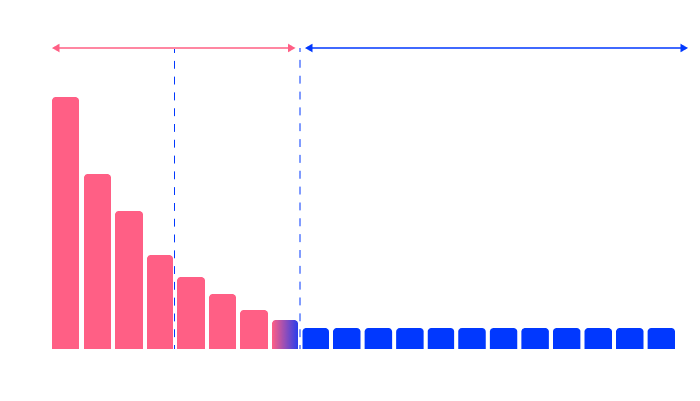
CMAX is an agentic SEO platform built to capture the 90% of search demand that lives in long-tail keywords, the exact queries a content gap analysis is designed to surface. Our AI agents deploy and continuously update pages targeting thousands of those terms, using just two lines of code. Teams that would need months of manual prioritisation start seeing measurable results in six weeks.
If your gap analysis keeps producing lists no one has bandwidth to act on, that’s the problem CMAX was built to solve.
Author
Jeremy Tang
Founder and CEO of CMAX
Jeremy Tang is the Founder and CEO of CMAX. With over 2 decades of experience in business consulting and digital marketing, he has successfully driven seven startup businesses, six of which achieved $1 million in revenue from zero in less than 16 months, 5 of which grew to multi-million dollar a year ventures without any external funding. Jeremy's expertise lies in streamlining business processes through technology and leveraging digital (in particular SEO) for business growth. He resides in Australia, travels extensively, and draws inspiration from his global experiences.