SEO for fintech works when the content matches how carefully buyers search. For regulated lenders, it means mapping fees, eligibility, repayment terms and security checks to the stage of the decision each one belongs to.
A buyer researching a business loan doesn’t stop at the first result.
Picture a customer walking into a hardware shop and saying “I need paint.”
The staff member who points at the paint aisle loses the sale. The one who asks about the surface, indoors or out, and how many walls, wins it.
Your buyer has the same questions about fees, eligibility, repayment terms and security checks, and they want them answered before they apply or book a call. Good fintech marketing answers all of them.
In this context, SEO for fintech means building the pages that answer the staff’s questions before the customer has to ask, so your site is the shop they stay in.
Google holds pages about money to a higher standard, because the decision can affect the reader’s finances. Trust signals matter more here than in most categories.
For SEO for financial services, that means clear sourcing, accurate claims and visible trust signals.
Ranking for broad terms is different from earning the searches that lead to approved sign-ups or booked calls. CMAX approaches regulated search as a B2B SEO company should: long-tail, compliance-aware content built around the specific questions buyers ask before they ACT.
SEO for fintech works best when compliance and intent lead the strategy.
Intent depth matters most.
Fintech buyers research before they ACT. A search that starts with “business loan” branches into questions about fees, eligibility, repayment terms, transfer limits, security controls, settlement speed, chargeback rules, integrations and provider credibility.
Each branch is a separate search. Buyers work through most of them before anyone applies or books a call.
Those detailed questions are where trust is won or lost. For SEO for finance companies, we map each question to buying stage, risk concern and compliance sensitivity.
Google gives extra weight to trust signals on finance topics, because these pages can affect a person’s financial stability. A strong strategy maps searches the same way, and doesn’t stop at monthly volume.
Measure qualified demand, not visits.
Judge a fintech SEO programme by the qualified demand it drives. The measures that count are non-brand query mix, high-intent landing page performance, application starts, approved sign-ups, qualified demo requests, booked advisory calls and assisted conversions.
Search Console is Google’s free tool that shows which searches your site appears for. It separates broad awareness searches from decision-stage searches.
Teams delivering B2B SEO services can give more commercial weight to a page ranking for “same day business loan eligibility sole trader” or “payment gateway chargeback protection Australia” than to a generic glossary term.
When choosing an SEO company, ask which of these measures it reports. Any SEO agency for financial services should report them, and a financial services SEO company that shows only visits is reporting the wrong number.
The strongest fintech pages answer high-intent questions without creating regulatory risk.
Clear claims reduce approval friction.
Regulated pages clear legal review faster when the claim, the condition and the evidence sit together. A page that says “fast approvals” needs to define “fast”, who qualifies, what checks apply and what can delay a decision.
A page that says “low fees” needs to show the fee type, when it applies and where the full schedule lives. Legal teams read every word.
They’re the only audience that does.
For SEO for financial advisors, specific, bounded content is easier for a compliance team to verify, which cuts rewrite cycles. Google also advises creators to prioritise trust, clear sourcing and factual accuracy.
Approval-friendly structure helps legal sign-off and B2B SEO performance alike.
Long-tail coverage captures better-fit searches.
The fintech meaning is simple: financial technology. The long tail is where it gets specific.
It is the set of detailed queries buyers type when they’re close to a decision, and these carry more buying intent than head terms because they name the product, audience, use case, geography or risk concern.
“Invoice finance for recruitment agency with weekly payroll” tells a content team far more than “invoice finance.” Detailed coverage lets SEO for fintech work across questions about invoice finance, weekly payroll and approval criteria.
In complex buying decisions, SEO for B2B saas may organise pages around integrations, user roles and recurring plans. Fintech content must resolve questions about fees, eligibility, limits, documentation, approval criteria, security and product comparisons.
CMAX builds fintech SEO around breadth, freshness and connected content.
Coverage and freshness drive visibility.
Fintech content goes stale fast. New regulatory language, audience segments and product combinations all need pages.
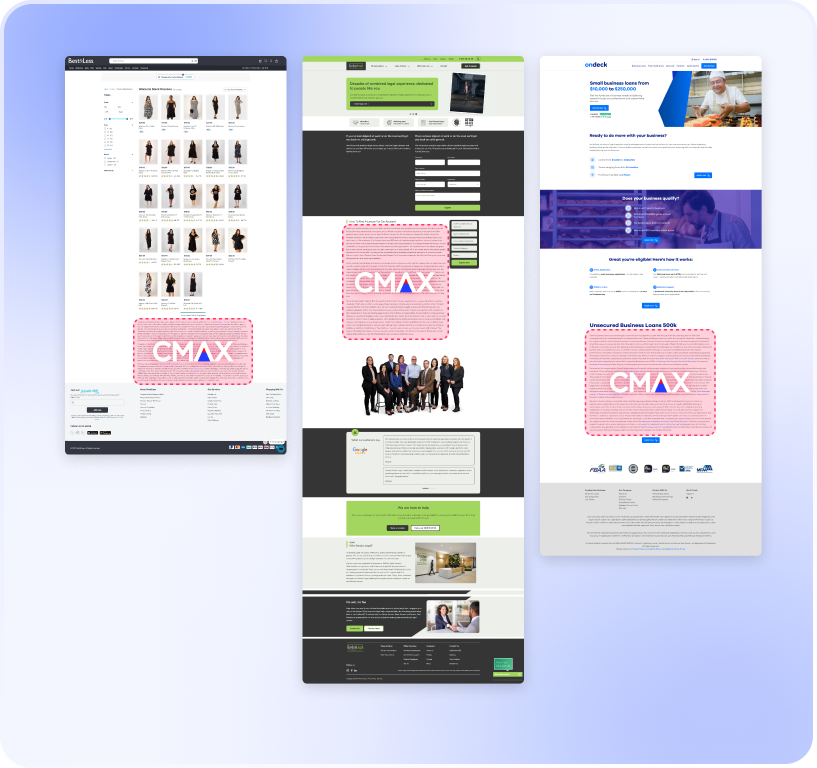
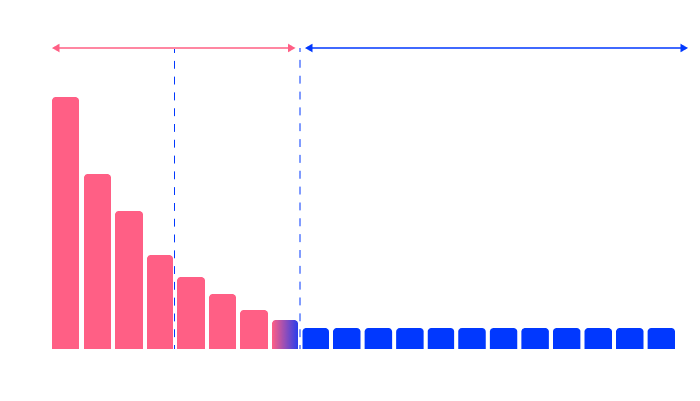
CMAX targets the 90% of search demand in the long tail. Beyond regulated finance, SEO for SaaS companies can use the same coverage logic around integrations, user roles, pricing and recurring plans.
Connected pages stay relevant longer.
For SEO for finance, CMAX writes approved language into product, eligibility, comparison and risk-explainer pages. Across regulated fintech programmes and SEO for saas, Dynamic Internal Linking connects related pages around eligibility, pricing, suitability, integrations and alternatives.
Each link reinforces the authority of the page it points to.
Full Body SEO optimises the whole page, headings and metadata included. Google’s URL Inspection tool lets teams confirm that updated pages are processed in Google’s index.
Frequently Asked Questions (FAQ)
How can fintech marketers track the real ROI of SEO?
Count actions that show buying progress. For consumer fintech, that means funded-account applications, verified sign-ups, completed eligibility checks or activated cards.
For B2B fintech, it means qualified demo requests, sales-accepted opportunities, booked advisory calls or pipeline influenced by non-brand search. Reporting for SEO for financial planners can connect booked advisory calls and qualified enquiries to non-brand landing pages.
Connect Search Console query data with your analytics platform and CRM stages. You then see which searches create commercial movement.
Direct visits blur this, because a buyer may find you through search, return later by typing your URL, then convert. Assisted-conversion reporting shows that path when branded search and return visits rise after discovery.
Tying Search Console data to CRM stages gives SEO for fintech a measure grounded in applications, sign-ups and qualified opportunities.
At a fintech marketing conference or in your agency review, the useful question is the same: which of these actions did search produce?
How long does fintech SEO take to show results?
Timing depends on site authority, technical health, competition, how often Google visits your pages, publishing pace and approval workflow. SEO for insurance and fintech both move on those factors.
Fintech sites usually move slower than simpler categories, because regulated claims need review before Google recognises the site as a reliable answer for YMYL searches. YMYL stands for “your money or your life”, and it covers pages that can affect a person’s finances or health.
CMAX adapts SEO for small business Australia work to Australian spelling and dollars. US programmes use American spelling and US currency.
The useful question is how quickly you can publish accurate, approved answers to searches that signal buying intent. Most SEO programmes run by conventional agencies, using outdated methods, tell clients to expect results in six months.
CMAX’s methods allow clients to start seeing clicks in 6 to 8 weeks.
What technical SEO issues most commonly affect financial websites?
The most common issues are indexing blockers, duplicate-page confusion and JavaScript that hides content or links from crawlers. Crawlers are the programs Google uses to read pages.
Google states that blocked resources can stop rendering and that JavaScript content may only be processed after a separate rendering step.
A page can exist for users and still be hard for Google to discover or assess. Canonical errors are also common on financial sites with similar product, state, segment or eligibility pages.
A canonical tag tells Google which of several similar pages is the main one. Fixing indexing blockers, canonical errors and hidden JavaScript content gives SEO for fintech the technical foundation regulated pages need.
Google confirms that rel=”canonical” and redirects are strong signals for consolidating duplicate URLs, while robots.txt should not be used for canonicalisation.
SEO for Fintech Starts With Intent Depth
SEO for fintech works better when the strategy follows the questions buyers ask before they trust a provider. The biggest keywords in a category rarely answer them.
CMAX builds around that coverage: specific, intent-led content on eligibility, fees, limits and risk concerns, in language compliance teams can verify. If you’re shortlisting a fintech content marketing agency, check that its content passes that compliance test.
This work centres on eligibility and trust. In adjacent software markets, a B2B saas SEO agency may organise content around integrations, use cases and buyer roles.
That fits how search and AI visibility work. CMAX can structure SEO services for franchises around location-specific questions, keeping approved brand language consistent across connected pages.
A review shows which of those buyer questions your site already answers and which it leaves open. That makes it the plain first step.
If you’re curious as to how you’re performing on AI, book in a Missing Customer Map review with our Growth Team.
Author
Jeremy Tang
Founder and CEO of CMAX
Jeremy Tang is the Founder and CEO of CMAX. With over 2 decades of experience in business consulting and digital marketing, he has successfully driven seven startup businesses, six of which achieved $1 million in revenue from zero in less than 16 months, 5 of which grew to multi-million dollar a year ventures without any external funding. Jeremy's expertise lies in streamlining business processes through technology and leveraging digital (in particular SEO) for business growth. He resides in Australia, travels extensively, and draws inspiration from his global experiences.