Product pages SEO helps one specific item show up when a shopper already knows what they want. A customer searching “oak 6 drawer tallboy black handles” needs a different page from one searching “bedroom furniture.”
Treat those two searches the same and SEO for ecommerce product pages stops working.
Picture a supermarket. The crowd gathers at the entrance, looking at the displays.
The shoppers with full trolleys are deeper in, in aisle nine, hunting one particular tin. In this context, product pages SEO means building the aisle page for the exact item, while the category page works as the entrance display for people still browsing.
The split holds in every market. When you compare an SEO agency Gold Coast with a Sydney provider, ask each how they separate exact-item demand from broad category demand.
For many retail teams, SEO for ecommerce stores means the platform fills in the product templates automatically while all the attention goes to collections and categories. That gap matters, because exact-item searches often carry the strongest buying intent.
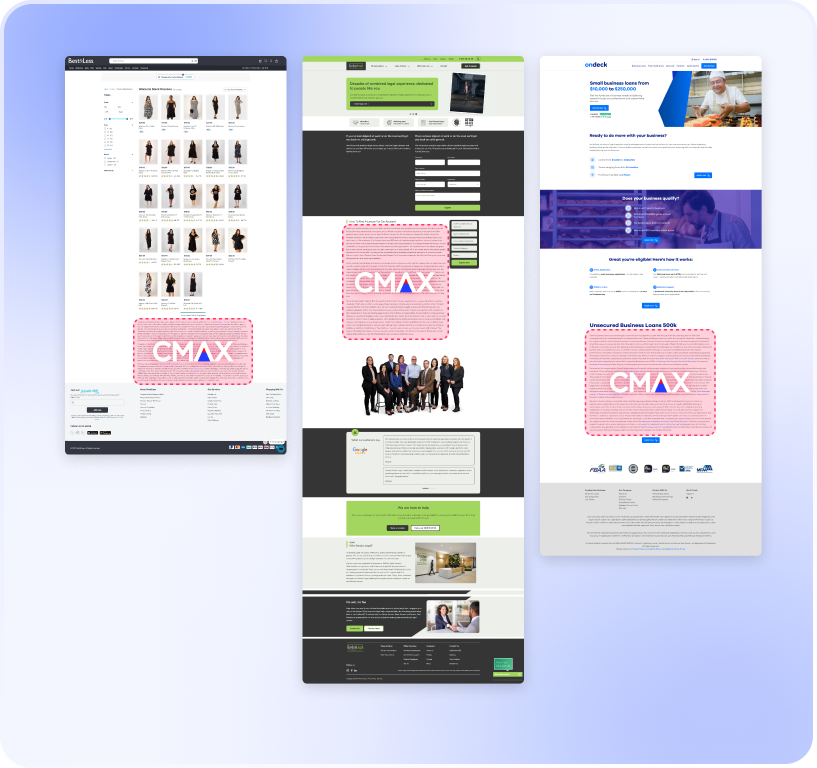
CMAX works on this layer, using approved brand content to keep product pages updated and connected to the categories above them.
Capture Exact-Item Searches and Support Category Discovery
Target exact-product searches
A shopper searching “oak 6 drawer tallboy black handles” already knows what they want. A tallboy is rarely an impulse buy.
They need the price, the dimensions, the delivery timeframe, the current availability and enough confidence to purchase.
Product pages should target searches like this one, where the shopper has a specific item, SKU, model, material, size, colour or variant in mind. Broad terms like “bedroom furniture” belong elsewhere.
Some specific searches are research, not buying, so check the intent behind a query before you promise sales from it. Google’s ecommerce guidance separates site structure from product data so search engines can match individual products to individual searches.
Support categories without cannibalising
Category pages own broad demand, such as “linen quilt covers.” Good ecommerce category page SEO gives that demand to the collection page.
Product pages own exact-item demand, such as “stonewashed linen quilt cover sage king.” Splitting the job this way stops one page type doing work it was never built for.
A strong product page links back to its parent category, shows the relevant variants and related products, and makes the next step obvious. Those internal links also help Google read the context around each page.
If you are weighing SEO services Perth against an Adelaide provider, ask how they plan the links between product and category pages, because that structure decides how cleanly the site reads.
Answer the Questions Shoppers Ask Before They Buy
Add content that answers buying questions
Product pages SEO answers the questions that stop a shopper buying, and the questions that stop Google matching the page to a detailed search. Unique product copy, exact dimensions, materials, compatibility, care instructions, delivery notes, original images, reviews and FAQs all add to your content surface area.
That is the number of ways customers search for which you have a useful answer.
Good SEO product descriptions say what the item is, who it suits and what comes with it. The same standard applies to product title SEO: use the verified name, model and variant, because vague wording weakens both visibility and trust.
Among the on page SEO factors that matter here, specific answers count most, because AI tools can retrieve them through several smaller Google searches when they build a response.
Accuracy matters beyond retail too. It is just as important in SEO for law firms, where unsupported answers damage visibility and trust.
Control variants and duplicate pages
Decide how variants are handled. Do not leave it to your platform’s default settings.
Size or colour pages with identical copy, the same reviews and no search demand create thin duplicate URLs that waste Google’s crawling time. A variant with its own demand, such as a specific finish, a bundle or a popular colour, may deserve its own indexable page.
Among the most practical SEO optimisation techniques, canonical URLs consolidate signals from duplicate pages. ProductGroup markup helps Google interpret genuine product variants.
Written details on the page still do the main work of telling Google the names, prices, availability and variants.
Improve Product Page Coverage and Keep Category Strategy Intact
Keep product pages fresh and connected
CMAX is trained on human-reviewed, client-approved content. It uses Dynamic Internal Linking and Full Body SEO to keep product pages useful, fresh and connected.
A three-day ecommerce SEO audit can reveal stale specifications, stock details, bundles and internal links across your existing product pages.
Product pages go stale fast. Stock status, specifications, reviews, bundles, delivery promises and related products all shift, and a page that stops moving loses ground to one that keeps up.
Scale long-tail coverage with control
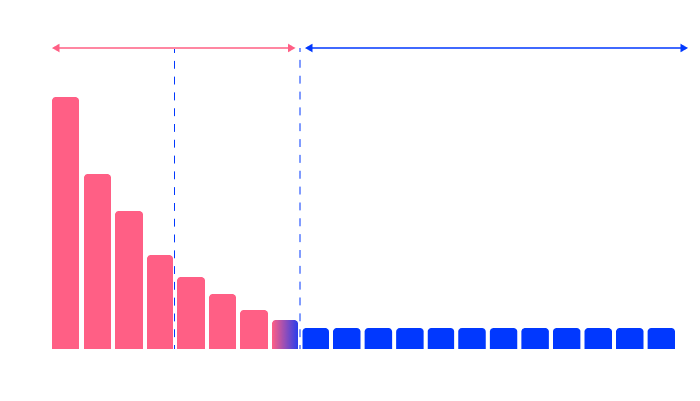
Over 90% of search and AI demand is in the long tail. No ecommerce team can write and refresh detailed content by hand across hundreds or thousands of product pages.
That is where ecommerce SEO marketing breaks down for most retailers, and where an ecommerce SEO agency earns its fee or doesn’t.
As the Agentic SEO Platform, CMAX scales content and freshness on existing pages using approved brand inputs and performance data. Most SEO programmes run by conventional agencies, using outdated methods, tell clients to expect results in six months.
CMAX’s methods allow clients to start seeing clicks in 6 to 8 weeks. When you compare marketing SEO services, ask each provider for their timeline and what they base it on.
Ask about the types of SEO content they will produce for product pages, and who approves it. Ecommerce SEO best practices only work when someone reviews the copy before it goes live.
Frequently Asked Questions (FAQ)
How do you handle SEO for product pages that go out of stock?
Keep the page live. An out-of-stock URL has already built exact-item relevance, and removing it throws that away.
Show the stock status clearly near the purchase area. Offer restock alerts, close substitutes, other sizes or a link to the parent category.
Among practical ecommerce SEO tips, pair OutOfStock markup with those next steps so the unavailable page stays useful. Google’s product structured data supports an OutOfStock availability state, so search engines can read current stock information without the page being pulled.
What do I do with discontinued product pages?
Redirect the old URL to the closest replacement, matched on size, range and shopper intent. A retired mattress model should point to its successor model, not the homepage.
Across a large catalogueue, SEO agents can surface retired URLs for review, so replacements, redirects and permanent removals are handled consistently.
If no suitable replacement exists, Google recommends noindex for permanent removal. Deleted pages should return a 404 or 410 status rather than being blocked only by robots.txt.
Sound on page optimisation sends a deleted product URL to a 404 or 410 when no relevant successor exists.
Does product schema make rich results certain?
No. Schema helps Google read a page’s product name, price, availability, reviews, images and variants. Rich results are shown at Google’s discretion and can change over time.
Treat schema as a clarity layer on top of a strong product page. The page still needs accurate content covering the name, price, availability, reviews, images and variants.
Product Pages SEO With Clear Page Roles
Product pages handle exact-item and variant searches. Category pages carry the broader demand.
CMAX is built around the same idea: growth comes from covering more of the specific ways customers search, and no single page type should do every job.
Retailers comparing proposals for AI SEO Brisbane with those from Melbourne providers should check one thing. Does the product-page work support the category strategy, or compete with it?
The hard part is keeping that coverage useful, fresh and connected across hundreds or thousands of pages. CMAX handles ecommerce product SEO across existing pages through fresh content, internal linking and reporting tied to sales.
Product pages then support conversion and the category strategy stays under your control.
A review of your current product pages shows which exact-item searches have no page answering them. That is the quickest way to see where you stand.
If you’re curious as to how you’re performing on AI, book in a Missing Customer Map review with our Growth Team.
Author
Jeremy Tang
Founder and CEO of CMAX
Jeremy Tang is the Founder and CEO of CMAX. With over 2 decades of experience in business consulting and digital marketing, he has successfully driven seven startup businesses, six of which achieved $1 million in revenue from zero in less than 16 months, 5 of which grew to multi-million dollar a year ventures without any external funding. Jeremy's expertise lies in streamlining business processes through technology and leveraging digital (in particular SEO) for business growth. He resides in Australia, travels extensively, and draws inspiration from his global experiences.