The term AI driven SEO gets used to describe two different jobs: using AI to scale SEO workflows across large page sets, and optimising for visibility inside AI-generated search answers. If you run SEO for a site with thousands of URLs, the distinction matters because each job has different workflows, measurement requirements and risk profiles. Getting them confused leads to misaligned expectations and wasted budget. CMAX works in the first category, using AI to scale programmatic SEO production while keeping human review at the points where quality and compliance decisions are made.
AI-Driven SEO Has Two Distinct Meanings
Workflow SEO vs AI-Answer Visibility
“AI-driven SEO” covers two different jobs, and conflating them leads to the wrong strategy.
In practice, AI driven SEO starts with recognising that AI in search engine optimisation spans everything from automating content briefs to improving how a site surfaces across AI-generated answer layers.
The first is workflow SEO: using AI to accelerate repeatable tasks across hundreds or thousands of URLs. Think query clustering, brief generation, internal link suggestions and traffic-loss flagging. The second is AI-answer visibility: improving the likelihood that a brand gets cited, quoted or summarised inside AI-generated search answers. Practitioners focused on LLM SEO concentrate on how large language models select and cite sources. Those working on gemini SEO focus specifically on visibility within Google’s Gemini-powered answer surfaces, including AI Overviews.
Both matter. They require different tactics, different measurement approaches and different definitions of success. A team optimising for AI-answer visibility needs to think about attribution, source clarity and topical authority. A team using AI to scale workflow output needs to think about review gates, template quality and indexation logic. Treating them as the same problem produces a strategy that does neither well.
AI Scales Tasks, Humans Own Quality
On large sites, AI earns its place in repeatable production and analysis work. It can process patterns across thousands of URLs faster than any manual process.
What it cannot do is judge query intent with the nuance a page actually requires, verify whether a source is accurate, assess compliance-sensitive claims or decide whether a page is genuinely useful enough to deserve indexation. Those calls still sit with people.
Some practitioners searching for AI driven SEO guidance encounter the term AI engine optimisation, which is not a formally recognised discipline but is often used interchangeably to describe improving brand visibility within AI-generated search answers.
The practical implication: AI raises the ceiling on how much work a team can move through. Human review determines how much of that work holds up.
Large-site workflows benefit most from repeatable AI assistance.
High-scale SEO tasks AI can assist
AI earns its place on large sites when the work follows a recognisable pattern across hundreds or thousands of URLs. Grouping similar queries by intent, drafting briefs from recurring SERP themes, suggesting internal links between related page sets, flagging pages that no longer match search demand or have lost traffic, these are tasks where the logic is consistent enough that AI powered SEO tools can run it at scale without reinventing the approach each time.
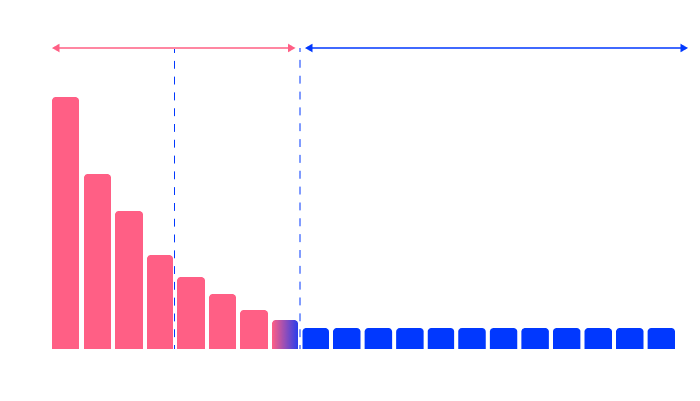
The value is throughput. A team of two to five cannot manually audit 10,000 product pages for intent drift or map internal linking gaps across a catalogue that size. AI-driven SEO can surface those patterns in a fraction of the time, freeing the team to act on findings rather than compile them. One of the clearest wins in AI driven SEO is the ability to systematically pursue SEO longtail opportunities across thousands of product or category URLs that a manual programme would never have the capacity to address.
Human review in assisted workflows
Scale creates leverage, but it also amplifies mistakes. Where AI SEO agents can execute tasks autonomously, such as clustering queries or generating draft meta descriptions, a practical manual-to-assisted workflow keeps human review at the points where errors carry the highest downstream cost.
That means people stay in the decision seat for four specific calls: choosing the target intent for a page, validating factual claims, checking whether a page says something materially different from near-duplicates, and confirming that a page adds enough value to deserve indexation. Getting intent wrong at brief stage sends production in the wrong direction across an entire page set. Publishing a factual error at scale creates a compliance or credibility problem that is expensive to unwind. At the heart of any effective AI-driven SEO workflow is a rigorous approach to search intent SEO, since AI tools can group queries by pattern but humans must still confirm whether a page genuinely satisfies the underlying need behind each query cluster.
The workflow that holds up is one where AI handles pattern recognition and first-draft production, and humans approve the decisions that shape what gets published and indexed.
Measurement Needs Visibility, Traffic and Quality Signals
Metrics That Matter for AI-Driven SEO
Standard rank-tracking tells you where a handful of head terms sit. A workable measurement set for AI driven SEO checks whether gains are broad and durable or shallow and concentrated.
That set covers five areas. First, indexed coverage: is a larger share of the site actually being crawled and indexed, or are new pages sitting in limbo? Second, keyword spread: are rankings distributing across a broader long-tail query set, or still clustering around the same short head terms? Third, non-brand organic traffic: volume from queries where the brand name plays no role is the clearest signal that new content is earning its own demand. Fourth, assisted conversions: organic visits that contribute to a conversion path, even without being the last click, show commercial relevance. Fifth, AI-answer visibility: when you run priority queries manually in AI Overviews or comparable answer surfaces, does the site appear?
A core goal of AI-driven SEO at scale is growing SEO website traffic across a broad long-tail query set rather than concentrating gains on a handful of high-competition head terms.
That last signal requires active testing. Standard analytics platforms do not yet surface AI-answer impressions reliably, so teams need a repeatable SEO AI audit cadence alongside their core dashboards. Pairing that diagnostic work with ongoing SEO optimisation across the broader page set turns raw measurement into actionable improvement.
Enterprise Proof Point from CMAX
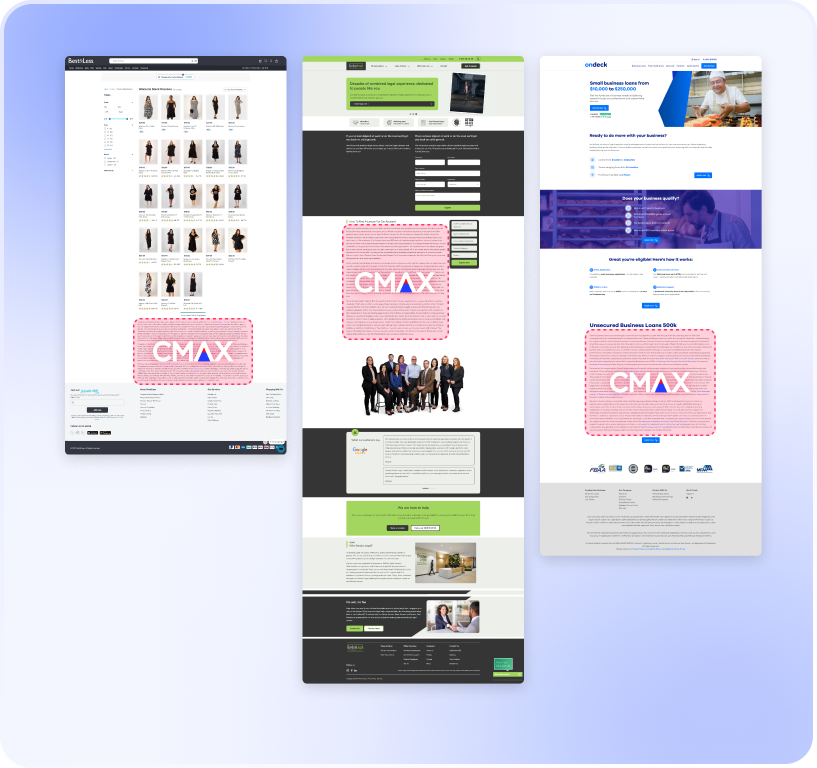
The mechanism behind large-site SEO gains is catalogue scale, and the numbers from one CMAX engagement make it concrete. Based on CMAX’s client engagement data, a B2B omnichannel hospitality retailer added 5,000 long-tail product pages and reached $1M+ per month in incremental SEO revenue within 8 months.
The gain came from covering specific product-level searches that a head-term programme leaves untouched. Each page targets a query too narrow to justify manual production, but collectively those pages capture demand that compounds. That is the same mechanism available to any large enterprise site with a deep product or service catalogue.
Google Policy Risk Sits in Execution, Not Automation
Risk Comes from Thin, Scaled Pages
Automation itself is not what triggers Google’s scaled content abuse guidance.[1] The risk is what gets published: large volumes of pages that are thin, repetitive, weakly validated, or built primarily to capture search traffic without offering original value. That pattern is exactly what the policy targets, and it can happen whether a team uses AI or not.[1] Scale amplifies the problem because a flawed template or a poorly defined brief can produce hundreds of low-quality pages before anyone notices the crawl data shifting.
When scaling AI driven SEO across a large catalogue, product pages SEO deserves particular attention because thin or templated product pages are among the patterns most likely to trigger Google’s scaled content abuse guidance.
Expectations for an AI SEO Engagement
Most AI powered SEO services scope the workflow, review gates, and measurement rules before content volume increases. A realistic AI driven SEO engagement starts by defining that sequence clearly, because scaling a weak process produces index bloat, quality issues, and rework rather than durable search coverage. Providers offering AI driven SEO services should tie every deliverable back to measurable search outcomes, not just production volume.
In practice, that means working through a defined sequence:
- Define target query sets, page types, and business outcomes before any assisted production begins.
- Set human approval rules covering intent, factual accuracy, compliance-sensitive claims, and indexation decisions.
- Build repeatable inputs: templates, source libraries, internal link logic, and refresh criteria.
- Launch in controlled batches so teams can review page usefulness, crawl behaviour, and early ranking patterns.
- Measure indexation, non-brand traffic, assisted conversions, and AI-answer visibility at page-set level, not only sitewide.
- Use early performance data to prune weak patterns, improve prompts or briefs, and expand only the page types that prove useful.
The sequence is deliberate. Each stage produces the evidence the next stage depends on.
The Practical Limits Are Clear on Large Sites
Where AI Stops Being Enough
AI can help teams publish and refresh more pages faster. That’s a real operational gain. But there are decisions it cannot own.
Source validation requires a human who can trace a claim to a primary source and judge whether that source is current, credible and appropriate for the context. Regulated or high-risk claims, anything touching legal, financial, medical or compliance-sensitive territory, need sign-off from someone accountable, not a model that produces plausible-sounding output. Brand positioning calls, where the question is whether a page should exist at all given how it reflects on the business, sit outside what any assisted workflow can resolve. So does the judgment call that an SEO opportunity, however technically viable, carries operational or legal trade-offs that make it not worth pursuing.
These are not edge cases on large sites. They come up regularly.
What Still Determines Outcomes
Even a disciplined AI driven SEO strategy can still underperform if the underlying site conditions work against it. Weak information architecture limits how well crawlers and users move through new page sets. Slow internal approval workflows create bottlenecks that offset any production speed gain. Limited crawl equity means new pages may not get indexed quickly enough to generate useful performance data. Duplicate-prone templates produce pages that are technically distinct but practically identical, which compounds index quality problems rather than solving them.
Competitor depth matters too. If the pages covering the same intent are clearer, more detailed or carry stronger topical authority, better SEO strategies alone won’t close that gap.
Frequently Asked Questions (FAQ)
How do you measure the success of AI SEO?
Rankings alone don’t capture what AI-driven SEO actually moves. A workable measurement set tracks page-set level changes in indexed coverage, keyword spread beyond core head terms, non-brand organic traffic, conversion assistance and visibility in AI-generated answer surfaces when target queries are tested directly. Measuring at page-set level matters because the gains from AI-assisted programmes typically come from covering many specific queries across a template type, not from a single page climbing one position.
How does AI impact SEO and Google rankings?
AI can improve SEO when it helps teams cover more relevant queries, refresh outdated pages faster and tighten internal linking across large URL sets. Rankings still depend on intent match, content quality, site health and the strength of competing pages. AI accelerates the inputs; it doesn’t override the fundamentals.
Can publishing AI-generated content hurt SEO?
Yes. AI-assisted content creates risk when it produces thin, repetitive or inaccurate pages at scale, particularly when no one reviews whether a page meets the query properly or adds anything distinct enough to deserve indexation. The volume is not the problem; the absence of review gates is.
How is Google’s search evolving with AI (AI Overviews/AI Mode)?
Google’s AI features can reduce clicks on some informational queries and shift value toward pages that are clearly attributable, well structured and closely aligned to the facts and subtopics those answer systems draw on.[2] Visibility in those surfaces requires the same rigour as organic ranking: accurate, specific, well-organised content.
Teams pursuing AI-driven SEO increasingly ask how SEO for AI search differs from traditional ranking work, since AI-generated answer surfaces reward different signals than a standard blue-link result.
How do AI SEO agencies measure success differently than traditional SEO firms?
Agencies specialising in AI-assisted SEO measure performance at workflow, template and page-set level alongside keyword level. The main gains come from improving repeatable systems, so a keyword-only view misses where the programme is actually working or breaking down.
AI Does the Heavy Lifting. Strategy Stays Human.
CMAX is a programmatic SEO platform built for teams that need to scale content across thousands of long-tail keywords without scaling headcount.
Two lines of code deploy an agentic system that continuously creates and updates pages targeting the high-intent searches most businesses never reach. The platform handles the repeatable, high-volume work, keyword mapping, content deployment, performance iteration, so your team can focus on strategy, quality control, and the editorial decisions AI shouldn’t make alone. Results from live deployments typically begin surfacing within weeks, not quarters.
When AI driven SEO is the goal, the real question isn’t whether to use AI, it’s where to draw the line between automation and human judgment. CMAX draws it clearly.
References [1] – https://developers.google.com/search/docs/essentials/spam-policies [2] – https://www.seerinteractive.com/insights/aio-impact-on-google-ctr-september-2025-update
Author
Jeremy Tang
Founder and CEO of CMAX
Jeremy Tang is the Founder and CEO of CMAX. With over 2 decades of experience in business consulting and digital marketing, he has successfully driven seven startup businesses, six of which achieved $1 million in revenue from zero in less than 16 months, 5 of which grew to multi-million dollar a year ventures without any external funding. Jeremy's expertise lies in streamlining business processes through technology and leveraging digital (in particular SEO) for business growth. He resides in Australia, travels extensively, and draws inspiration from his global experiences.