Most agencies marketing themselves as an AI SEO agency will show you output volume. Fewer will show you the workflow behind it, the review steps that caught problems, or the technical controls that kept thousands of new pages from creating indexation issues. The difference matters because AI scales mistakes just as efficiently as it scales good work. Knowing where human judgement sits in the process, and where it doesn’t, is the fastest way to separate credible partners from risky ones. CMAX publishes its workflow, review checkpoints, and technical safeguards so buyers can inspect the method before committing.
The Right AI SEO Agency Pairs Automation with Experts
Human Review Protects Search-Fit Content
Scaled content production creates a specific risk: pages that match a keyword but miss the query intent behind it. For teams exploring AI SEO services Melbourne businesses rely on, the first question is whether human review sits inside the workflow. Before a page goes live, a strategist or editor checks whether it actually answers what the searcher is asking, whether it meets brand standards, and whether any compliance or factual issues need to be resolved. Without that step, weak pages publish at scale, and weak pages at scale compound into an indexation and quality problem that takes far longer to fix than it did to create.
AI Accelerates Execution, Experts Steer
A credible AI SEO agency uses AI to compress the time-intensive parts of the workflow: keyword research, query clustering, and first-draft production. What AI does not decide is which page types are worth scaling, which topics should stay out of scope, and what quality bar a page must clear before it earns a URL. Those calls belong to specialists. Automation applied to the wrong page type, or to a topic with weak or ambiguous demand, produces volume without value.
An AI SEO agency builds its foundation on knowing how AI and SEO interact, where automation genuinely accelerates execution and where human judgment must remain in control.
Transparent Workflows Show Control Points
Any agency worth evaluating should be able to walk through its workflow step by step and identify exactly where automation runs and where human approval is required. More specifically, it should be able to name the conditions under which it stops scaling: intent is unclear, search demand is too thin, or the template cannot produce a page that is genuinely distinct from others already in the index. If an agency cannot articulate those stopping points, the workflow has no real controls.
Technical SEO discipline determines whether AI scale performs.
Publishing controls prevent scale problems
Scaling content without technical controls in place is where AI-assisted programmes most commonly fail. Indexation logic, duplicate patterns, canonical rules, internal linking, and template quality all need to be locked down before hundreds or thousands of pages go live. A single weak canonical rule or an uncontrolled duplicate pattern compounds across every page the system produces, diluting crawl budget and muddying reporting before anyone notices the problem. An AI SEO agency handling large, complex sites should demonstrate the same technical depth and strategic oversight expected of an enterprise SEO consultant, including controls for indexation, crawl efficiency, and canonical integrity at scale. For teams running product catalogues, an ecommerce SEO agency Sydney retailers trust will apply these same publishing controls to thousands of SKU-level pages.
Ask any agency you’re evaluating to show you its pre-publication QA checklist. If the answer is vague, the risk is real.
Monitoring should cover key platforms
Publishing is only half the discipline. Reliable agencies track page discovery, index coverage, crawl behaviour, traffic, and query movement across Search Console, analytics platforms, and crawling tools. For organisations exploring AI SEO services Sydney providers offer, this technical monitoring layer is what separates scalable programmes from fragile ones. As AI-driven discovery surfaces increasingly serve as a referral channel worth watching, monitoring should extend to identifiable AI citation and referral patterns as well. Reporting that covers only aggregate traffic misses the technical signals that indicate whether scaled pages are actually being found, indexed, and served to the right queries.
Quality standards matter more than drafting
What separates a dependable AI SEO agency is whether its pages answer a specific query clearly, add information beyond a keyword variant, and hold up technically. How the first draft was produced is irrelevant to that assessment. Pages that pass those three tests perform. Pages that don’t, regardless of how they were written, create index weight without search value. An AI SEO agency that also operates as a SEO content marketing agency should be able to show how its publishing controls, internal linking model, and editorial review process work together to keep scaled content both technically sound and genuinely useful to the reader.
A Numbered Verification Checklist Makes Agency Comparisons Clearer
AI SEO Agency Verification Checklist
An AI SEO agency should be able to prove human review, technical safeguards, and measurement discipline. Use these six checks when comparing any provider. Each one tests a specific capability, not a general claim.
1. Workflow transparency. The best AI SEO agency will name the exact tasks handled by AI and the exact tasks that require strategist or editor sign-off. If judgment only appears in the sales deck, it is not in the process.
2. Technical safeguards before scale. The agency can show how it prevents duplicate variants, weak canonicals, orphan pages, and index bloat before a single batch goes live. These problems compound fast once scale is introduced, and fixing them after publication costs more than preventing them.
3. Measurement discipline. Results are reported against a stated baseline, a defined timeframe, a clear methodology, and a named page set. A blended sitewide traffic story tells you nothing about which URLs or query clusters actually moved.
4. Intent mapping, not keyword permutations. The agency can explain why its long-tail model reflects real query patterns and how each page type maps to a distinct intent. Near-duplicate pages that compete with each other dilute the index rather than expand it.
When working through a verification checklist, buyers comparing an AI SEO agency against alternatives should confirm whether the scope of AI SEO services on offer includes technical QA, intent mapping, and editorial review, not just automated content production.
5. Human review at defined control points. The agency can show where strategist or editor approval is required in the workflow, and where it will stop scaling because intent is unclear, search demand is weak, or the template cannot produce a distinct page.
6. Inspectable examples. The agency has examples that show template logic, internal linking model, and review steps, so you can evaluate the operating method rather than a screenshot of a traffic chart.
The agency states where AI is not appropriate, such as thin demand, unclear intent, or regulated claims that need tighter approval, because responsible scale includes knowing when not to publish.
A credible AI SEO agency draws a clear line between what should be scaled and what should not. Thin demand, ambiguous query intent, and regulated content categories, financial, medical, legal, each require a different approval threshold.[1] An agency that cannot name those limits is automating without a strategy.
Buyers deciding between an AI SEO agency and a traditional enterprise SEO company should assess not just scale capability but also how each handles reporting methodology, human review checkpoints, and limits on automation for regulated or low-demand content areas.
Outcome reporting needs full context
Reported gains mean little without the surrounding detail. Buyers evaluating an AI SEO agency should expect the baseline, methodology, and time window to be stated upfront. A blended sitewide traffic number can mask a handful of URLs doing all the work while hundreds of scaled pages contribute nothing. Gains tied to a named page set, a defined timeframe, and a stated calculation method are far easier to present to a CFO with confidence.
For an AI SEO agency Brisbane enterprises can evaluate, outcome reporting with full context is the clearest trust signal.
Long-tail scaling needs intent mapping
Long-tail expansion produces compounding coverage when high-intent queries group into repeatable page types, each serving a distinct intent. Without that mapping, the site fills the index with near-duplicate pages that compete with each other for the same query, diluting rather than extending reach. The agency should be able to show how each page type it recommends maps to a specific intent cluster, and where the grouping logic stops because the queries are too similar to justify separate pages.
Relevant Proof Should Show Methods, Timeframes, and Limits
Proof Should Reveal the Method
A before-and-after screenshot tells you a number. It does not tell you whether that number will hold, transfer to your site, or survive a core update. As an Australia SEO agency, proof should reveal the method, timeframe, and limits behind any scaled result. Scaled SEO outcomes depend on how pages were planned, validated, linked, and measured, the content model, the review process, the technical setup. When an agency shares proof, ask what those elements were. If they can’t describe them, the result is not reproducible.
CMAX Enterprise Long-Tail Proof
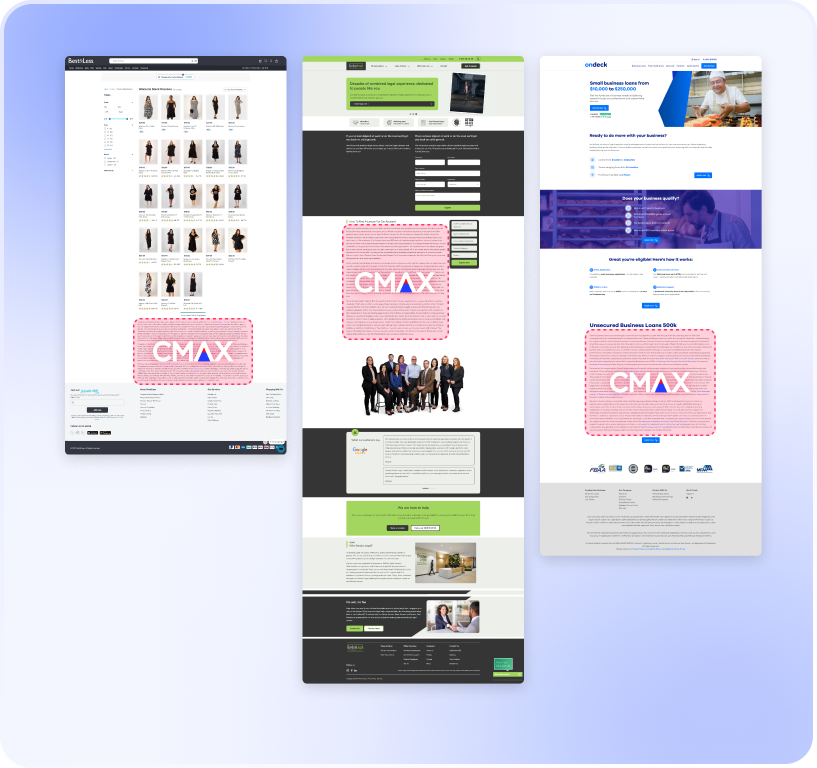
In one CMAX engagement, a B2B omnichannel hospitality retailer added 5,000 long-tail product pages and reached $1M+/month in incremental SEO revenue within 8 months. The result came from targeting query variants that sit well beyond the head terms a conventional agency typically covers, a catalogue-scale long-tail coverage problem many enterprise buyers recognise. Enterprise buyers evaluating AI SEO agency options often face this same catalogue-scale challenge, and if your site has a large product or service catalogue with demand spread across thousands of specific queries, that is the problem this approach is built to address.
An AI SEO agency serving business clients should be able to show proof examples that reflect the longer sales cycles and account-based intent patterns typical of a B2B SEO agency engagement, not just consumer or e-commerce benchmarks.
Fast-Growth Claims Need Full Disclosure
Rapid-growth figures deserve scrutiny before they influence a procurement decision. Ask the agency to state the dataset, sample size, and reporting window behind any headline number. Ask whether technical changes, sitewide migrations, or content consolidations happened during the same period, because those factors can move traffic independently of the AI-assisted pages being credited. Proof that holds up under those questions is proof worth presenting to a CFO.
How to measure AI search visibility?
Track indexation status, non-brand impressions, and ranking spread across long-tail queries rather than a single aggregate traffic number. Layer in organic conversions and any identifiable referral or citation patterns from AI-driven discovery surfaces. That combination gives you a clearer picture of where pages are actually surfacing and which query clusters are pulling weight.
When evaluating an AI SEO agency, it is also worth asking how the agency tracks and reports visibility across AI search engines, since citation and referral patterns from those surfaces are increasingly relevant to measuring organic reach.
When to choose AI SEO over traditional SEO?
AI-supported SEO earns its place when the site has repeatable intent patterns, a large long-tail opportunity, or resource constraints that make manual page creation too slow to cover available demand with enough specificity. Verticals like SEO for recruitment agencies, where thousands of role-location combinations generate distinct high-intent queries, are a strong example of this pattern. If your catalogue, service area, or product range means a small team cannot address those queries page by page, AI-assisted scale is the practical option.
For anyone asking what is SEO services in this context, the core goal remains the same: increasing organic visibility for queries your audience already uses. The difference is whether that work is done manually or accelerated with AI tooling.
How to vet an AI SEO agency?
Ask for the workflow, review checkpoints, technical QA process, and reporting methodology. Then ask where automation stops and what proof the agency can show for page types that resemble the ones it recommends for your site. Answers that stay vague at any of those points are a signal worth taking seriously.
Will Google penalise AI content?
Google does not evaluate pages by whether AI was involved in drafting.[3] Low-value, duplicative, or unhelpful content can still perform poorly regardless of how it was produced. Page quality and usefulness are what determine performance.
Which LLMs do AI SEO agencies optimise for?
Focus first on the search and content systems the agency can directly control. From there, formatting, entity clarity, source quality, and page structure can be adapted so content is easier for different LLM-driven interfaces to interpret, retrieve, and cite.
Most AI SEO Agencies Outsource the Hard Part, CMAX Built It
CMAX is an agentic SEO platform, not a traditional agency.
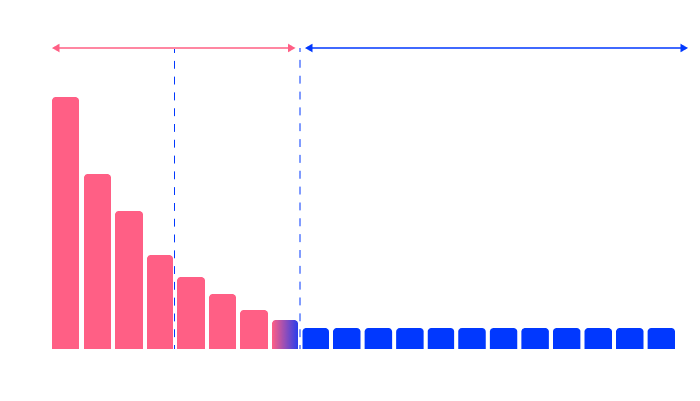
Where most AI SEO agencies layer tools on top of manual workflows, CMAX deploys AI agents that publish and continuously update content across thousands of long-tail keywords, the 90% of search demand most teams never reach. Two lines of code connect it to your site. Results have been observed within six weeks across measured accounts. Every page targets high-intent queries your buyers are already typing, and each new piece of content strengthens the performance of the rest.
If you’re evaluating AI-driven SEO partners, CMAX gives you the scale of automation with the specificity your board actually wants to see.
References [1] – https://developers.google.com/search/docs/fundamentals/creating-helpful-content [2] – https://ahrefs.com/blog/long-tail-keywords/ [3] – https://developers.google.com/search/docs/appearance/ranking-systems-guide
Author
Jeremy Tang
Founder and CEO of CMAX
Jeremy Tang is the Founder and CEO of CMAX. With over 2 decades of experience in business consulting and digital marketing, he has successfully driven seven startup businesses, six of which achieved $1 million in revenue from zero in less than 16 months, 5 of which grew to multi-million dollar a year ventures without any external funding. Jeremy's expertise lies in streamlining business processes through technology and leveraging digital (in particular SEO) for business growth. He resides in Australia, travels extensively, and draws inspiration from his global experiences.