Most providers marketing an AI SEO service are vague about what the system actually does versus what still requires your team’s time and judgement. That gap makes it harder to compare vendors, scope internal resources, or build a business case your CFO will trust. The practical question is where automation genuinely operates and where it stops. CMAX is one provider that publishes those boundaries explicitly, which makes it a useful reference point as you define what to look for.
An AI SEO service should solve scale without guesswork.
Long-tail query coverage
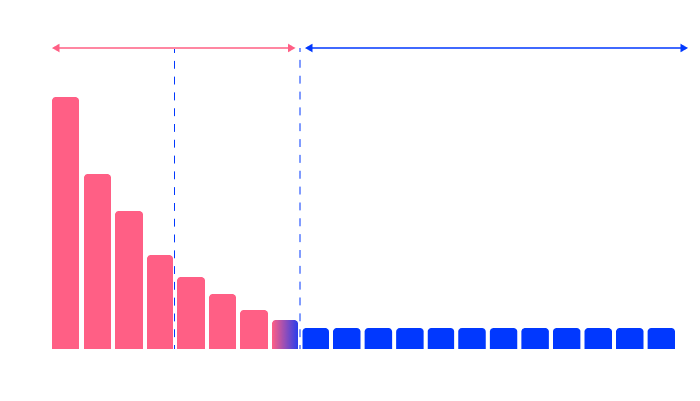
Most SEO programmes are built around a manageable list of head terms. That list gets prioritised, briefed, written, and published, then the team moves on. Based on CMAX’s analysis, over 90% of search demand sits in the long tail: product-specific queries, feature comparisons, location variants, use-case combinations. Static editorial calendars can’t keep pace with that volume, and they rarely try.
A genuine AI SEO service addresses this by generating query-specific pages for lower-volume searches with clear commercial intent. These aren’t generic category pages stretched to cover more ground. Each page targets a distinct search, a specific product paired with a location, a feature matched to a use case, so the coverage reflects how buyers actually search, not how an editorial team has time to write.
An AI SEO service built for scale draws on the broader relationship between AI and SEO to determine which query clusters are worth targeting and how pages should be refreshed as search behaviour shifts.
Continuous page optimisation
AI SEO is the working term for what this kind of system does: it pairs machine-scale production with live performance feedback to keep pages competitive. Publishing at scale is only half the problem. Search behaviour shifts. Product feeds change. Pages that ranked well six months ago may now sit below threshold without anyone noticing.
Ongoing optimisation means the service monitors performance signals and updates pages when conditions change, whether that’s a drop in rankings, a shift in query patterns, or a product update that makes existing copy inaccurate. Weak pages get refreshed rather than left to decay. Coverage stays current across the full page set, not just the handful of URLs someone happened to review last quarter. That’s the operational difference between a one-time content push and a system that maintains search presence over time. The practical overlap of SEO and AI is clearest here, where algorithmic monitoring and content generation work in tandem to sustain rankings across thousands of pages.
The service boundary should be clear before you compare providers.
Included and excluded service scope
Any provider can attach “AI-powered” to a pitch deck. What separates a credible AI SEO service from a relabelled content agency is a precise, documented scope, one that names what the system handles automatically, where human judgement still enters, and what falls outside the engagement entirely. Clarifying what is SEO services in this context helps buyers confirm that what a provider describes aligns with what AI SEO services actually include in practice, covering query discovery, page generation, refresh logic, and duplication safeguards rather than just the AI label.
What should be included and named explicitly:
- Query discovery, page generation, refresh logic, publishing workflows, and performance monitoring. These are the core jobs. If a provider cannot describe how each one works mechanically, the automation claim is thin.
- Duplication safeguards, indexation controls, and CMS or feed integration. Page volume only converts to organic traffic when search engines can crawl, distinguish, and publish those pages cleanly. A service that skips this detail is leaving the hardest part unaddressed.
- Human review points for approvals, sensitive topics, and exception handling. Scaled production still needs defined sign-off moments. Teams need to know exactly where human judgement enters the workflow and who authorises pages before they go live.
What should be listed as excluded:
- Broader technical SEO projects, site migrations, Core Web Vitals remediation, backlink acquisition, sit outside a focused AI SEO engagement. When providers leave this boundary vague, buyers absorb delivery risk for work that was never scoped.
A provider that documents all of this gives you something to test against. One that leads with the AI label and skips the operating model detail is asking you to take the marketing on faith.
Excluded: Claims That the Provider Replaces Strategy, Guarantees Rankings, or Covers Every Query Should Be Treated as Outside a Credible Service Definition
Any provider that promises to replace strategy, guarantee rankings, or cover every possible query is describing something that does not exist. Those claims sidestep the practical constraints buyers need to evaluate before signing anything. A credible AI SEO service defines its limits as clearly as it defines its capabilities.
Human Strategy and Approvals
Automation handles repeatable execution across large page sets. Human strategy handles everything that requires judgement.
That means brand rules, legal and compliance checks, page exclusions, and escalation paths all stay with your team. A SEO service specialist still sets those brand rules, compliance checks, and escalation paths, because the automated system does not decide which topics are off-limits, which pages require sign-off before publishing, or how to handle a query that sits in a grey area for your industry. Those decisions need a person with context, authority, and accountability.
An AI SEO service should document where human strategy still governs outcomes, which is a distinction that also applies when evaluating an enterprise SEO company whose delivery model may blend automated tooling with senior consultant oversight.
What this looks like in practice: your team sets the guardrails once, and the platform operates within them at scale. When an exception falls outside those guardrails, it routes to a human for review rather than publishing automatically. That approval layer is a feature, not a workaround.
Buyers who treat human oversight as a weakness in an AI SEO service are comparing it against a promise rather than a real operating model. The question to ask any provider is where human judgement enters the workflow and who holds sign-off authority when it does.
The Strongest Providers Show How Automation Works in Practice
How Automation Actually Operates
Vendor claims about AI often stop at output volume. What separates a credible AI SEO service from a label is the decision logic behind the automation.
Genuine automation shows up in specific workflow layers: how the system clusters queries into distinct page targets, what triggers a page to be created or updated, how approval routing works when content needs a human sign-off, and what controls govern publishing. When a provider can walk through each of those layers with specifics, the AI label reflects the operating model. When the answer stays at “we produce content faster,” the label is doing marketing work, not technical work.
An AI SEO service operates through automated decision logic across large page sets, whereas an enterprise SEO consultant typically applies that same strategic judgement manually, making it worth clarifying which elements of the engagement remain human-led.
Ask for a walkthrough of the update trigger logic in particular. A generative AI SEO service that refreshes pages in response to performance signals or product feed changes operates differently from one that publishes once and waits for a manual review cycle. That difference determines whether coverage holds over time or degrades quietly.
Technical Conditions for Scaled Pages
Page volume creates value only when search engines can act on it. Indexability, duplication control, internal linking, and clean CMS integration are the conditions that determine whether scaled pages rank or sit invisible.
Duplicate or near-duplicate pages can suppress each other in search results.[1] Pages without internal links are harder for crawlers to discover and harder for search systems to place in site context. Poor CMS integration can introduce canonicalisation errors or publishing delays that undercut the entire programme.
Before evaluating content quality, confirm how the provider handles these technical conditions at scale. A credible answer names the specific controls, not the general intention.
The right buying criteria make vendor claims easier to verify.
Metrics and timeframe
Ask any shortlisted provider to tie their reporting to a stated baseline and a defined timeframe. Coverage, rankings, organic sessions, and conversions each tell a different part of the story, and they arrive at different points in the engagement.
Early signals, typically within the first six to ten weeks, are indexing rate and ranking spread across the target query set. These confirm the pages are being discovered and placed, but they do not yet prove commercial value. Later signals, qualified traffic and attributed revenue, are the outcomes a CFO will want to see. A provider who conflates the two, or who cannot separate them in their reporting, is harder to hold accountable.
Insist on a measurement framework before the engagement starts, not after the first reporting cycle. Locking down SEO services pricing at this stage, tied to agreed baselines and milestones, prevents scope disputes once results begin to compound.
An AI SEO service targeting commercial intent can share measurement principles with a B2B SEO agency, particularly when the goal is attributing incremental organic revenue to specific query sets over a defined timeframe.
CMAX proof point
One CMAX engagement with a B2B omnichannel hospitality retailer demonstrates what an AI SEO service can deliver when coverage and measurement are tied together.[2] The retailer added 5,000 long-tail product pages and reached $1M+ per month in incremental SEO revenue within eight months.
The mechanism is consistent with what large-catalogue and enterprise sites typically find: a significant share of buying-intent searches sits in product-specific queries that standard category pages miss entirely, and that manual production cannot reach at volume. Paid channels can cover some of that gap, but at a cost per click that compounds. Organic coverage at scale changes the unit economics.
A confident shortlist should reflect fit, proof, and operating model.
Best-fit use cases
Large catalogues, high-CPC markets, and plateaued SEO programmes are the clearest candidates for an AI SEO service. The commercial logic is straightforward: when a site carries thousands of products, locations, or feature variations, the number of buying-intent queries that standard category pages and manual production leave uncovered is too large to close through editorial effort alone. In high-CPC markets, those same queries carry enough commercial value that leaving them to paid channels is a recurring cost, not a one-time gap. For programmes that have plateaued, the issue is usually coverage depth rather than on-page quality at the head of the funnel. Scaled, query-specific pages address that directly.
If your catalogue is small, your query set is narrow, or your site lacks the technical foundation to support indexed pages at volume, the fit is weaker and the operating model will not deliver proportionate returns.
When shortlisting providers, buyers evaluating an AI SEO service should look at how the operating model of an AI SEO agency differs in terms of human oversight, approval workflows, and the degree of genuine automation behind the delivery. For teams evaluating a SEO service Melbourne buyers can access locally, fit and proof matter more than proximity.
Typical time to first results
Results typically begin within 6 weeks when implementation, approvals, analytics access, and publishing permissions are already in place. That window covers initial indexing and early ranking spread across the new page set.
Later gains move at a different pace. Crawl speed, indexation rate, site integration quality, and how competitive the target query set is all shape how quickly organic sessions and conversions follow. Six weeks is a realistic start point, not a ceiling, and programmes with stronger technical foundations tend to compound faster. The same evaluation criteria apply whether you need a SEO service Sydney teams rely on or coverage in another market. For anyone seeking AI SEO services Melbourne, the shortlisting framework above applies with equal weight to local and national providers.
Does Google penalise AI-generated SEO content?
AI-generated content is not inherently a ranking problem. Scaled page sets run into trouble when pages are thin, repetitive, or factually loose, or when the primary purpose is to manipulate search results rather than answer a query clearly. The content quality bar is the same regardless of how the page was produced.
How does AI SEO affect E-E-A-T rankings?
AI SEO supports E-E-A-T only when pages are grounded in real expertise, checked against approved source material, and kept current. Search systems assess whether users can trust what a page says, and that trust depends on accuracy and freshness, not on whether a human or an automated system drafted the copy.[3] Any AI SEO service claiming to boost E-E-A-T must still demonstrate that its outputs meet those accuracy and freshness standards.
Can AI SEO help a site appear in Google AI Overviews?
It can improve eligibility. Pages that carry direct answers, structured information, and query-specific wording tend to be easier for search systems to interpret, which may improve their chances of surfacing in AI Overviews. Generic or vague pages are less likely to be selected regardless of volume.
An AI SEO service that targets query-specific pages may also need to account for how AI search engines surface and summarise content, since eligibility for AI Overviews depends on page clarity and structured answers rather than volume alone.
What are the risks of AI SEO at scale?
The main risks are duplication, weak factual control, index bloat, and inconsistent brand language. Publishing large page sets without the internal links, canonical signals, or information architecture that help search engines distinguish pages compounds each of those problems.
How to measure AI SEO ROI?
AI SEO ROI is measured by comparing the cost of producing and maintaining incremental search coverage against the additional revenue, leads, or qualified conversions attributed to those pages over a defined period. A stated baseline and timeframe are required to separate early indexing signals from later business outcomes.
The Label Says AI, CMAX Does the Work
Most platforms bolt “AI” onto a manual workflow and call it innovation.
CMAX is a programmatic SEO platform built to operate differently. Our agentic system deploys and continuously refreshes query-specific content across thousands of long-tail keywords, the 90-plus percent of search demand most teams never reach, with just two lines of code. Every page is generated, monitored, and updated by AI agents, not queued for a human bottleneck.
That distinction matters when you’re evaluating an AI SEO service. If the automation stops at keyword research or draft generation, you’re still staffing the hard part. CMAX automates deployment, performance tracking, and content iteration at a scale and speed a manual team can’t match. Early results are typically visible within six weeks, measured by indexed pages, ranking movement, and incremental organic traffic.
References [1] – https://developers.google.com/search/docs/essentials/spam-policies [2] – https://cmax.ai/ai-and-seo [3] – https://developers.google.com/search/docs/fundamentals/creating-helpful-content
Author
Jeremy Tang
Founder and CEO of CMAX
Jeremy Tang is the Founder and CEO of CMAX. With over 2 decades of experience in business consulting and digital marketing, he has successfully driven seven startup businesses, six of which achieved $1 million in revenue from zero in less than 16 months, 5 of which grew to multi-million dollar a year ventures without any external funding. Jeremy's expertise lies in streamlining business processes through technology and leveraging digital (in particular SEO) for business growth. He resides in Australia, travels extensively, and draws inspiration from his global experiences.