Most conversations about artificial intelligence in SEO blur together research automation, content drafting, technical fixes, and visibility in AI answers as though they’re one thing. They’re not. Each application runs on different inputs, fails in different ways, and needs its own baseline before you can call it a win or a waste of budget. Splitting them apart is the only way to test what actually moves qualified traffic and revenue. CMAX is one platform built around that kind of structured, evidence-led approach to AI at scale.
AI in SEO Covers Several Different Jobs
AI Tasks Need Separate Evaluation
When teams break artificial intelligence in SEO into distinct jobs, each one can be judged on its own inputs and outputs. The discipline spans at least five distinct workflows: research, technical diagnosis, drafting, internal linking, and measurement. Each one draws on different inputs, produces different outputs, and fails in different ways. A tool that accelerates keyword clustering tells you nothing about whether your technical audit logic is sound. A drafting workflow that cuts production time in half tells you nothing about whether those pages are indexed or converting.
Artificial intelligence in SEO spans a wide range of workflows and applications, which is why resources covering AI in search engine optimisation often begin by separating research, drafting, and measurement into distinct evaluation tracks.
Treating AI in SEO as a single capability makes it nearly impossible to judge accurately. When a test produces a weak result, teams can’t tell whether the problem was the source data, the editorial review, the page template, or the measurement window. Splitting by workflow gives each application a fair test and a clear failure mode to fix.
Separate Rankings, Publishing, Markup, and AI Answers
Four applications attract the most attention and the most conflation: ranking improvements, autonomous publishing at scale, structured data implementation, and visibility inside AI-generated answers. They are not interchangeable, and stronger performance in one does not mean the others are working.
Artificial intelligence in SEO is sometimes searched under the phrase AI engine optimisation, a variant wording that refers to the same discipline of applying AI-assisted workflows to improve organic search performance.
A site that climbs in traditional rankings may still have thin coverage in AI-generated answers. A team that ships structured data correctly may still be publishing pages that don’t index cleanly. Each application needs its own baseline, its own success metric, and its own test window before any conclusion is drawn. Measuring them together produces noise, not signal.
Measurable SEO gains usually come from workflow changes.
Reviewed AI speeds production workflows.
Reviewed AI can cut manual effort across keyword clustering, content brief creation, issue triage, and first-draft production. Teams that previously spent days building briefs or triaging crawl reports can compress that work significantly, freeing capacity for higher-judgement tasks. When applied to SEO optimisation activities like meta-tag refinement or internal linking audits, the time savings compound across large page sets.
Those efficiency gains only hold if the published pages clear the same bar as any other page: correct search intent, factual accuracy, and editorial quality. Speed without those standards produces pages that index poorly, attract unqualified traffic, or create duplication problems that take longer to fix than the time saved. Effective SEO strategies pair AI-driven speed with a review gate, and that combination is what makes the workflow change durable.
Use baselines before judging results.
A credible AI SEO test begins before a single page goes live. Pull pre-test baselines from Google Search Console and your analytics platform, covering the specific page set you plan to affect. Record indexed page count, qualified organic clicks, conversions, and any downstream sales-quality signal your team already tracks.
After launch, those same metrics tell you whether you produced faster output or actual business impact. Without a baseline, a rise in impressions or sessions can look like progress while conversion quality quietly drops. Separating faster production from genuine ranking and revenue movement requires the comparison point to exist before the test starts, not after results come in and someone asks what changed. Artificial intelligence in SEO is most defensible when workflow improvements can be tied to real outcomes, and tracking SEO website traffic before and after a test window is one of the clearest ways to separate efficiency gains from actual business impact. AI-generated audits can surface useful SEO recommendations, but each one still needs validation against baseline data before a team acts on it.
Evidence Separates Useful Applications from Hype
Run an Eight-Week Comparison
Anecdotes and early ranking movement are the two most common ways AI SEO claims fall apart under scrutiny. An eight-week test is the clearest way to judge whether artificial intelligence in SEO is delivering indexed pages and qualified clicks.
The setup is straightforward: take a defined set of page templates, run human-only production on one group and reviewed-AI production on an equivalent group, then measure indexed pages, qualified organic clicks, and conversions across both. Same templates, same intent targets, same measurement window. That structure isolates the workflow variable and gives you a result you can defend to a CFO, because the comparison is direct and the conditions are controlled.
Reliable artificial intelligence SEO statistics come from controlled tests, not vendor dashboards. Eight weeks is the minimum. Pages need time to be crawled, indexed, and visited before conversion data becomes meaningful. Teams that call results at two or three weeks are measuring indexation speed, not business impact.
Client Proof by Shared Mechanism
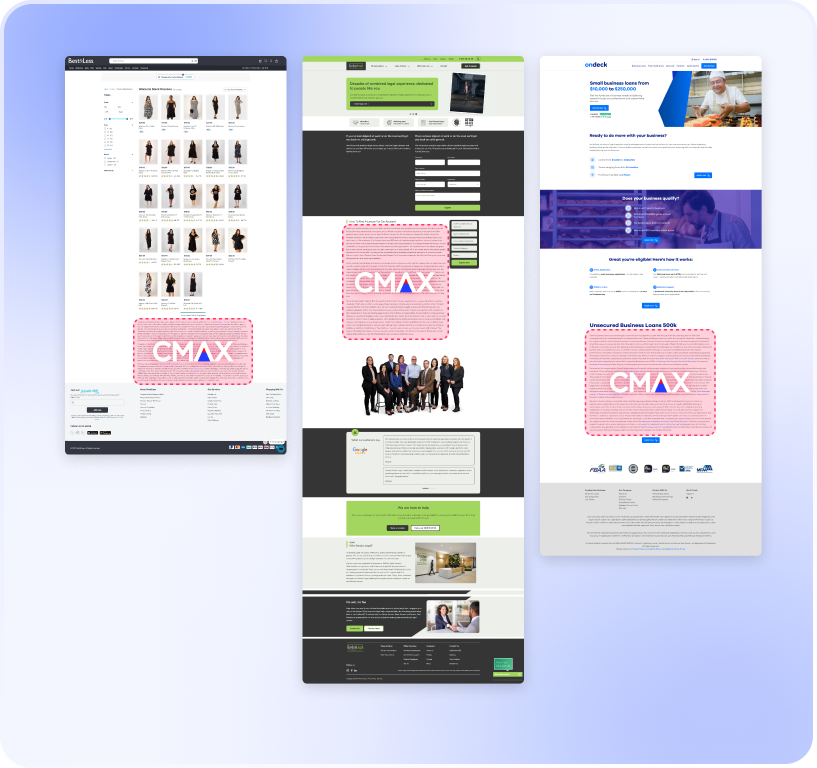
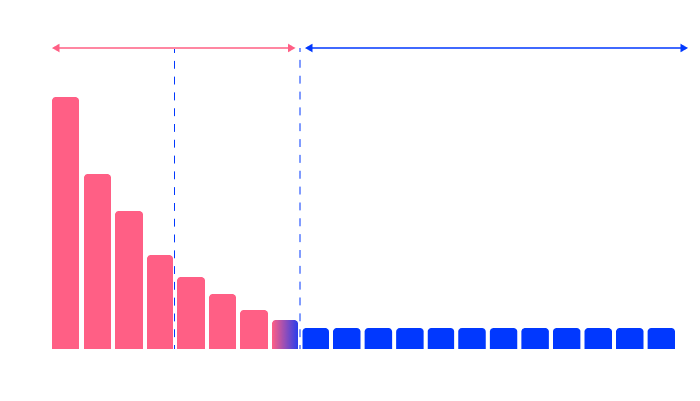
The mechanism that makes large-scale reviewed-AI output valuable is coverage. Core category pages capture the searches buyers use when they already know what they want. The long tail captures the thousands of specific, product-led queries buyers use before they get there, and most enterprise catalogues leave that demand unaddressed.[1]
Artificial intelligence in SEO shows some of its clearest measurable gains in keyword research, where a focus on SEO longtail coverage allows large catalogues to capture the specific, product-led queries that core category pages rarely rank for.
In one CMAX engagement, a B2B omnichannel hospitality retailer added 5,000 CMAX long-tail product pages and reached $1M+/month in incremental SEO revenue within 8 months. The result came from coverage at scale, reviewed for quality before publication. Enterprise SEO for retail sites face the same long-tail gap when core category pages cannot capture every product-led query.
Human Review Determines Whether AI Helps or Harms
Weak Inputs Create Weak Pages
Thin, duplicated, or inaccurate pages are an upstream problem. The value of artificial intelligence in SEO depends on the review gates applied before publication. They trace back to weak source material, vague intent mapping, or missing editorial review gates. If the brief is shallow, the output will be shallow. If intent mapping skips the specific queries a buyer actually uses, the published page won’t satisfy them regardless of how it was drafted.
The fix sits before the AI touches anything: clean source data, clearly scoped intent, and defined review checkpoints for factual accuracy, duplication, and compliance-sensitive language. Teams that skip those gates and then attribute poor performance to AI are diagnosing the wrong variable.
Search Rules Still Apply
Artificial intelligence in SEO does not change what search systems evaluate. Spam avoidance, helpful page design, crawlability, internal linking, and valid structured data are still requirements.[2] Search systems assess the published page, the drafting method is invisible to them.
That means an AI-assisted workflow that produces uncrawlable pages, thin content, or broken internal linking will underperform for the same reasons a manually produced page would. The method of production carries no ranking credit. Every page that goes live needs to meet the same technical and quality bar it always did: clean markup, logical site architecture, and content that serves the searcher’s actual goal. Visibility inside large-language-model results, sometimes called LLM SEO, still requires the same page-quality fundamentals. Scaling output through AI scales those requirements alongside it.
Artificial intelligence in SEO requires especially careful editorial review when applied at scale, and product pages SEO is one area where thin or duplicated output can quickly undermine crawlability and conversion quality if review gates are skipped.
A practical checklist keeps AI SEO claims honest.
AI SEO evaluation checklist.
Before any engagement starts, agree on five things: the outcome you are testing for, the baseline you are measuring from, the review gates that sit between draft and publication, the timeline, and the deliverables that will be handed over at the end.
Without those five elements locked in writing, an AI SEO engagement has no pass or fail condition. That makes it impossible to scale what works or cut what does not.
Artificial intelligence in SEO is most credible when teams commit to defined baselines and stop-or-scale thresholds before launch, which is the same evidence-first standard that AI driven SEO frameworks recommend before any workflow is expanded.
Work through each question before committing budget or resource:
- Is the proposed use case limited to one job, such as clustering, briefing, drafting, internal linking, or reporting?
- Is there a pre-test baseline for indexed pages, qualified clicks, leads, or revenue from the affected page set?
- Are human review steps defined for factual accuracy, duplication, intent coverage, and compliance-sensitive language?
- Is the test isolated enough that other site changes, such as template edits, technical fixes, or campaign shifts, will not blur the result?
- Is the success measure tied to business quality, not just page output, impressions, or raw visit volume?
- Is there a stop or reject threshold if quality, indexation, or conversion quality drops?
- Are organic search traffic, AI assistant referrals, and the conversion quality of each channel being measured separately?
A vendor or internal team that cannot answer every question before launch is not ready to run the test. These steps let teams scale or reject artificial intelligence in SEO on evidence, not assumptions.
Frequently Asked Questions (FAQ)
Is the proposed use case limited to one job, such as clustering, briefing, drafting, internal linking, or reporting?
It should be. Mixing multiple AI applications into a single test makes it impossible to attribute results to any one workflow.
Is there a pre-test baseline for indexed pages, qualified clicks, leads, or revenue from the affected page set?
Without a baseline pulled from Google Search Console and your analytics platform before the test begins, post-launch numbers have no reference point. A baseline is the minimum requirement for any credible measurement.
Are human review steps defined for factual accuracy, duplication, intent coverage, and compliance-sensitive language?
Review gates need to be documented before pages go live, not added after a quality problem surfaces.
Is the test isolated enough that other site changes, such as template edits, technical fixes, or campaign shifts, will not blur the result?
Concurrent changes make attribution unreliable. If the test period overlaps with a site migration or a paid media push, the SEO signal is compromised.
Is the success measure tied to business quality, not just page output, impressions, or raw visit volume?
Page count and impression growth are leading indicators at best. Qualified clicks, conversions, and downstream revenue are the measures that hold up in a board-level review.
Is there a stop or reject threshold if quality, indexation, or conversion quality drops?
Define the threshold before the test starts. A drop in indexation rate or conversion quality is a signal to pause, diagnose, and correct, not to wait and hope the trend reverses.
Separate traffic sources and conversion quality.
Organic search traffic, AI assistant referrals, and the conversion quality of each channel should be measured separately. More visits from a new source do not tell you whether that traffic is qualified, commercially relevant, or worth scaling.
Artificial intelligence in SEO is increasingly shaping how pages are discovered and ranked, making it worth understanding how SEO for AI search fits into a broader measurement and visibility strategy.
How do you measure the success of AI SEO?
Compare pre- and post-test performance on a defined page group. The metrics that carry weight are indexation, qualified organic clicks, conversions, and any downstream sales-quality signal your team already tracks and trusts.
How soon can I measure AI SEO ROI accurately?
ROI can only be judged after pages have been published, crawled, indexed, and converted. That sequence takes time, which is why an eight-week or longer test window is the standard, early ranking movement is a data point, not a verdict.
What tools do I need for AI SEO ROI tracking?
At minimum: Google Search Console for query and page performance, your analytics platform for session and conversion data, and a CRM or lead-quality source if the goal is revenue attribution rather than traffic volume.
If we don’t implement structured data, are we losing out on AI crawler traffic?
Missing structured data can make it harder to interpret page entities and attributes clearly. It does not, however, substitute for crawlable pages, useful content, and clean internal linking, those remain the foundation.
Is AI content actually safe for SEO?
AI-assisted content can be safe when it is grounded in reliable source material and reviewed for accuracy, duplication, and intent fit before publication. Scaling unchecked drafts skips those gates and can create quality problems that reduce performance over time.
Two Lines of Code, Thousands of Long-Tail Keywords
CMAX is a programmatic SEO platform built for teams that need scale without headcount.
Our agentic AI deploys and continuously updates content targeting the long-tail queries where over 90% of search and AI-driven demand sits, the high-intent phrases most businesses never reach. Every page acts as another node in a growing content network, capturing qualified traffic that broad-match strategies leave on the table. Teams typically see measurable movement within six weeks of deployment.
When the conversation turns to artificial intelligence in SEO, the real question is which applications produce documented gains, and CMAX was engineered to answer that with specifics, not promises.
References [1] – https://ahrefs.com/blog/long-tail-keywords/ [2] – https://developers.google.com/search/docs/essentials/spam-policies
Author
Jeremy Tang
Founder and CEO of CMAX
Jeremy Tang is the Founder and CEO of CMAX. With over 2 decades of experience in business consulting and digital marketing, he has successfully driven seven startup businesses, six of which achieved $1 million in revenue from zero in less than 16 months, 5 of which grew to multi-million dollar a year ventures without any external funding. Jeremy's expertise lies in streamlining business processes through technology and leveraging digital (in particular SEO) for business growth. He resides in Australia, travels extensively, and draws inspiration from his global experiences.