Most people who define SEO marketing stop at “getting found on Google,” which sounds right but leaves out the systems that actually produce visibility. Organic search performance depends on whether pages can be crawled, whether they match what someone is searching for, and whether the site makes it easy to act. When any of those layers breaks, publishing more content rarely fixes the problem. CMAX works with enterprise teams to diagnose and scale exactly those systems across large sites.
SEO Marketing Is Organic Search Marketing
Technical, Content, and Authority Alignment
To define SEO marketing properly, start with what it actually covers: organic search visibility earned through technical, content, and authority work. Search engines use all three to decide which pages to crawl, what those pages are about, and whether they deserve to appear for the searches a business wants to earn organically. So what is SEO in marketing? It is the practice of improving these three interconnected systems on a website: its technical setup, its page content, and its external signals.
Define SEO marketing in plain terms and you arrive at the same discipline covered under search engine optimisation-aligning technical setup, content, and authority signals so a site earns unpaid visibility in search results.
Technical setup covers how a site is built and maintained so search engines can access and process it. Page content shapes whether a given page clearly matches what a searcher is looking for. External signals, primarily links from other sites, help search engines judge whether a page carries enough authority to rank competitively. The SEO meaning marketing professionals rely on comes down to this three-part alignment. Weakness in any one of these areas limits what the other two can achieve.
SEO vs SEM and Paid Traffic
What is SEO marketing in practice separates itself from SEM and paid ads by focusing on unpaid visibility in search results, where visibility stops the moment spend pauses.
The distinction is real, but organic traffic carries its own ongoing costs. Teams still need to maintain site health, publish or improve pages that match search intent, and measure whether organic visits lead to meaningful actions. Treating SEO as a one-time project rather than an active system is one of the most common reasons results plateau. The work is continuous: technical maintenance, content that stays relevant as search behaviour shifts, and tracking that connects organic visits to business outcomes rather than rankings alone.
Practitioners who want to define SEO marketing in actionable terms often start by working through how to define search engine optimisation, since both phrases describe the same discipline of earning unpaid visibility through technical, content, and authority alignment.
Search Visibility Depends on Four Practical Systems
Crawlability and Indexing Basics
Strong copy on a page that search engines cannot crawl or choose not to index produces zero organic visibility. Crawlability and indexation are the floor, and everything else sits on top of them.
Robots rules can block crawlers from reaching a page entirely. Weak internal linking means discovery paths never form, so pages sit orphaned regardless of their quality. Canonical tags, when misconfigured, redirect authority away from the page you actually want to rank. Indexation status tells you whether a page has been accepted into the index at all. Each of these variables needs to be confirmed before on-page edits are worth making. Fixing copy on a de-indexed page changes nothing. The connection between how we define SEO marketing and these crawlability, indexing, and relevance fundamentals becomes clearer when you explore SEO what is SEO as a foundation for the four practical systems that drive organic search visibility.
Relevance, Links, and Usability Signals
Once a page is crawlable and indexed, visibility depends on three further signals working together.
Relevance determines whether the page is considered for a query. A page that answers one clear question, written around a specific search intent rather than a broad topic, is more likely to be surfaced than a page trying to cover everything. When we talk about SEO meaning in digital marketing, these four systems are what give the term its practical weight across digital channels. Internal links do two jobs: they help search engines map the relationship between pages, and they give users a logical path forward. A page that sits in isolation, with no internal links pointing to or from it, is harder to evaluate and harder to navigate.
Usability affects what happens after a visit lands. Pages that load slowly, break on mobile, or bury the next action cause visits to stall. Search engines read those signals. Reducing that friction keeps sessions moving and supports the organic performance the other two signals worked to earn.
Progress shows up in measurable search patterns.
Search Console trend patterns
One way to define SEO marketing concretely is to look at the measurable search patterns it produces. Rankings tell you where a handful of tracked terms sit on a given day. That number moves for reasons that have nothing to do with your work: personalisation, location, device, and competitor activity all shift it. Google Search Console gives you something more reliable: the full query mix, impression volume, and click trends across every search that surfaced your pages.
The pattern to watch is directional. After a technical fix or a content update, do impressions rise across a broader set of queries? Do clicks follow? Is the query mix pulling in searches that are closer to what your buyers actually type? If impressions climb but clicks stay flat, the page is being seen but not chosen, which points to a title or meta description problem. If both rise, the fix is working. That sequence is more diagnostic than any single ranking position.
As teams track impressions and clicks to measure SEO performance over time, the rise of AI search is reshaping how queries are processed and which signals influence organic visibility. Grasping what is SEO online marketing in practice means tracking whether those organic visits convert into revenue.
CMAX proof point
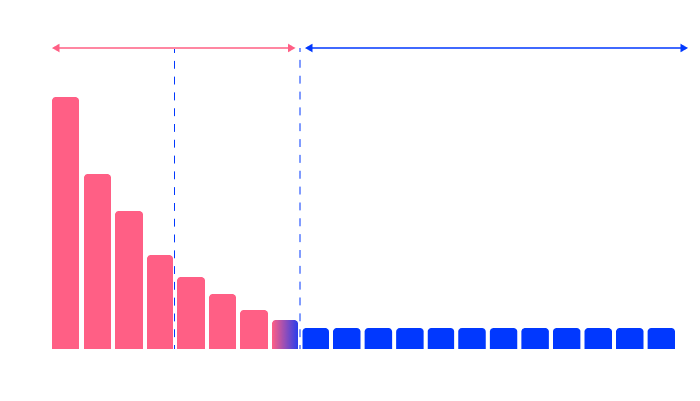
The revenue gap in enterprise SEO is usually in the long tail. Head terms get the attention; long-tail query variations get the volume.
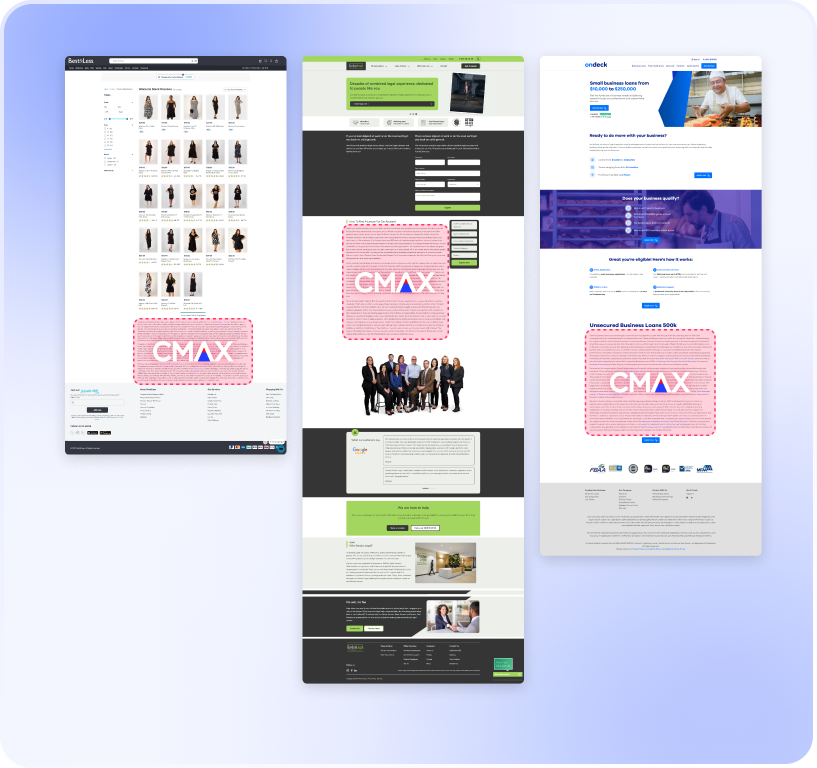
In one CMAX engagement, a B2B omnichannel hospitality retailer added 5,000 long-tail product pages and reached $1M+ per month in incremental SEO revenue within 8 months. The mechanism was coverage: thousands of specific queries that a head-term strategy would never target, each page matched to a distinct search intent.
Large sites face this gap acutely. The infrastructure exists, but the content coverage does not. Long-tail variations go unaddressed, and the revenue those queries represent stays with competitors who do cover them.
A plain-language SEO marketing self-assessment clarifies next steps.
Stranger find, understand, act check
Before acting on any checklist, it helps to define SEO marketing in terms a first-time visitor would recognise. Start with one diagnostic question: can a first-time visitor find the right page from search, recognise within seconds why it matches what they searched for, and complete the intended action without friction?
That three-part check covers the full chain. If a page ranks but the headline doesn’t match the query intent, visitors leave. If the page matches intent but the next step is buried or unclear, the visit stalls. When any part of that chain breaks, the problem is diagnostic. Publishing more content won’t fix it.
Fix the weakest system first
Identify which constraint is doing the most damage, then address that before anything else. Common culprits: pages that aren’t indexed and therefore can’t appear in results, topic areas where no page clearly matches what searchers are asking, or pages that attract clicks but don’t move users toward a decision.
Adding pages to a site with indexation gaps or intent mismatches compounds the problem. The weakest system sets the ceiling for everything else. Teams serving a specific area should also ask what is local SEO marketing doing for their map and local-pack presence.
Plain-language SEO marketing self-assessment
Use the checklist below to identify whether your primary SEO constraint sits in visibility, relevance, usability, or measurement before committing to more content production.
- Visibility: Can search engines crawl and index the pages you want to rank?
- Relevance: Does each important page clearly match one specific search query?
- Usability: Does the page make the next action obvious and easy to complete?
- Measurement: Are you tracking whether organic visits lead to meaningful outcomes?
One honest answer to each question will tell you where to focus first.
A practical self-assessment to define SEO marketing for your own site becomes easier once you know what search engine optimisation means in terms of crawlability, intent alignment, and measurable outcomes.
Can search engines crawl the pages you actually want to rank, without being blocked by robots rules, weak internal links, or technical setup issues?
Crawlability is the first gate. A page with strong copy, clear intent, and solid external links still won’t appear in search results if a crawler can’t reach it or chooses not to index it.
The most common blockers are also the easiest to overlook. A disallow rule in robots.txt that was added during a site migration and never removed. A canonical tag pointing to a different URL, quietly telling search engines to credit another page instead. Orphaned pages with no internal links pointing to them, so crawlers never discover them in the first place. None of these show up in a content audit.
Start with Google Search Console’s Coverage report. Pages flagged as “Excluded” or “Crawled but not indexed” are telling you something specific: either the site’s configuration is pushing them out, or search engines have decided they don’t add enough to warrant inclusion. Both are fixable, but they require different responses.
Internal linking is the structural layer underneath. If your most commercially important pages sit three or four clicks from the homepage with few internal links pointing to them, crawl budget gets distributed unevenly and those pages get less attention than they deserve. A flat, logical link structure moves equity and discovery signals toward the pages that matter.
Fix the access problem before adjusting the content. Rewriting a page that search engines can’t reliably crawl produces no measurable return.
Are the important pages indexed and appearing for the queries they target, rather than sitting undiscovered, excluded, or competing with other pages on your own site?
Indexation is where many SEO efforts quietly stall. A page can be technically sound, well-written, and internally linked, and still not appear in search results because Google has excluded it, chosen a different URL as the canonical, or decided another page on the same site is a closer match for the query.
The most common culprits are pages marked noindex by mistake, canonical tags pointing away from the intended URL, and duplicate or near-duplicate pages splitting relevance signals across multiple URLs. In each case, the page exists but search engines either won’t show it or don’t know which version to show.
Google Search Console’s Coverage and Indexing reports surface these issues directly. Pages flagged as “Excluded,” “Duplicate without user-selected canonical,” or “Crawled, currently not indexed” are telling you something specific: the page isn’t competing for rankings yet, regardless of what’s on it.
Cannibalisation is a separate but related problem. When two or more pages target the same query, neither tends to rank as strongly as one consolidated, authoritative page would. The fix is usually to merge, redirect, or clearly differentiate the intent each page serves.
Before adding new content, check whether the pages you already have are actually in the index and appearing for the right queries. If they’re not, that’s the constraint to resolve first.
Frequently Asked Questions (FAQ)
Is SEO really worth investing in?
Whether is SEO marketing worth it depends on how much of your audience already uses search to compare options, research a category, or solve a problem. In those cases, a well-optimised page can keep producing qualified visits long after it’s published. Paid traffic stops the moment spend pauses; organic visibility doesn’t carry that dependency.
How does SEO work exactly, and how can you make the most of it?
SEO works by making pages easier for search engines to crawl, index, and trust. For anyone still asking what does SEO stand for in marketing, it is search engine optimisation applied to earn unpaid visibility. Businesses get more from it when they align technical fixes, search-intent content, internal linking, and conversion tracking together. Treating keywords as the whole strategy leaves the other systems unaddressed, which is where most plateaus come from.
When readers want to define SEO marketing beyond a surface-level answer, revisiting the core SEO definition helps clarify exactly which technical, content, and authority factors drive organic visibility.
How can you prove the ROI of SEO?
Connect Search Console and analytics trends to leads, sales, or assisted conversions over time, then compare those outcomes with the cost of the work and the organic traffic that produced them. Measure page groups and query themes rather than a handful of tracked rankings, that’s where the real signal sits.
What are the 3 types of SEO?
Technical SEO affects crawlability, indexation, and site performance. On-page SEO shapes page relevance and intent match. Off-page SEO relates to external signals such as links and mentions. All three interact; weakness in any one limits what the others can achieve. These three categories are the simplest way to define SEO marketing as a working system rather than a single tactic.
Readers who want to define SEO marketing in plain terms frequently ask search engine optimisation what is as a starting question before moving on to technical setup, content alignment, and authority signals.
How can SEO increase sales?
SEO brings in people already searching for a specific product, service, or problem, then routes them to pages that reduce friction between discovery, evaluation, and conversion. It works best when the query, the landing page, and the next action align clearly.
Small Teams, Thousands of Keywords, One Platform
Most businesses compete for the same handful of high-volume search terms and ignore the rest.
CMAX is an agentic SEO platform built to target the long tail, the thousands of specific, high-intent phrases that make up over 90% of search and AI demand. It deploys with two lines of code, automatically creates and updates content at a scale manual teams can’t match, and starts producing measurable results within six weeks. If your definition of SEO marketing stops at a few trophy keywords, you’re leaving most of your addressable traffic on the table.
CMAX turns that gap into a growth channel.
Author
Jeremy Tang
Founder and CEO of CMAX
Jeremy Tang is the Founder and CEO of CMAX. With over 2 decades of experience in business consulting and digital marketing, he has successfully driven seven startup businesses, six of which achieved $1 million in revenue from zero in less than 16 months, 5 of which grew to multi-million dollar a year ventures without any external funding. Jeremy's expertise lies in streamlining business processes through technology and leveraging digital (in particular SEO) for business growth. He resides in Australia, travels extensively, and draws inspiration from his global experiences.