At the category-page level, SEO for ecommerce decides whether your collection pages win broad comparison searches or sit invisible beside product pages that only answer narrow, bottom-of-funnel queries.
Most category pages fail this job quietly. The question “What is ecommerce SEO?” starts with recognising why reused supplier copy and neglected category pages gradually lose relevance with Google.
The fixes that actually scale are not about writing more copy once. A practical ecommerce SEO guide connects comparison copy, crawl controls, and internal links instead of treating content volume as the only lever.
CMAX works on exactly this layer of your site, using Search Console data (Google’s free tool showing which searches your site appears for) to find where category pages already earn impressions and closing the gaps before coverage goes stale.
Ecommerce category pages win when they answer shopper comparisons clearly
For a sofa-bed collection, ecommerce category page SEO structures comparisons around frame type, mattress size, and price tier before visitors reach individual products. A category page performs best when it helps shoppers compare brands, features, price bands, and use cases before a product detail page asks for a narrower choice.
Within a broader ecommerce SEO strategy, category pages target wider commercial investigation terms while product pages support specific model, SKU, or buy-now searches. The two layers do different jobs.
Effective SEO for ecommerce stores gives category pages original range descriptions, clear filter labels, useful buying cues, and links to relevant subcategories. These elements help shoppers narrow their options without leaving the category too early, which also strengthens how search engines read topical relevance.
What belongs on category pages?
A strong category page needs enough original copy to explain what the range covers, who each option suits, and which trade-offs matter during comparison. Clear subcategories, filter labels, buying cues, and internal links keep shoppers moving through the site rather than bouncing out.
Why category pages stay undercovered
Weak On Page SEO for ecommerce leaves linen bedding categories with duplicated introductions across colour and size filters. Ecommerce SEO services should address thin copy and reused manufacturer text that make broad pages look interchangeable, so they struggle to appear for comparison searches that mention attributes, materials, or sizes.
Weak taxonomy and duplicate filter URLs split ranking signals across near-identical pages. A “linen bedding” category will not hold if every colour and size filter creates a near-copy page with the same intro paragraph.
Strong category pages combine intent matching, crawl control, and internal links
Among practical ecommerce SEO tips, the best category templates match shopper language while keeping technical controls tight enough to stop filter combinations from flooding Google’s index with near-duplicate pages. Internal linking then connects parent categories, subcategories, and related guides so authority flows to the pages that carry the most commercial weight.
The goal is to keep the main collection page strong, then surface only the filter states that serve a real search purpose.
Long-tail fixes that scale
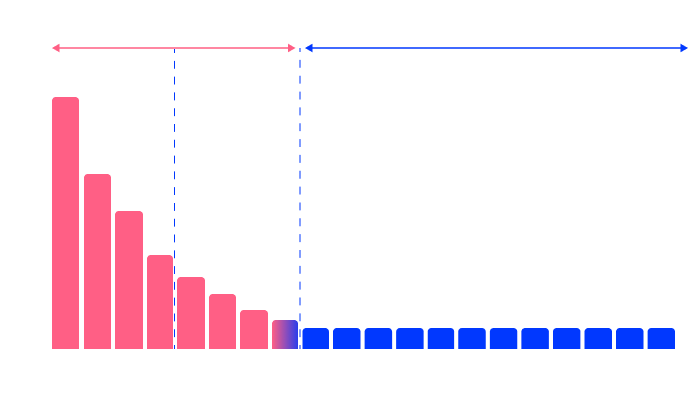
The high-volume keywords in your category have almost certainly been claimed by larger competitors. The remaining value is in thousands of specific, detailed searches shoppers type, such as “stain-resistant dining chairs under $800” or “queen sofa bed with firm mattress.”
Think of a large hardware store that stocks ten thousand product lines. No single staff member can memorise every SKU, so the store runs a catalogueue system: one record per item, searchable by attribute, updated when stock changes.
Ecommerce category page SEO works the same way. Building systems that cover thousands of small long-tail queries at scale is the only approach that pays off, because working through them one page at a time never does.
Category pages capture more long-tail demand when headings, intro copy, subcategory modules, and comparison blocks reflect real modifiers pulled from search data. Search Console makes this measurable through clicks, impressions, click-through rate, average position, and query breakdowns at no cost, which makes it the right starting point for spotting broad category pages that already appear for detailed searches but convert poorly.
A retailer investing in SEO services for ecommerce website can treat a high-impression, low-click-through category page as a signal to rewrite its title, intro, and comparison copy around the modifiers that shoppers are already using.
Filters, facets, and internal linking
What is faceted navigation? It is the set of filters (brand, material, colour, size) that let shoppers narrow a category.
The SEO question is which filter combinations should produce their own crawlable page and which should not. Faceted navigation SEO means distinguishing useful brand or material filters from session IDs, empty result sets, and endless parameter variations that should generate no crawlable URL at all.
Dynamic Internal Linking works best when it routes users and crawlers from broad categories to the most relevant subcategories, guides, and high-intent filter states. Index only the filter pages that map to a clear search pattern, such as “oak dining tables” or “black leather office chairs,” and noindex the rest.
CMAX helps scale category content so coverage stays fresh and connected
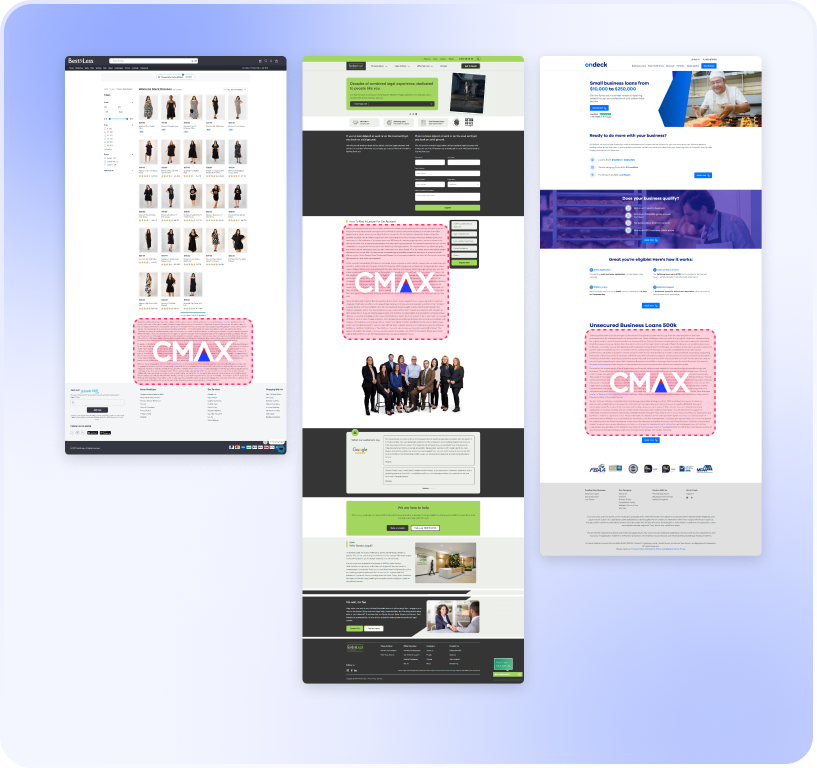
CMAX is the Agentic SEO Platform, built on the principle that content surface area and freshness both shape search and AI visibility. CMAX applies ecommerce category page SEO differently from static template publishing by updating category coverage as demand, stock, and merchandising priorities shift.
Where static template pages get published and left, CMAX keeps category content connected, reviewed, and updated so it reflects what shoppers are actually searching for right now.
How CMAX finds and closes gaps
Mapping the distance between what shoppers search and what your pages actually say is the kind of review an ecommerce SEO consultant does by hand, one page at a time.
CMAX reads the long-tail demand around what you sell, the thousands of query variations customers and AI engines actually use, and injects self-updating content across new and existing pages to cover it. The content is not write-once: each page runs micro-experiments and refreshes against real performance data, so coverage keeps pace with how people search.
Take a homewares range. Shoppers search “easy clean dining chairs”, but if no page speaks to stain resistance, that demand goes uncaptured. CMAX covers those variations at query scale across Google and AI engines like ChatGPT, Perplexity, Claude and Gemini, then keeps the content current rather than leaving it to go stale.
Why CMAX scales long-tail coverage
Over 90% of search and AI demand is in the long tail. CMAX targets that majority of search demand by expanding coverage across the specific, detailed searches shoppers type.
Scalable ecommerce on page SEO means expanding that coverage while keeping output aligned with what your brand actually says. CMAX is trained on human-reviewed, client-approved content, which matters because updating category copy at scale is only useful when the content is accurate and brand-safe.
Most SEO programmes run by conventional agencies, using outdated methods, tell clients to expect results in six months. CMAX’s methods allow clients to start seeing clicks in 6 to 8 weeks.
Proof signals that matter
Useful proof signals for ecommerce category page SEO include stronger positions for targeted category terms, Search Console growth in impressions and clicks at page and query level, and downstream revenue from organic sessions. If a category page is improving, you should be able to trace that lift from query visibility through to category revenue, not just a rank tracker screenshot.
CMAX supports Full Body SEO, which means category-level coverage connects directly to product-level performance so neither layer works in isolation.
Frequently Asked Questions
How many products does an ecommerce category page need to rank?
There is no fixed product count that triggers a result. Across a well-planned ecommerce SEO marketing programme, relevance, original copy, internal linking, and crawlability carry more weight than an arbitrary product count.
Strong SEO product pages cannot compensate for a category that remains thin, duplicated, or difficult to move through.
Should out-of-stock products appear on category pages?
Temporarily out-of-stock products can stay visible when availability is clearly labelled and alternatives are shown alongside. Careful faceted navigation SEO keeps stock filters useful.
Schema (hidden labels in a page’s code that tell Google what things are) defines explicit states including InStock, OutOfStock, PreOrder, BackOrder, and Discontinued, giving teams a consistent way to model stock status in structured data.
When should you merge or redirect a category with no products?
Merge, redirect, or deindex a category when it no longer supports comparison and meaningful stock is unlikely to return. Google advises that pages with no useful content should not keep generating crawlable URLs.
A category with no inventory, no search demand, and no merchandising plan adds maintenance cost without adding value.
Ecommerce Category Page SEO: Comparison Copy That Scales
Ecommerce category page SEO works better when category pages do more than list products. CMAX is built around the same idea: broad collection pages win when they cover the comparison questions shoppers actually have, then keep that coverage current as search demand shifts.
CMAX supports ecommerce product page SEO alongside its primary category-page work, keeping specific products connected to broader comparison content. Our platform helps you make SEO for ecommerce websites more scalable by expanding category content, connecting it through internal links, and updating it from real performance data rather than leaving thin template copy in place.
The clearest way to see where your category coverage has gaps is to look at the queries you already appear for but are not winning. That is exactly what the Missing Customer Map review maps out.
If you’re curious as to how you’re performing on AI, book in a Missing Customer Map review with our Growth Team.
Author
Jeremy Tang
Founder and CEO of CMAX
Jeremy Tang is the Founder and CEO of CMAX. With over 2 decades of experience in business consulting and digital marketing, he has successfully driven seven startup businesses, six of which achieved $1 million in revenue from zero in less than 16 months, 5 of which grew to multi-million dollar a year ventures without any external funding. Jeremy's expertise lies in streamlining business processes through technology and leveraging digital (in particular SEO) for business growth. He resides in Australia, travels extensively, and draws inspiration from his global experiences.