Most searches for an enterprise SEO agency Melbourne lead to lists of providers, not a clear way to compare how they actually work. The real difference between agency models shows up in three places: who owns the strategy, who gets changes implemented across your site, and who is accountable when approvals stall between legal, brand, or regional teams. Those structural questions matter more than credentials on a pitch deck. CMAX works with enterprise teams where governance complexity and content scale shape which model fits.
Melbourne Enterprise Agencies Differ by Operating Model
Agency Models and Ownership
An enterprise SEO agency Melbourne can follow one of several operating models, but enterprise specialists, full-service agencies, and platform-led models tend to diverge in three specific places: who owns the SEO roadmap, who creates or scales pages and assets, and who is accountable for getting template, CMS, or engineering changes live after strategy is approved.
That last point is where most delivery gaps appear. A roadmap can be technically sound and still stall for months if no one has a clear mandate to push changes through engineering queues or CMS workflows. Before comparing agencies on strategy quality, confirm where accountability sits once the proposal is signed.
Why Melbourne Coordination Matters
Any SEO agency in Melbourne handling enterprise-scale accounts knows that coordination becomes operationally relevant when local landing pages, franchise operators, state-based teams, or regulated approval groups add review layers to what might otherwise be a straightforward national SEO plan.
Organisations comparing enterprise SEO agency Melbourne options sometimes also evaluate enterprise SEO services Sydney when their operations span both cities and require a consistent governance model across state-based teams.
Each additional stakeholder group introduces a potential hold point. A franchise network may require individual operator sign-off on location pages. A regulated industry may route content through legal or compliance before anything publishes. State-based teams may have separate brand guidelines that affect template decisions. When those layers stack, a national SEO plan becomes a multi-stakeholder workflow, and the SEO agency Melbourne that handles a single-site rollout cleanly may not be equipped to manage that coordination at scale. The operating model a SEO Melbourne agency adopts needs to account for those layers from the start, not after the first rollout is delayed.
Governance Determines Whether Enterprise SEO Scales
Governance Bottlenecks
On large websites, the initial recommendations rarely determine whether SEO progresses. What determines it is whether approval paths, engineering capacity, and content ownership are defined clearly enough for changes to ship repeatedly across templates, sections, and business units.
A technical audit that identifies 200 indexation issues across a site’s product templates is only useful if someone owns the ticket, an engineer has capacity to action it, and a stakeholder with sign-off authority is in the loop before the sprint closes. Without that structure, the same recommendations sit in a backlog for months. This is where many enterprise SEO Melbourne engagements stall, and it has nothing to do with the quality of the strategy.
For Melbourne organisations with franchise operators, state-based teams, or regulated approval groups, the governance layer adds further complexity. Each review step is a potential delay point. An agency model that doesn’t account for those layers at the proposal stage will hit them at implementation. Enterprise SEO agency Melbourne engagements increasingly require leadership teams to recognise how AI in search engine optimisation is reshaping crawlability and content evaluation standards, making it important to distinguish credible implementation approaches from unsupported claims.
Guidance Over Shortcuts
A credible enterprise SEO agency Melbourne model is grounded in crawlable architecture, useful content, and clear duplication controls that align with Google’s published guidance on helpful content and crawlability.[1] Those are the mechanisms that move rankings and hold them. As part of evaluating any enterprise SEO services provider, organisations should ask how the agency’s technical and content recommendations align with SEO for AI search principles grounded in Google’s own guidance rather than speculative tactics.
Vague claims about AI-search tactics are worth scrutinising closely. If a proposed approach cannot be traced to a specific implementation step, an indexing mechanism, or a measurable content output, it is not a strategy. Ask any prospective agency to explain exactly how a tactic gets from recommendation to a live change on the site.
Proof Should Extend Beyond Ranking Reports
Reporting That Ties to Revenue
Ranking reports tell you where a tracked keyword sits on a given day. They do not tell leadership whether the SEO programme is generating qualified leads, phone enquiries, or revenue. For an enterprise organisation, that gap creates a real problem: when budget reviews arrive, a list of position movements is difficult to defend against a CFO who wants to see commercial return.
Useful enterprise reporting traces a direct line from specific work to specific outcomes. A technical fix to crawlability or internal linking should be tied to the pages it unblocked and the traffic or conversion change that followed. A content release should be measured against qualified lead volume and revenue, not only impressions. When that attribution is built into the reporting model from the start, leadership can see which decisions moved commercial outcomes and which did not.
When assessing proof of performance, an enterprise SEO agency Melbourne should be able to explain how AI SEO services Melbourne are measured against commercial outcomes such as qualified leads and revenue, rather than visibility metrics alone.
Enterprise-Scale Proof Point
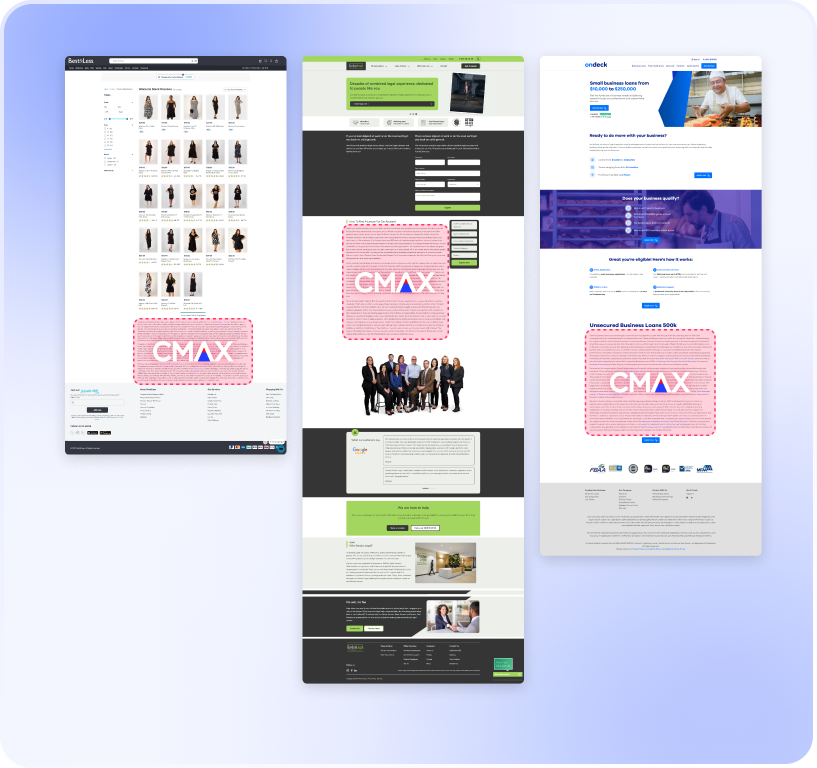
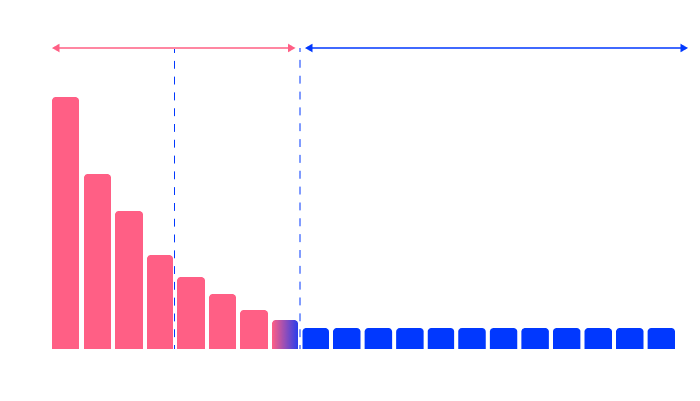
In one CMAX engagement, a B2B omnichannel hospitality retailer added 5,000 CMAX long-tail product pages and reached $1M+ per month in incremental SEO revenue within 8 months. The mechanism was scale: targeting the query-level demand that a small set of head terms never reaches.
Large enterprises carry the same structural opportunity. An ecommerce SEO agency Melbourne managing thousands of product pages faces the same scaling dynamics, where catalogue-scale or query-scale demand exists across most large organisations and head terms cover only a fraction of it. When reporting is built to capture that long-tail revenue, the commercial case for expanding the SEO programme becomes straightforward for any enterprise SEO agency Melbourne to present.
A practical shortlist makes model fit clearer.
Melbourne Model-Fit Checklist
Most agency proposals look credible on paper. The gaps show up after the contract is signed, when the people who pitched the work hand it to a delivery team with different access, different priorities, and a different read on what was agreed.
A shortlist gets more useful when it tests delivery assumptions before you commit. Focus on four areas: access, approvals, reporting, and how each model handles the operational complexity that comes with a large Melbourne-based organisation. What separates one enterprise SEO agency Melbourne from another is how each handles these four areas under real delivery conditions.
Ownership after the pitch. Confirm who holds strategy, production, and implementation once the proposal stage closes. If the senior strategist presenting is not the person responsible for delivery, ask who is and speak to them directly. A qualified SEO consultant Melbourne should be the named owner of strategy through execution, not someone introduced after the contract is signed.
Approval paths. Ask what sign-off process the agency assumes for legal, brand, franchise, or regional stakeholders. Then ask what happens when one of those stakeholders blocks a rollout. A credible answer names a contingency; a vague answer is a risk.
Engineering dependency. Check whether template changes, internal linking updates, and indexation decisions require engineering tickets. If they do, ask who writes those tickets, who prioritises them, and who tracks them through to release.
Commercial measurement. Review how the agency ties qualified leads, revenue, and phone enquiries back to specific technical or content releases, not only to ranking movement. Any provider offering SEO services Melbourne should demonstrate a clear method for attributing commercial outcomes to individual releases.
Local page governance. If multiple business units share the same domain, test how suburb or location pages will be managed where ownership, duplication risk, and location intent overlap across teams. For organisations that depend on suburb-level visibility, local SEO Melbourne governance should define which team controls each location page and how conflicts between business units are resolved.
When building a shortlist for an enterprise SEO agency Melbourne, organisations with franchise networks or suburb-level landing pages should confirm how each agency approaches multi location SEO, including how duplication risk and ownership are managed across a shared domain.
Ask Which Work Is Manual, Which Is Templated, and What Quality Controls Apply Before Pages Go Live, Including Source Approval, Duplication Checks, and Review Responsibility
Choosing the Right Model
The right model depends on three variables: how complex your governance is, how much implementation access the agency can realistically secure, and what level of commercial proof your leadership will need before the SEO programme gets expanded budget.
Governance complexity is the starting point. A single-brand site with one CMS owner and a two-person approvals chain operates differently from a multi-brand or franchise environment where legal, regional, and brand teams each hold a veto. The agency model that works for the first will stall in the second.
Implementation access is the second variable. An agency that produces strong recommendations but relies entirely on your engineering queue to ship them is only as fast as your slowest sprint cycle. Before signing, confirm whether the agency can write, prioritise, and track tickets through to release, or whether that responsibility sits entirely with your internal team.
Commercial proof is the third. If your CFO needs to see qualified leads, revenue, or phone enquiries tied to specific technical or content releases before approving the next phase, the agency’s reporting model has to support that link from day one. Visibility metrics alone will not hold the room.
Choosing the right enterprise SEO agency Melbourne means knowing exactly what is included in enterprise SEO services Melbourne, specifically who owns strategy, who handles production, and what quality controls apply before pages go live. A nearby provider such as an SEO agency south Melbourne can simplify the review layers when face-to-face coordination speeds up approvals.
When those three variables are mapped against what each agency model actually delivers, model fit becomes a practical question rather than a preference. Size and reputation matter less than whether the delivery structure matches how your organisation approves, builds, and measures work.
Frequently Asked Questions (FAQ)
How do you handle technical SEO for large-scale websites?
Large-scale technical SEO starts with crawlability, indexation, internal linking, and template-level fixes. Log-based or platform-based prioritisation identifies which sitewide blockers affect thousands of pages simultaneously, so those get resolved before any team spends time on isolated page issues that won’t move the needle at scale.
How do you scale SEO content without losing quality?
Content scales more safely when templates, editorial rules, approved source material, and review boundaries are defined before production begins. That structure reduces duplication and keeps new pages aligned with brand standards, compliance requirements, and search intent from the first publish.
Is programmatic SEO risky for rankings?
Programmatic SEO carries real risk when it publishes thin, duplicative, or low-intent pages at volume. It becomes workable when each page addresses a distinct query, includes information a generic template would miss, and sits within a clear internal linking and indexation plan.
The same governance and content-scaling principles that define a strong enterprise SEO agency Melbourne engagement also apply in highly regulated verticals, as seen in specialised work like SEO for migration agents Australia, where compliance, approval layers, and intent-matched content are equally critical.
What tools and technologies do you use for SEO analysis and implementation?
Enterprise SEO teams typically combine crawling tools, analytics platforms, search performance data, ticketing systems, and CMS or engineering workflows. That combination lets recommendations get prioritised by sitewide impact and then implemented through existing delivery processes rather than sitting in a backlog.
Can you provide case studies or examples of successful projects?
When evaluating an enterprise SEO agency Melbourne, the most useful case studies show the starting constraint, the delivery model applied, and the commercial outcome measured. That detail lets you judge whether the mechanism matches your own governance structure, rollout constraints, and growth targets before committing to a model.
Most Melbourne Enterprise Teams Have the Strategy Right and the Scale Wrong
CMAX is an agentic SEO platform built for one job: capturing the long-tail demand that accounts for over 90% of search and AI traffic.
Two lines of code deploy thousands of pages targeting the specific, high-intent queries your customers actually type. Our AI agents continuously update that content so rankings compound rather than plateau. Results typically begin within six weeks, giving you a measurable timeline to take back to the boardroom.
For Melbourne enterprises weighing agency models against platform-led delivery, CMAX replaces the bottleneck of limited staff and manual content production with programmatic scale your team controls directly.
References [1] – https://developers.google.com/search/docs/fundamentals/creating-helpful-content
Author
Jeremy Tang
Founder and CEO of CMAX
Jeremy Tang is the Founder and CEO of CMAX. With over 2 decades of experience in business consulting and digital marketing, he has successfully driven seven startup businesses, six of which achieved $1 million in revenue from zero in less than 16 months, 5 of which grew to multi-million dollar a year ventures without any external funding. Jeremy's expertise lies in streamlining business processes through technology and leveraging digital (in particular SEO) for business growth. He resides in Australia, travels extensively, and draws inspiration from his global experiences.