Entity SEO services help Google tell a national brand apart from location offers such as SEO services Melbourne. Google can only do that if it sees your brand as a defined thing with clear links to your products, places and topics.
Repeating keywords doesn’t create that clarity. It matters because your customers rarely search in one tidy phrase.
They search specific problems, comparisons and product details, and Google has to work out which of your pages fits. Clear entity SEO connects those searches to the pages that answer them.
If your site doesn’t make the connections clear, your pages compete against each other. A site that competes with itself wins every time and gains nothing.
AI search raises the stakes. AI engines retrieve from Google, and tools like ChatGPT build answers from several searches run in the background, not one lookup.
If you’re asking “What is SEO services?” then the answer is strategy, implementation and connected content that support visibility across Google and AI engines. CMAX works on this problem for retailers.
We build the brand clarity and page connections that help Google and AI tools place your products in front of the right searches.
Entity SEO services help search engines see what your brand is, more than what it says
Entity SEO services make your brand, products, categories, locations and expertise easier for Google to read as connected things. Buyers search detailed problems, comparisons, use cases and product attributes, and Google needs clear relationship signals to choose the best page.
This is what knowledge graph SEO means in practice. A knowledge graph example is a brand that Google links to its products, locations and topics, so a search for one brings up the others.
In this context, an entity is a brand, product or topic that Google can identify and link to other things it already knows. Schema markup labels the entity on the page.
The connected pages, internal links and consistent names are the evidence that makes Google believe the label.
Clarify brand and topic relationships
Entity SEO starts with the basics: who the company is, what it sells, which audiences it serves, where it operates, and how each product, service or content hub connects to the rest of the site. That includes whether demand for SEO services Perth points to a dedicated local offering or part of a broader Australian service area.
A retailer selling dining tables should make the relationship between “oak dining table,” “extendable dining table,” “small apartment dining table” and the parent dining room category clear through copy, page structure and internal links.
Schema can reinforce this by tagging organisations, products, reviews, FAQs and breadcrumbs. Schema.org is the shared vocabulary those labels use, so schema org for SEO work starts there.
What is schema markup? It is a set of hidden code labels on a page.
Google is explicit that structured data gives clues about content and doesn’t replace the content.
Support detailed customer searches
A customer may search “best sofa for small living room,” then “modular sofa with washable covers,” then “Australian made modular sofa delivery Sydney.” Entity SEO services connect those searches to the right category, product and advice pages instead of leaving each page to compete alone.
The same logic applies to a procurement team that moves from broad platform research to multi-site governance questions and then to enterprise SEO services Adelaide. It should reach the most relevant service, location and supporting pages.
Local searches such as SEO services near me work the same way: the page has to say where you operate and who you serve.
When an AI tool answers a query, it runs several smaller Google searches and builds its response from what it finds. Clear source pages, connected topics and consistent naming give those systems better material.
Semantic SEO checks whether the copy clearly identifies its subject, intended audience and the next related decision.
Strong entity SEO depends on more than schema alone
Entity SEO services cover more than a markup project. They combine consistent naming, useful page copy, internal linking, structured data, a site structure Google can read, and enough content coverage to show Google how your commercial topics fit together.
Schema helps, content carries more weight
Schema reinforces meaning. A strong entity SEO review checks whether priority pages answer three plain questions at the top of the page and throughout the copy: what is this page about, who is it for, and what should the visitor decide next?
On large sites, particularly those using international SEO services across several markets, consistent naming is often the bigger issue. Descriptive internal links, consistent product and service names, and supporting pages around adjacent questions often do more for interpretation than markup on thin or vague pages.
Coverage matters beyond page markup
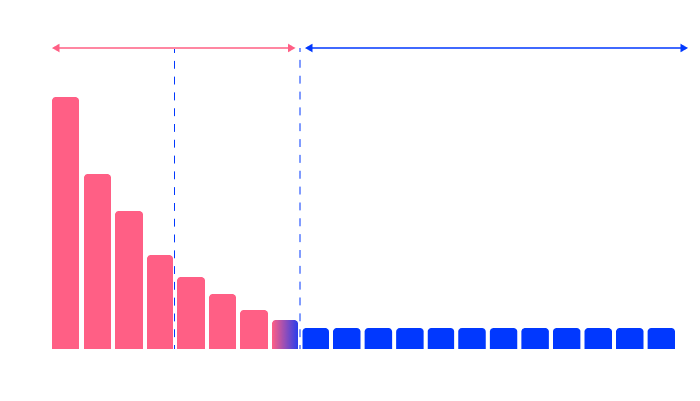
Over 90% of search and AI demand is in the long tail, meaning the specific, detailed searches people actually type. The commercial opportunity sits across hundreds or thousands of specific needs: size, price, use case, location, comparison and problem-led searches.
Across a broad site, marketing SEO services can use content surface area as a practical measure of entity strength. That means how many of the ways customers search you have a useful answer for.
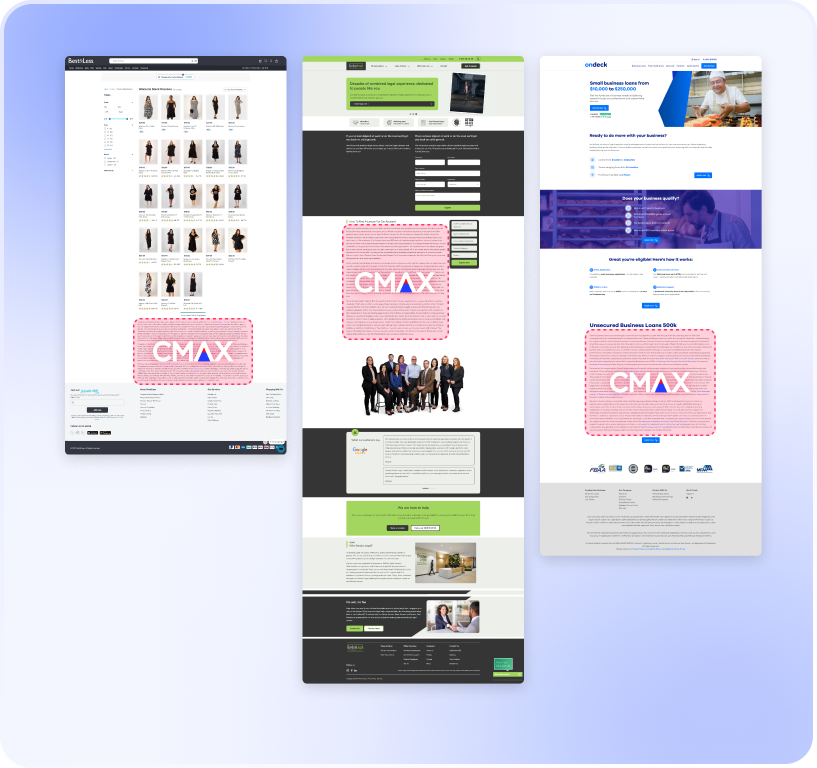
CMAX defines entity SEO services as coordinated work across content coverage, internal links, structured data and the relationships between commercial pages. If your site sells a product but has no page covering key variants, use cases, objections and comparisons, Google has less evidence your brand is relevant across the category.
CMAX builds entity clarity into content that keeps improving with demand
Through entity based SEO, CMAX delivers entity SEO services as an ongoing search and AI visibility programme. It suits brands where customers search in thousands of ways, approved language matters, and new demand appears faster than a manual content calendar can cover.
CMAX is trained on human-reviewed, client-approved content.
Useful structured data SEO examples include organisation, product, review, FAQ and breadcrumb labels that repeat meaning already stated in the body content. Entity signals also sit in the link paths across the site, where Dynamic Internal Linking builds them over time, instead of living only in metadata or schema.
Frequently Asked Questions (FAQ)
Does entity SEO replace keyword research?
No. Keyword research shows the language buyers use and where demand is growing. Entity SEO decides how those searches connect across a hub, comparison page, product page and FAQ, so the site builds meaning and avoids disconnected articles.
Do I need a Wikipedia page to benefit from entity SEO?
No. On-site consistency, structured data, internal links, author or organisation information and useful supporting pages are more in your control than a third-party source you don’t own. Schema markup for local SEO can identify an organisation and its location, but consistent service information and connected supporting pages still carry the weight.
A Google knowledge panel is the information box Google shows beside some brand searches. People ask how to get a Google knowledge panel.
The practical answer is a clear, consistent brand across your own site and trusted sources, since Google decides when to show one. When questions as specific as SEO services for my website go unanswered and your product categories and advice content are vague or disconnected, fixing your own site is the better first move.
How do you measure entity SEO success?
Track broader query coverage, stronger impressions and clicks from long-tail searches, and better performance across connected page groups. Search Console, Google’s free tool showing which searches your site appears for, lets teams review impressions, clicks, average position and the actual queries driving visits.
The useful executive view is whether more of the searches customers use across a category reach the right pages.
Entity SEO Services Need Coverage Beyond Schema
Entity SEO services work best when they make your brand, categories and supporting topics clear across the pages customers search. CMAX focuses on wider coverage for the specific searches that tell Google what you sell, who it is for and how each page connects.
CMAX is the Agentic SEO Platform. It helps brands add and update approved content across new and existing pages, with internal linking that builds stronger topic relationships over time.
CMAX scopes SEO services cost, and enterprise SEO pricing for larger sites, against the strategy, implementation and connected content needed to improve search and AI visibility.
A site can’t rank for what it doesn’t talk about, and schema alone can’t cover the long tail of customer demand or local needs such as SEO agency Wollongong. You can’t fix a gap you can’t see.
The review maps the searches your customers make that your site has no page to answer.
If you’re curious as to how you’re performing on AI, book in a Missing Customer Map review with our Growth Team.
Author
Jeremy Tang
Founder and CEO of CMAX
Jeremy Tang is the Founder and CEO of CMAX. With over 2 decades of experience in business consulting and digital marketing, he has successfully driven seven startup businesses, six of which achieved $1 million in revenue from zero in less than 16 months, 5 of which grew to multi-million dollar a year ventures without any external funding. Jeremy's expertise lies in streamlining business processes through technology and leveraging digital (in particular SEO) for business growth. He resides in Australia, travels extensively, and draws inspiration from his global experiences.