Most teams treat product led SEO as a content play, publishing more blog posts and calling it product-led because the topics relate to the product. But the model works differently. It starts with product data you already have, such as integrations, templates, comparisons or marketplace listings, and turns those into indexable pages where someone can actually do something, not just read about it. The distinction matters because it changes what you build, how you scale and whether pages hold up over time. CMAX works with teams applying this model at scale, particularly where page quality and governance need to keep pace with volume.
Product-led SEO builds discovery into the product itself.
Product Data as Search Entry Points
Product led SEO creates indexable pages directly from real product entities, integrations, templates, comparisons, usage states, marketplace listings, so the page a user lands on is one where they can evaluate, configure or act on something concrete. Most SEO programmes treat the product as a destination and content as the path to it. Product-led SEO inverts that, making the product data itself the source of search entry points.
That distinction changes what the page does. A user searching for how two tools connect does not want a category overview. They want a page that reflects the actual relationship between those tools, with enough specificity to make a decision or take a next step. Product-led SEO makes that page possible because the product data already contains the inputs.
How It Differs From Similar Models
Product SEO is frequently conflated with two adjacent models, and the differences are operational, not cosmetic.
Product-led content starts with education. The product may appear, but the page’s primary job is to inform, and the URL does not need to map to a distinct product state. Product-led SEO starts with product functionality that can support a distinct search journey and a valid URL, the page exists because the product relationship or workflow exists.
Programmatic SEO scales page production. That is a mechanism, not a strategy. Pages can be produced at volume without any of them delivering product-native value. Product-led SEO requires that each page earns its URL by answering a task, decision or workflow that the product itself makes possible.
Product-led SEO is often conflated with programmatic content, yet the key distinction is that product-led pages derive their uniqueness from real product entities and user tasks rather than from keyword-driven template variation alone.
The core model starts with searchable product value.
Common Page Types in Product-Led SEO
Product-led SEO works because certain page types map directly to how people search. Integration pairings, ready-made templates, comparison intent, marketplace inventory, location-specific availability and user-generated states all reflect the nouns, tasks and decision points that appear in real queries. A user searching for a specific tool pairing or a template for a particular workflow is not looking for a category overview, they want a page that matches the exact object they have in mind.
SaaS Integration Search Journey
A SaaS product with dozens of integrations has dozens of distinct search relationships waiting to be indexed. A single integrations hub answers none of them precisely. Splitting that hub into individual, indexable pages, each covering a tool pair, its setup intent and its workflow-specific use cases, captures queries that the hub page will never rank for. When a user searches how two specific systems connect, a page built around that relationship answers the query directly. The hub does not.
What to Build Instead
The most common mistake is mass-producing keyword variants that leave the user task unchanged. Page count is not the model. Each URL needs a real product object, workflow or decision point behind it, something that changes what the visitor can learn, compare or do. Product led SEO shares structural concerns with faceted navigation SEO because both disciplines require teams to decide which filtered or parameterised URLs represent a distinct enough user task to merit indexation rather than consolidation.
A practical checklist:
- Do turn integrations, templates and comparisons into indexable pages tied to a real search task.
- Do require each URL to answer a distinct task, decision or workflow.
- Do connect page creation to product data, internal search behaviour, ownership and refresh logic so pages stay accurate as the product evolves.
- Don’t treat blog volume as product-led SEO.
- Don’t publish pages that only swap location or keyword text without changing the user’s experience. A location page built for SEO Hobart or SEO newcastle should change the data and action available, not the city name alone.
- Don’t separate SEO planning from product data, both reveal what users already expect to find.
Search quality depends on evidence, uniqueness and governance.
What Makes Scaled Pages Useful
Scaled pages stay useful when each URL draws on genuinely different inputs. A different dataset, a distinct integration pairing, a location constraint, a comparison outcome, any of these changes what the page contains and what a visitor can actually do on it. When the underlying input is the same and only the surface text shifts, the page adds no new value to the index. The test is simple: does this URL answer a task or decision that no other URL on the site already covers? If the answer is no, the page has no reason to exist.
Product-led SEO relies on the same principles that govern SEO dynamic content, since pages built from live product data must still present crawlable, indexable output that search engines can evaluate consistently across every generated URL.
Transparency and Editorial Controls
At scale, quality depends on being able to show where page information came from, how it was produced, who reviewed it and why the page exists for users. What separates credible product led SEO from thin automation is this kind of source transparency and production accountability. Google’s people-first guidance explicitly focuses on these signals and production methods.[1] Teams that cannot answer those questions for a given page are exposed, both to search quality reviewals and to internal credibility problems when a page surfaces inaccurate product data. enterprise SEO teams standardise review rules before expanding page count, because retroactive fixes across thousands of URLs are far more costly than upfront governance.
Automation Governance Risks
Automation becomes risky when a team cannot trace source fields, update rules, ownership, canonical logic or noindex criteria for a page. An AI SEO workflow must trace these source fields with the same rigour, since one faulty input or misconfigured rule can replicate errors across thousands of URLs before anyone spots the pattern. The risk compounds because the failure mode is silent: pages get indexed, traffic arrives, and the problem only surfaces when rankings drop or a crawl audit flags the damage. Governance controls, defined ownership, refresh schedules, traceable data sources, need to be in place before page count scales, not after.
Product-led SEO teams that adopt automated SEO tooling must still establish clear governance rules for source fields, ownership and refresh logic to prevent systematic errors from propagating silently across thousands of product-derived URLs.
Organic growth compounds when product signals match real demand.
A SaaS-Relevant Proof Point
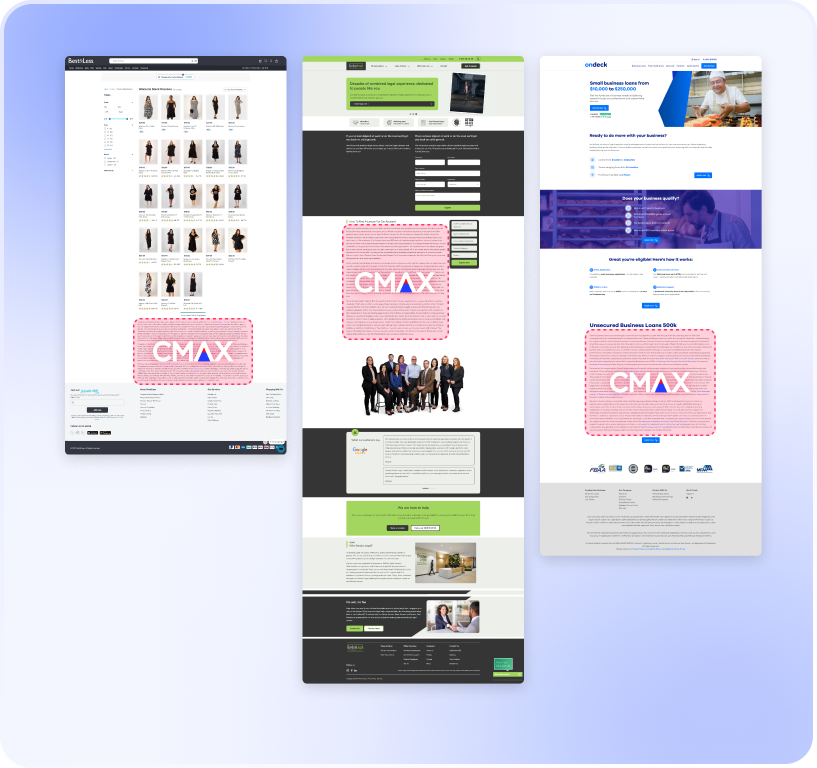
In one CMAX engagement, a fintech lender scaled from 1,000 to 15,000+ pages by May 2023 and delivered 6X SEO traffic alongside 6X loan applications within 12 months. The mechanism was the same one product-led SEO applies to SaaS: matching indexable pages to specific demand that a single category page cannot reach.
That dynamic becomes particularly valuable when paid acquisition costs are high, category terms are already contested, and real search volume sits in long-tail queries tied to specific use cases, workflows or location variants. Whether a SaaS team needs SEO Sydney coverage, SEO Melbourne reach or SEO Perth visibility, the principle holds: head-term pages don’t cover that ground. Product-derived pages do.
Product-led SEO is particularly well-suited to longtail SEO because the specific integration pairings, workflow states and location variants that product data generates naturally map to the precise, lower-competition queries where long-tail demand concentrates. Broader SEO Australia demand patterns confirm that these long-tail product queries often outperform generic category terms in conversion rate.[2]
Why It Matters Beyond Rankings
Rankings are a proxy. The more direct outcome is qualified entry points. Every indexable product state, a new integration, a template variant, a location-specific availability, captures intent that would otherwise stay buried in product navigation, internal search logs, filter menus or support documentation. Those are searches happening right now, with no organic page to receive them.
Product-led SEO increasingly intersects with AI and SEO as teams explore how machine-learning signals and automated content evaluation shape which product-derived pages earn visibility at scale. Product led SEO turns each of those qualified entry points into a durable, compounding asset.
The Practical Takeaway
Product-led SEO produces compounding returns when teams treat page creation as a product discipline, not a publishing exercise. That means translating proven product utility into pages that are indexable, distinct and maintainable, with explicit rules governing data quality, ownership and refresh cadence. Page count is an output of that system, not the goal itself. Teams that reverse the order, chasing volume first, typically produce coverage that degrades as the product evolves.
How to measure product-led SEO success?
Track qualified landing pages, non-brand impressions and clicks, assisted sign-ups or leads, and conversion rate by page type. The metric that separates product-led SEO optimisation from general content performance is which demand patterns originate from product-derived URLs rather than blog content alone. That distinction tells you whether the product is generating discovery or whether organic traffic still depends on editorial volume.
How to use search logs for product-led SEO?
Search logs surface repeated nouns, integrations, filters, locations and task phrases that users already expect to find. That pattern data is a direct input for deciding which product states deserve dedicated pages and which searches still dead-end in navigation or support content. Start with what users are already typing before building new page templates.
How to align SEO with a product roadmap?
Review planned launches, including new integrations, templates, filters and marketplace inventory, before they ship. The question at each review is whether the launch creates a distinct search journey that merits its own indexable URL. Catching that early means pages are ready at launch rather than retrofitted months later.
Product-led SEO vs traditional SEO for SaaS?
Traditional SaaS SEO centres on category pages and educational content. In contrast, product led SEO expands organic reach by turning the product’s own relationships, configurations and workflows into searchable entry points with direct product relevance. The coverage model is different, not just the page count.
Product-led SEO strategies are beginning to account for AI search engines as new retrieval surfaces that may index and surface product-native pages differently from traditional web search.
How to scale product-led SEO for enterprise?
Standardise page inputs, review rules, ownership, refresh schedules and indexation controls before expanding page count. Coverage can grow without losing accuracy, traceability or search quality when those controls are in place from the start.
Product Data Creates Search Traffic, CMAX Builds the System
Most SEO strategies stop at publishing articles. CMAX starts where the product does.
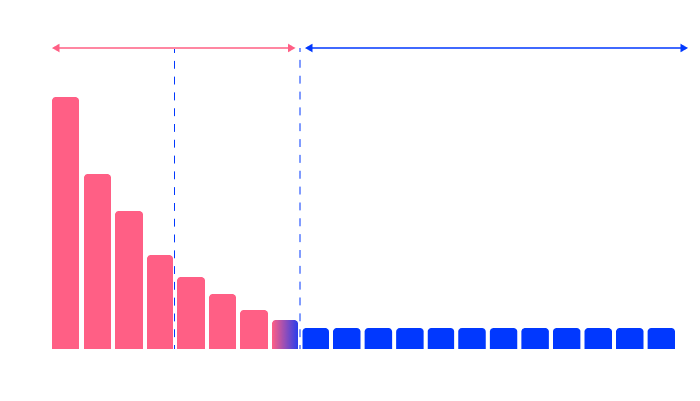
CMAX is an agentic SEO platform that turns product data, use cases, integrations, and customer search patterns into thousands of indexable pages, deployed with two lines of code. Over 90% of search and AI demand sits in long-tail queries, the exact terms your buyers type when they’re ready to act. Our AI agents create, deploy, and continuously update content across those queries at a scale and speed manual teams can’t match.
Teams running product-led SEO need infrastructure that translates product value into discoverable pages without thin content or governance risk. CMAX delivers that infrastructure, with measurable organic results starting in six weeks.
References [1] – https://developers.google.com/search/docs/fundamentals/creating-helpful-content [2] – https://ahrefs.com/blog/long-tail-keywords/
Author
Jeremy Tang
Founder and CEO of CMAX
Jeremy Tang is the Founder and CEO of CMAX. With over 2 decades of experience in business consulting and digital marketing, he has successfully driven seven startup businesses, six of which achieved $1 million in revenue from zero in less than 16 months, 5 of which grew to multi-million dollar a year ventures without any external funding. Jeremy's expertise lies in streamlining business processes through technology and leveraging digital (in particular SEO) for business growth. He resides in Australia, travels extensively, and draws inspiration from his global experiences.