SEO and content strategy is more than a keyword list handed to a writer. Keyword research is one step. The full job connects what customers search, which pages need to exist, how those pages link together, and whether any of it becomes qualified visits and revenue.
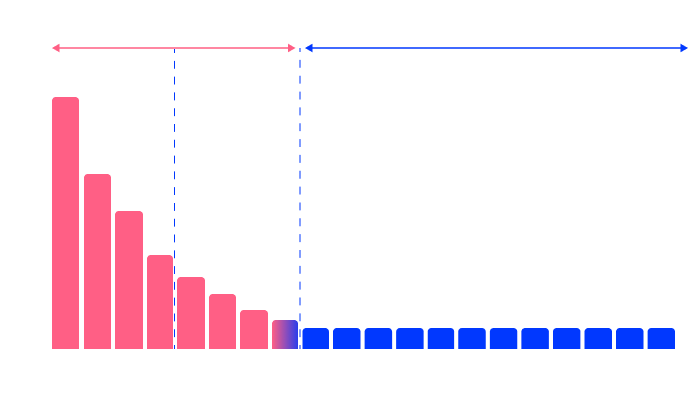
Most retailers chase a handful of head terms. Buyers don’t search that way. In SEO and content marketing, customers type specific queries by product, size, problem or comparison. Over 90% of search and AI demand is in the long tail, according to BrightEdge.
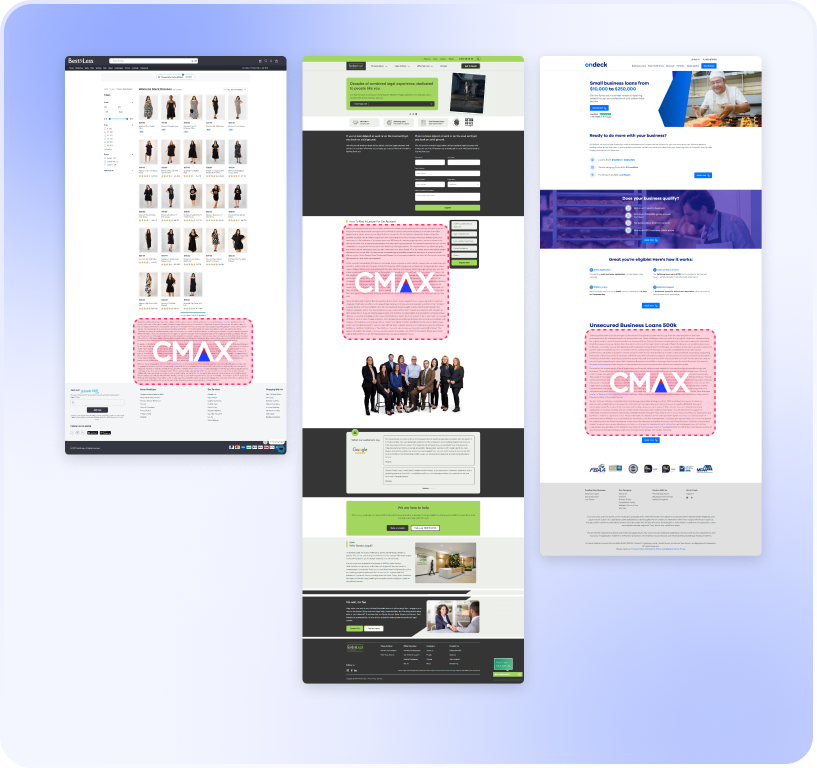
A strategy that covers only the obvious terms leaves most of that demand uncontested. CMAX works from this starting point. Our agents use SEO dynamic content to answer long-tail searches, connect the relevant pages and measure the sales that coverage drives.
Search demand, content planning and revenue goals line up from the start
One system from research to measurement
An SEO and content strategy prevents content cannibalisation by giving every page a distinct purpose. It connects five decisions: what customers search, which pages need to exist, how those pages sit in the site structure, how they link to each other, and how performance is measured against qualified visits and revenue.
The main types of SEO content are category, comparison, use-case, help and product pages. Each serves a distinct intent.
Built for broader topic coverage
A few head terms rarely match how buyers search. A practical content strategy for digital marketing maps product type, material, size, problem, comparison, location and use case to the right page format. Content surface area is the number of those searches you have a useful answer for. Category pages serve commercial demand. Comparison pages serve evaluation. Help content serves problem-led searches. Product pages convert.
If you’ve searched “What is keyword research?” or “How to do keyword research?” then the answer is short. List what customers type, then match each search to a page.
Long-tail coverage, freshness and connected pages do the heavy lifting
Long-tail searches are the specific queries people type: “linen quilt cover king size Australia” rather than “bedding.” A scalable SEO strategy for website growth gives each major intent cluster a useful page instead of expanding a keyword spreadsheet. A strategy built on a short list of obvious terms leaves most real buying intent uncontested. The sharper question for programmatic content is whether you have a useful page for each major intent cluster, however many keywords sit on a spreadsheet.
Freshness and links build momentum
Content goes stale, and unlike milk it has no date on the carton. Any content marketing plan template should schedule reviews for category pages, pricing information, comparisons and pages losing Search Console impressions. Prices shift, ranges change, competitors move and customers change the words they use.
Google also recommends internal links to help it find pages. Descriptive anchor text tells users and Google how those pages connect.
CMAX turns strategy into a content system that keeps improving
Scales long-tail visibility
Compared with a conventional content marketing strategy agency, CMAX is the Agentic SEO Platform, built for brands whose customers search in thousands of specific ways. Whether work stays in-house or moves to SEO content marketing services, the main blocker for most brands is the manual work to create, connect, monitor and update enough content for the demand that already exists.
Examples of content marketing strategy are easy to find, and any content marketing strategy ppt will describe the plan. The manual work comes after it.
Human-reviewed content, faster first clicks
A controlled B2B content marketing strategy can use approved brand assets, compliance requirements and human-calibrated source material. CMAX is trained on human-reviewed, client-approved content, which keeps scale tied to brand language and product reality.
Most SEO programmes run by conventional agencies, using outdated methods, make clients expect results in six months. CMAX’s methods allow clients to start seeing clicks in 6 to 8 weeks. Timelines still depend on the site, the competition and the execution.
Reporting ties coverage to revenue
CMAX’s content marketing strategy services connect new query groups and qualified landing-page visits with CRM and ecommerce revenue. Don’t rely on a single SEO content score. Look across landing pages, assisted conversions, CRM and ecommerce revenue, so no single source gets more credit than it earned.
How can you prevent keyword cannibalisation as your content library grows?
Cannibalisation starts when several pages chase the same intent with slightly different wording. A disciplined SEO and content strategy gives each category, comparison, use-case and help page a distinct purpose before publication.
Use consistent anchor text to signal which commercial page is primary. Then use Search Console to spot two URLs that repeatedly swap positions for the same query. Merge, redirect or rewrite the overlaps.
Does the ratio of blog posts to product pages matter for SEO?
There’s no fixed ratio that improves results on its own. SEO and content strategy prioritises gaps in buying, evaluation and problem-solving coverage instead.
Product pages capture buyers. Guides capture earlier searches like “how to choose” or “cost of.” The gap between content strategy vs content marketing gets clearer here: strategy decides which page meets which intent.
A structured SEO content gap analysis finds the missing buyer needs and should drive the next content plan. An arbitrary page ratio shouldn’t.
Can regulated brands scale SEO content without compromising compliance?
They can, if the workflow is built around approvals, source control and update logs rather than speed alone. Approved sources, named reviewers and version histories define a compliant SEO and content strategy for regulated brands. FINRA requires member communications to be accurate, fair and not misleading.
Use approved source libraries, named reviewers, version history, claim escalation rules and scheduled refreshes. Auditable approvals and scheduled refreshes make SEO and content strategy scalable without weakening compliance controls.
SEO and Content Strategy Starts With Coverage
SEO and content strategy works when research, page planning, internal linking, production and measurement run as one system. CMAX is built around that idea, because brands lose organic demand when no useful page exists for the way customers search. As an SEO strategy example, it turns long-tail search demand into connected pages that can be measured against qualified visits and revenue.
This shows most clearly in the long tail, where buyers search by product detail, problem, comparison and use case. CMAX helps teams expand that coverage and keep content fresh. Decisions on content pruning SEO remove or consolidate pages that no longer contribute useful demand across search and AI. The result is growth from a larger share of real demand across search and AI.
A review shows which customer searches already have a page and which don’t. It’s the quickest way to find your gaps before you plan anything.
If you’re curious as to how you’re performing on AI, book in a Missing Customer Map review with our Growth Team.
Author
Jeremy Tang
Founder and CEO of CMAX
Jeremy Tang is the Founder and CEO of CMAX. With over 2 decades of experience in business consulting and digital marketing, he has successfully driven seven startup businesses, six of which achieved $1 million in revenue from zero in less than 16 months, 5 of which grew to multi-million dollar a year ventures without any external funding. Jeremy's expertise lies in streamlining business processes through technology and leveraging digital (in particular SEO) for business growth. He resides in Australia, travels extensively, and draws inspiration from his global experiences.