A useful SEO optimisation definition treats content improvement as ongoing work, not a one-off page fix. Ask what is SEO optimisation and the short answer is this: making your pages findable for the searches that lead to sales.
Any SEO search engine optimisation definition should say the same.
For a retailer like yours, the problem is rarely one weak page. Content optimisation for SEO means answering thousands of product and buyer questions, the same ones competitors with more pages are already picking up.
The gap widens as search behaviour shifts, products change and AI tools change how people ask questions. SEO friendly copywriting follows those changes.
It doesn’t leave published pages untouched while demand moves on.
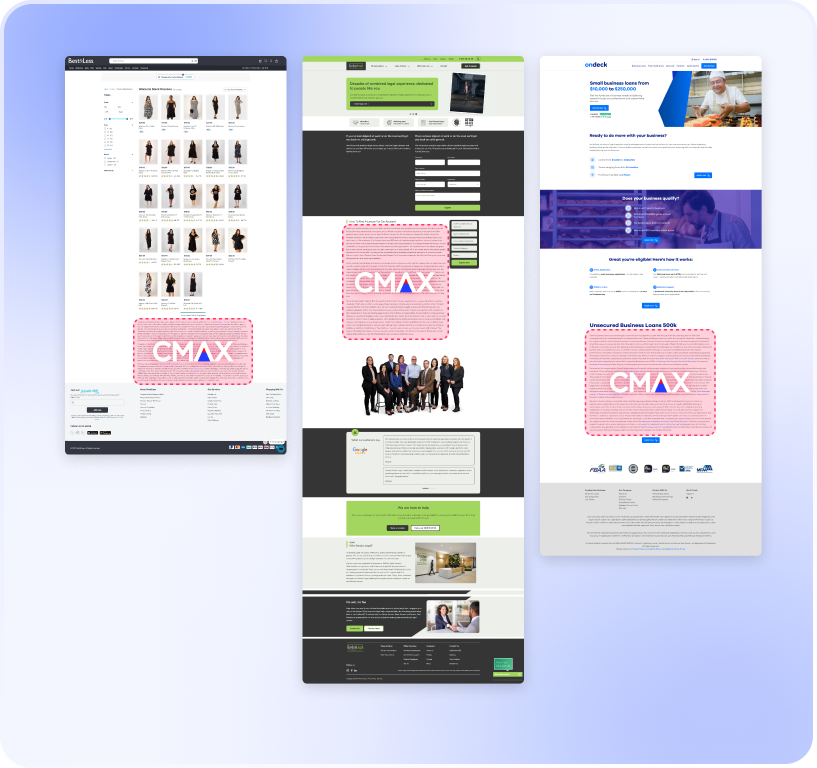
We built CMAX around that idea. Our AI-assisted content and internal linking keep pages useful as search behaviour moves.
SEO Content Optimisation Improves Intent Match, Coverage, Freshness and Internal Links
Match Long-Tail Intent
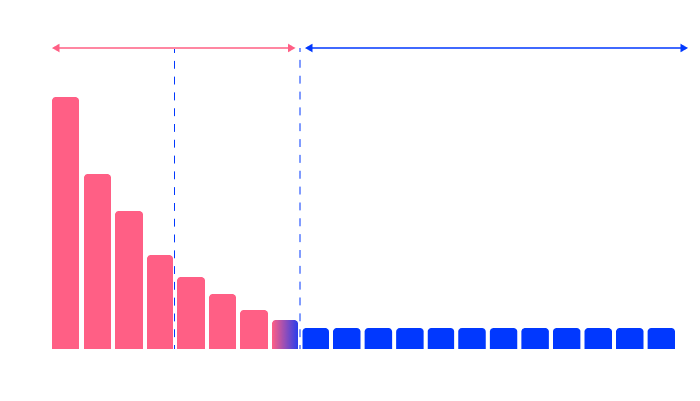
SEO content optimisation matches pages to detailed searches such as “best modular sofa for small apartment” and ties each answer to a commercial priority. Over 90% of search and AI demand is in the long tail.
Picture a city bus network with one route into the town centre. Your customers live in hundreds of suburbs, and a competitor runs a route to each one.
Riders take the bus that goes where they live. In this context, SEO content optimisation means adding a route for every suburb your customers live in, then keeping the timetable current.
Keyword research tools list those suburbs. A content strategy for digital marketing decides which ones to build first, and it should map the missing answers across product, location and buyer-question searches before production begins.
A content marketing plan template can hold that map, but only if it names the actual questions.
Close Coverage Gaps
Google can only rank pages that exist in its index. An on page SEO analysis can show that coverage stops at “accounting software” while franchise and multi-entity reporting questions go unanswered.
A site with nothing on “accounting software for franchise groups” or “Xero alternative for multi-entity reporting” hands that demand to competitors with more content surface area. Google’s own guidance backs fuller topic coverage over thin keyword targeting.
Any working definition of SEO has to account for the useful answers missing across the many ways customers search.
Better Search Results Usually Come From Depth, Connected Pages and Ongoing Updates
Depth Beats Keyword Placement
Keyword placement helps Google recognise the topic. A shallow page still won’t hold a buyer who has questions about price, comparisons, delivery or risk.
A stronger SEO content optimisation process checks whether the page answers those next questions. It then links the page to nearby pages on related subtopics, because internal links show Google how the topic fits together.
Google judges a page partly by the pages connected to it, so SEO search engine optimisation is a job for the page and the site structure together. Among SEO copywriting best practices, linking a detailed page to nearby subtopics helps Google place the answer within the wider subject.
SEO copywriting examples that perform tend to answer price, delivery and comparison questions on the same page.
Freshness Keeps Pace With Demand
A repeatable on page SEO process keeps content current. Product ranges change, competitors launch new offers and customer questions move with the market.
AI tools add to this: a single question can trigger several detailed Google searches, and each one is a retrieval path your stale page may lose. Stale pages don’t announce themselves.
They just stop getting visitors.
Ongoing updates keep a page matched to current intent instead of to its publish date.
CMAX Uses Agentic Optimisation to Keep Content Useful at Scale
Connected Updates at Scale
CMAX is the Agentic SEO Platform. It goes beyond one-off copy updates by grounding its output in your approved brand assets, products, proof points, compliance rules and commercial priorities.
CMAX is trained on human-reviewed, client-approved content.
We apply SEO page optimisation across the long tail, deploying and updating pages for the specific ways customers search. Dynamic Internal Linking and Full Body SEO then keep those pages connected, so new and refreshed content supports the wider topic and doesn’t sit as an isolated URL.
This extends on page SEO optimisation across long-tail content without leaving refreshed pages cut off from adjacent topics.
Faster Early Click Visibility
Most SEO programmes run by conventional agencies, using outdated methods, tell clients to expect results in six months. CMAX’s methods allow clients to start seeing clicks in 6 to 8 weeks.
For SEO optimisation for website coverage, we use Search Console data to check whether clicks are broadening beyond brand and category terms. Search Console is Google’s free tool that shows which searches your site appears for.
The platform applies AI SEO optimisation to expand long-tail coverage, refresh pages when demand shifts and strengthen internal links continuously.
Frequently Asked Questions (FAQ)
Should related keywords target one page or separate pages?
SEO already includes “search engine,” so SEO engine optimisation is redundant wording. It can share a page with clearer variants when the underlying intent and decision are the same.
SEO content optimisation and “content optimisation for SEO” can usually share one strong page if the buyer wants the same explanation and solution. Split into separate pages when the searcher expects a different outcome: “what is SEO content optimisation,” “SEO content optimisation software,” and “SEO internal linking platform” each signal a different need.
A practical test is whether one page can answer all the searches without becoming muddy. If it must serve a beginner, a budget holder and a vendor-comparison buyer at once, separate pages connected with clear internal links will perform better.
Can AI-generated content rank on Google?
It can, if it’s useful, original and created for people first. Google states that appropriate use of AI is not against its guidelines, and that AI gives content no ranking boost by itself.
Using automation mainly to manipulate search results does violate Google’s spam policies. Raw AI text that repeats generic advice or ignores a brand’s actual offer is weak content.
AI-assisted content that’s checked, grounded in approved information and updated against real search behaviour can support both search and AI visibility, which is what good AI SEO work should deliver.
Does duplicate content hurt SEO?
Duplicate content typically creates an indexing problem before it creates a penalty. Search engines often pick one version and ignore the others.
That dilutes signals across similar URLs and makes it harder to control which page earns visibility. The bigger risk is publishing near-identical pages that swap only a city, product name or industry label without adding distinct value.
Practical on page SEO steps include consolidating similar URLs and adding specific proof, use cases, comparisons, FAQs and internal links to every page you keep.
SEO Content Optimisation Needs Fresh Connected Pages
SEO content optimisation works better when it goes beyond keyword placement and fixes the real issue: missing coverage for the specific searches buyers use. CMAX supports a B2B content marketing strategy by expanding useful long-tail content, keeping it current and strengthening the links between related commercial topics.
If you’re weighing a content marketing strategy agency, ask how it keeps published pages current.
You can’t rank for searches you don’t talk about, and stale pages lose ground as demand shifts. When breadth, freshness and internal linking come together through SEO search optimisation, a site can broaden its click visibility sooner than under the old model of publishing a few pages and waiting months.
The quickest way to see which searches your site is missing is to have someone map them for you. It’s a diagnosis, and you can decide what to do with it afterwards.
If you’re curious as to how you’re performing on AI, book in a Missing Customer Map review with our Growth Team.
Author
Jeremy Tang
Founder and CEO of CMAX
Jeremy Tang is the Founder and CEO of CMAX. With over 2 decades of experience in business consulting and digital marketing, he has successfully driven seven startup businesses, six of which achieved $1 million in revenue from zero in less than 16 months, 5 of which grew to multi-million dollar a year ventures without any external funding. Jeremy's expertise lies in streamlining business processes through technology and leveraging digital (in particular SEO) for business growth. He resides in Australia, travels extensively, and draws inspiration from his global experiences.