SEO for law firms has two jobs. It brings in enquiries, and it stays inside advertising and conduct rules that most industries never face.
Good SEO for lawyers does both at once.
Responsible law firm internet marketing avoids unsupported labels such as “best lawyer”, even when the page performs well. Every firm says it’s the best.
The rules say none of them may.
Most legal marketing advice treats SEO for law firms as a generic brief for SEO services for my website. That leaves firms to work out the compliance questions after the strategy is set, when those questions should shape it from the start.
The better approach starts with how clients search: by practice area, location and case situation. It then builds visibility without touching language that could breach rules like ABA Model Rule 7.1.
Scale is where this gets hard, so picture brakes that fail one time in twenty. That figure is illustrative, not a measured rate for any tool.
In a car park at walking pace, a failure gives you a fright. At Formula 1 speed, you don’t get a second go.
In this context, legal SEO at scale means checking the brakes before the speed goes up: every page built from approved language, so one small error can’t repeat across hundreds of pages.
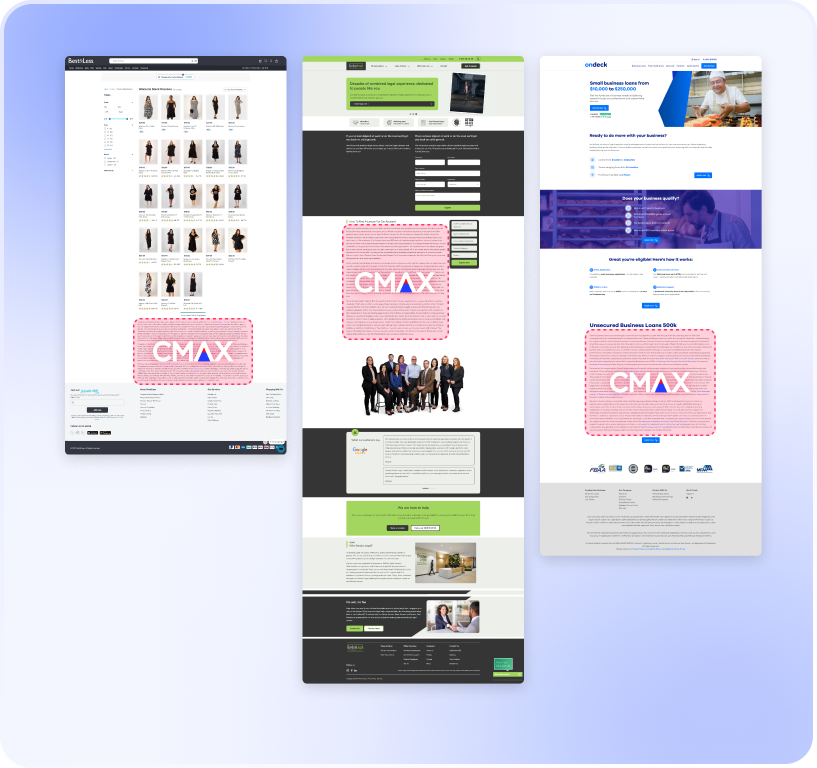
CMAX works with firms on this kind of compliance-ready content. We scope it around approved language and practice-area detail instead of generic templates.
It connects legal search visibility to qualified enquiries
Practice, place and case intent
SEO for law firms maps pages to practice area, location, urgency, cost and case situation. A search for divorce lawyer Leeds, one for no win no fee employment solicitor and one for what evidence do I need after a rear-end collision each signal a different intent.
Each needs a different page or answer. Search Console is Google’s free tool that shows which searches your site appears for.
It lets a firm see which queries and pages already earn impressions and clicks, so priorities follow live demand and not agency guesswork.
Compliant growth over risky claims
For a regulated practice, marketing SEO services have to build visibility without creating advertising or professional-conduct risk. Precise jurisdictions and verified office details make local SEO for law firms more defensible than inflated comparisons or outcome promises.
Pages should avoid outcome promises, inflated comparisons and unsubstantiated claims like best lawyer. ABA Model Rule 7.1 prohibits false or misleading communications about a lawyer or their services.
Strong legal SEO therefore relies on precise service descriptions, clear eligibility language, named jurisdictions, evidence of experience where permitted, and careful calls to action.
It builds more coverage across the searches firms miss
Long-tail content surface area
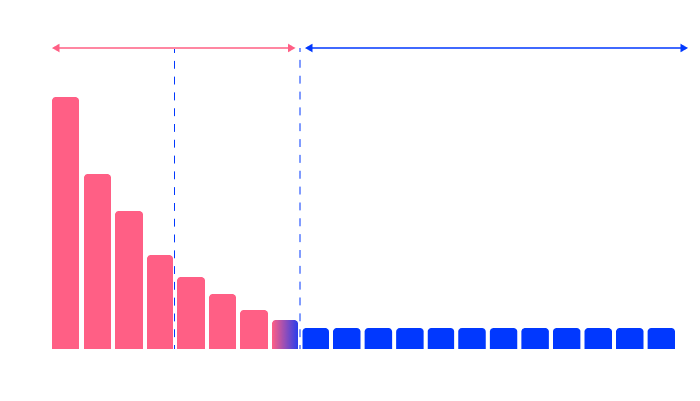
Content marketing for law firms has one big opening. Over 90% of search and AI demand is in the long tail.
A single page targeting “family lawyer” or “personal injury solicitor” won’t capture it. Useful law firm content marketing turns that demand into focused answers about children, property, time limits, settlement, fees, court process, evidence, locations and matter urgency.
Going beyond broad service pages lets smaller and mid-sized firms compete without paying for a handful of expensive head terms. Legal content marketing at this level is a matter of coverage, so a law firm website builder can produce the pages, but someone still has to decide which searches deserve one.
Regional demand differs. Work like SEO services Perth may emphasise Australian terminology and regulation, while comparable work in London or Toronto must account for different language, jurisdictions and local search patterns.
Law firm marketing and business development teams should plan coverage jurisdiction by jurisdiction.
Connected visibility across search
A legal SEO programme should connect practice pages, location pages, FAQs, case-type explainers and timely updates. That lets Google read the firm’s depth in a practice area.
Connected pages about collision evidence, time limits and locations help SEO for personal injury law firms establish clear topical context. Google doesn’t judge each URL in isolation, because related pages sharpen context.
Search Console’s Performance report breaks visibility down by query and page. It shows whether new employment law content is pulling in searches on redundancy, unfair dismissal, settlement agreements and individual cities.
It helps firms choose an approach that can scale
Measure the signals that matter
Qualified enquiries are the commercial outcome. The earliest useful signals are indexing, impressions on important pages, click growth on relevant long-tail queries, and crawl frequency, which is how often Google’s software comes back to read a site.
Crawl Stats supports measurement for SEO for law firm websites. It shows total crawl requests, host status and crawl activity over time, so firms can check whether priority legal pages are being found and revisited.
Rising branded searches only show existing awareness. SEO for law firms shows new matter demand through relevant long-tail impressions, clicks and qualified enquiries.
As AI-assisted discovery expands, analysis for gemini SEO should stay grounded in indexing, relevant impressions, qualified clicks and enquiries, not unsupported visibility scores.
How CMAX scales legal SEO
CMAX is the Agentic SEO Platform for firms that need more coverage without losing control of regulated copy. An SEO company for law firms might have the capacity to scale, but would the result be brand compliant?
We scale content from human-reviewed, client approved copy. New pages reflect approved language, practice-area nuance and local compliance boundaries.
A law firm marketing budget is easier to defend when each page traces back to wording the firm has already signed off.
Frequently Asked Questions (FAQ)
How long does SEO take to work for a law firm?
There’s no universal timeline. A newer firm in a competitive city starts from a lower base than an established practice with clean analytics and strong practice pages.
Law firm marketing Australia faces the same pressure to work from local realities. The first signals worth watching are indexing, impressions on non-branded queries, and clicks from long-tail searches like contested probate solicitor near me or how long after redundancy can I claim unfair dismissal.
Most SEO programmes run by conventional agencies, using outdated methods, make clients expect results in six months. CMAX’s methods allow clients to start seeing clicks in 6 to 8 weeks.
Even where SEO agents automate parts of implementation, timelines depend on the site’s starting position, technical accessibility, competitive market and breadth of approved content. Effective SEO for law firms shows up first in indexing, non-branded impressions and clicks from detailed searches such as contested probate questions.
How important are reviews for a law firm’s online presence?
Reviews help prospective clients judge trust before they call, particularly when they can’t assess legal quality in advance. A law firm digital marketing agency may track volume, recency, rating distribution and response quality.
A specific review mentioning communication or clarity carries more commercial weight than a vague five-star rating. Reviews support local visibility, but they don’t replace well-structured service pages, location pages and clear practice-area answers.
Law firm social media marketing supports the brand, but it doesn’t answer a search about a time limit.
Can a virtual law office have a Google Business Profile?
Only if it meets Google’s eligibility rules. Google requires in-person client contact during stated hours and lists online-only businesses as ineligible.
A virtual address alone doesn’t qualify. Check whether the firm has a staffed office or qualifies as a service-area business, then align the profile with Google’s guidance before publishing.
Once eligibility is confirmed, content freshness SEO can keep linked location and practice information current as office details, service boundaries and regulatory guidance change. Accurate office eligibility, service boundaries and practice information give SEO for law firms a compliant base for local visibility.
SEO for Law Firms Starts With Search Coverage
SEO for law firms works when firms publish useful answers to the practice, place and case-intent searches prospective clients actually use. CMAX supports legal content marketing with approved language, precise scope and coverage across those searches, so compliant growth is built into the work from the first page.
We aren’t only an SEO content writing agency. CMAX is the Agentic SEO Platform built to expand, connect and update approved content across existing and new pages.
It helps firms widen their long-tail legal coverage and keep approved content fresh and connected. Visibility can then grow in Google and AI-assisted search without losing control of regulated copy.
The quickest way to see which of your practice-area searches have no page yet is to look at the gaps directly.
If you’re curious as to how you’re performing on AI, book in a Missing Customer Map review with our Growth Team.
Author
Jeremy Tang
Founder and CEO of CMAX
Jeremy Tang is the Founder and CEO of CMAX. With over 2 decades of experience in business consulting and digital marketing, he has successfully driven seven startup businesses, six of which achieved $1 million in revenue from zero in less than 16 months, 5 of which grew to multi-million dollar a year ventures without any external funding. Jeremy's expertise lies in streamlining business processes through technology and leveraging digital (in particular SEO) for business growth. He resides in Australia, travels extensively, and draws inspiration from his global experiences.