Once a catalogueue grows from a few hundred products to thousands of SKUs, ecommerce SEO has to account for far more categories, variants, and use cases. A handful of category and product pages can rank fine at small scale.
At large scale, gaps appear quietly: unanswered long-tail searches, filter pages competing against each other for the same term, buyer questions that never get a page built to answer them.
The stall is rarely a content quality problem. It is a coverage problem.
A scalable ecommerce SEO strategy addresses the gap when too many buyer questions depend on too few page types.
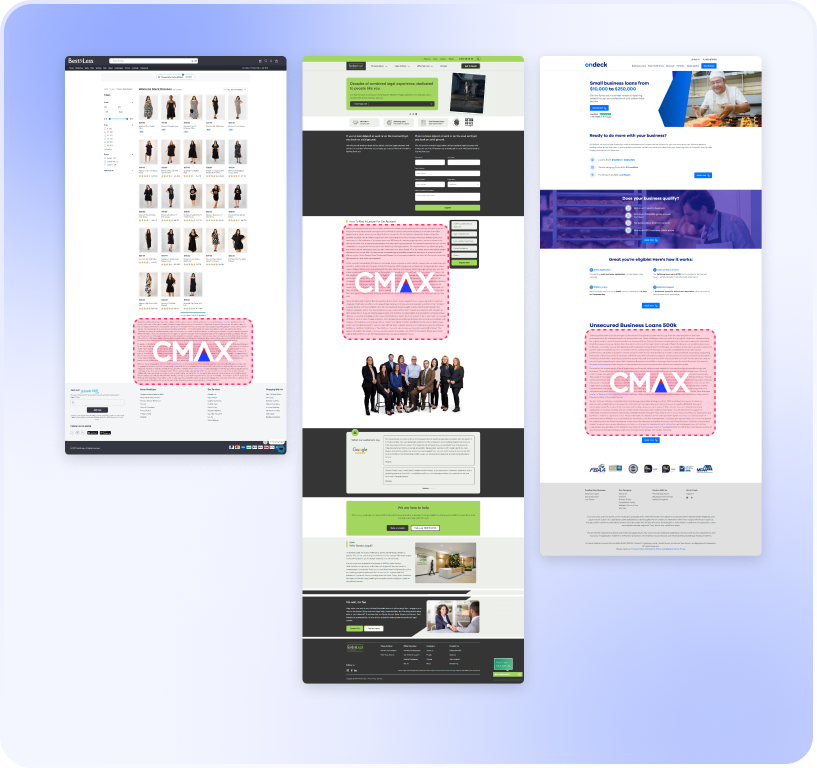
CMAX works with ecommerce retailers at exactly this scale, focusing on which page types should carry which search intent and how to expand coverage without a CMS migration. Through ecommerce SEO services, CMAX maps category, product, comparison and help queries, then expands long-tail coverage across the full catalogueue.
An experienced ecommerce SEO consultant can identify which page types are carrying the wrong intent before the gap becomes a traffic problem.
Large catalogueues usually stall because coverage is too narrow.
Search intent gaps block visibility.
Different buyer questions need different page types. Category pages should target browse-and-compare searches.
Product pages should answer exact-item searches. Comparison pages settle shortlist decisions.
Help content captures “how do I choose” searches that happen before a buyer is ready to click anything.
Ask one page type to do every job and it does none of them well. A category page trying to rank for specification-led questions produces weak relevance and scattered visibility.
When big stores rely on ecommerce SEO services, the first step is assigning the right intent to the right page.
Long-tail demand stays uncovered.
Big stores often win the obvious head terms, then miss the thousands of attribute, compatibility, size, material, use-case and model searches that buyers type when they are close to purchasing. Effective ecommerce keyword research extends well beyond those head terms.
Think of it like a market stall with a sign that only says “furniture.” Shoppers looking for a queen-size timber bed frame in warm oak walk straight past because nothing on the sign tells them you have it.
Google has confirmed that 15 percent of the searches it sees every day are brand new, so a fixed keyword list will always miss part of the demand curve. A site that only answers the terms everyone already knows leaves most discovery opportunities untouched.
The right page type should match the search intent behind each query.
Match page type to intent.
Strong on page SEO for ecommerce gives category, product, comparison and help pages distinct roles based on the intent each must satisfy. A buyer asking which mattress firmness suits side sleeping needs a different page from someone searching a specific model number.
The page type has to reflect that difference to rank.
Control duplication and thin coverage.
Across hundreds of filter combinations, SEO for ecommerce keeps valuable variants indexable while excluding duplicate URLs that waste crawl budget. Shopify flags this directly: faceted navigation dilutes internal linking signals when too many filter states are open to search.
Effective SEO services for ecommerce website growth identifies commercially useful filter pages, adds enough copy to explain each variant, and keeps low-value combinations out of search results. A SEO friendly ecommerce website indexes commercially useful filter pages while excluding thin combinations that duplicate stronger category content.
Scale depends on keeping content fresh, connected, and easy to expand.
Link related pages with context.
Internal links move customers from category to product to guide. Sound technical SEO for ecommerce helps search engines interpret which pages belong together and which carry the most weight.
A page with no obvious neighbours is easier for both search engines and buyers to overlook. On a large catalogueue, a connected architecture does more for visibility than simply publishing more pages.
Scale freshness and long-tail coverage.
Stock status changes. Product specs update.
Seasonal demand shifts. The exact wording shoppers use evolves.
SEO for ecommerce has to respond to all of it, continuously.
CMAX is the Agentic SEO Platform, built around long-tail coverage, self-updating content, and Dynamic Internal Linking. Ecommerce teams can keep expanding their content surface area without manually revisiting every page as the catalogueue, search demand, or customer language changes.
Frequently Asked Questions (FAQ)
Should out-of-stock product pages stay live for SEO?
Usually, yes. If a product is temporarily unavailable and the page still attracts demand or earns links, removing it discards that equity.
In ecommerce SEO marketing, temporarily unavailable products are marked as out of stock rather than deleted. For seasonal ranges or fast-moving inventory, keep the page live, state the status clearly, and point buyers to a close substitute or a back-in-stock notification.
This is why SEO is important for ecommerce when stock may return after a seasonal gap: the page keeps working while the shelf is empty.
How should ecommerce sites manage SEO for product filters?
Treat filters as an indexation decision. Shopify warns that faceted navigation can generate duplicate URLs and waste crawl budget when every filter combination is indexable.
Only filtered states with genuine search demand, such as a high-value colour or size pairing, should be indexed and promoted internally. If a filter page does not help a shopper compare or decide, it does not need search visibility.
Disciplined category page SEO promotes only filter states with genuine demand. A SEO friendly ecommerce website indexes commercially useful filter pages while excluding thin combinations that duplicate stronger category content.
What product details can schema show in Google results?
Google says product structured data can surface price, availability, review ratings, and shipping information directly in search results. For merchant listings, Google also supports apparel sizing, shipping details, and return policy fields, which reduce buyer uncertainty before the click.
A practical approach to SEO for ecommerce websites uses structured data for ecommerce to surface the details buyers already ask about, rather than populating every available field. Careful product page optimisation supports exact-item demand with current specifications, availability, and links to close substitutes when inventory changes.
SEO For Ecommerce Starts With Full Catalogueue Coverage
SEO for ecommerce stalls on large catalogueues when too much demand is forced onto too few page types. Category, product, comparison and help content each do a different job.
Strong ecommerce category page SEO supports browse-and-compare demand while product, comparison, and help content address different questions across the buying process.
CMAX is built around that coverage gap. Its agentic approach expands useful content across the long tail, keeps it updating as products and search demand change, and links related pages so Google has more context about what the catalogueue actually answers.
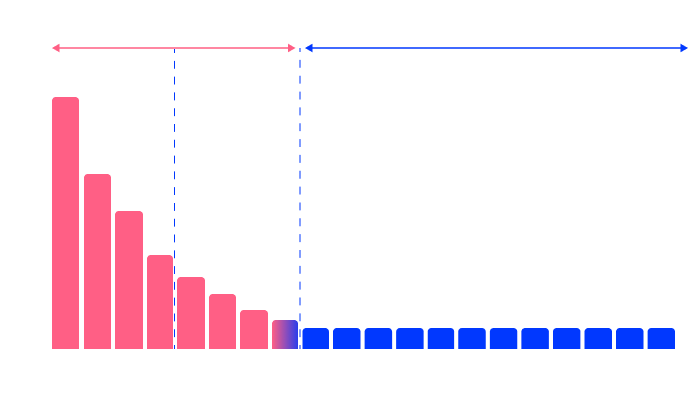
Over 90% of search and AI demand is in the long tail, and that is where most catalogueues are underweight.
Large-store growth is usually a scale problem. Although ecommerce link building remains a separate off-site lever, CMAX builds authority through useful long-tail coverage and increased crawl frequency.
If buyers search in thousands of specific ways, your store needs useful answers at that same level of detail.
The straightforward way to find out where your catalogueue has gaps is to see what searches you are currently missing. If you’re curious as to how you’re performing on AI, book in a Missing Customer Map review with our Growth Team.
Author
Jeremy Tang
Founder and CEO of CMAX
Jeremy Tang is the Founder and CEO of CMAX. With over 2 decades of experience in business consulting and digital marketing, he has successfully driven seven startup businesses, six of which achieved $1 million in revenue from zero in less than 16 months, 5 of which grew to multi-million dollar a year ventures without any external funding. Jeremy's expertise lies in streamlining business processes through technology and leveraging digital (in particular SEO) for business growth. He resides in Australia, travels extensively, and draws inspiration from his global experiences.