A basic grasp of SEO and how it works shows that topical mapping is about how category coverage is structured, not how many pages exist.
Most category pages are built around a handful of broad search terms. Semantic SEO connects those to the detailed questions buyers type before they click, the comparisons, the “what is the difference between” searches, the specific product questions.
The options for doing this range from a loose keyword list to a connected set of pages tied to one core category and built outward by search intent. A solid SEO content strategy organises definitions, comparisons, use cases and questions around that core category so each page earns its place.
Some approaches leave gaps that competitors fill. Others keep pages focused and connected, so each one supports the others through internal linking.
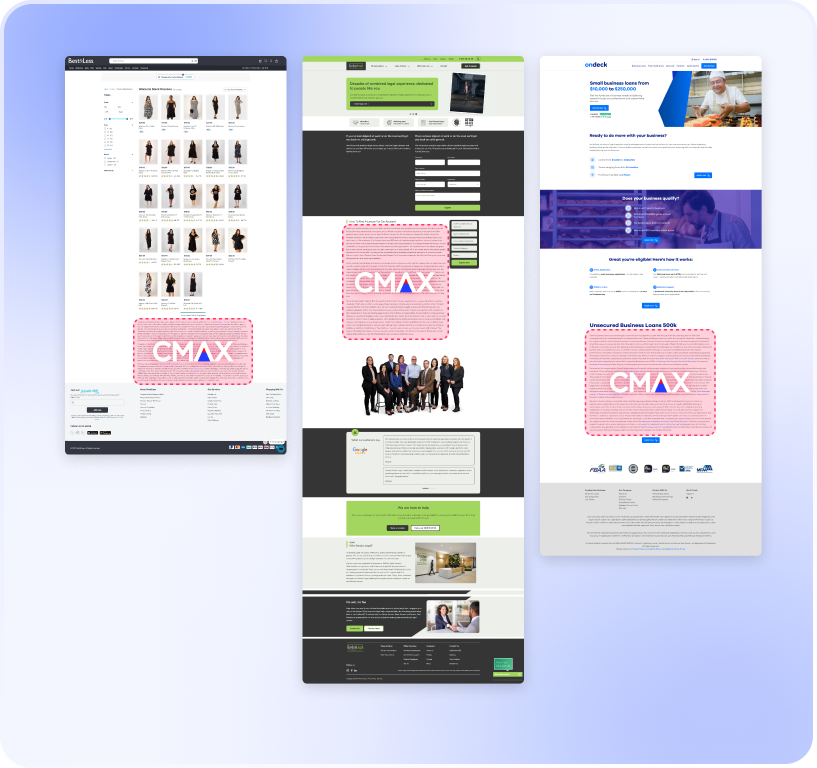
CMAX works from this category-first model, turning a topical map into connected pages built to capture the long-tail searches sitting around your core categories. Long-tail means the specific, detailed searches people type, as opposed to the short broad ones.
Topical map SEO gives category pages broader coverage, not just more pages
Topical map SEO connects a core category page with subcategory, comparison and question-led pages before production begins. By giving every term a page type, a search intent and a position in the site structure, topical authority grows from structure rather than from an article quota.
For regulated industries, a well-planned SEO for medical practices approach uses connected question coverage to build trust while keeping claims under control. Semantic SEO helps the page set cover the detail buyers need before they click.
Think of a topical map like a city street directory. Every suburb has a grid reference, every street sits inside a suburb, and someone looking for a specific address can trace a logical path from the index to the door.
A list of keywords is just a list of addresses with no map around them. Supporting pages create more entry points for specific searches while reinforcing the main commercial page they sit behind, the same way a street directory lets you find any address because every street knows where it belongs.
In this context, pillar page SEO means connecting those supporting articles to the main commercial page so Google can read each relationship clearly.
A useful topical map starts with the category, then builds outward
Topical map SEO starts with the commercial category page and expands through definitions, comparisons, use cases and questions. That keeps the structure tied to how customers actually search, not to a cluster diagram that looks tidy but does little for category growth.
Start with the core category
A practical build starts with one core category page. A content cluster becomes actionable when that page branches into definitions, comparisons, use cases and common questions.
That makes it easier to decide which queries belong on the category page and which need their own URL, so each page has one job.
Avoid thin or overlapping pages
Thin pages and overlapping intent weaken a map. Several URLs can end up competing for the same query while none goes deep enough to satisfy it.
A useful SEO strategy example gives every URL a single purpose: ranking for a comparison term, supporting a collection page, or answering a pre-purchase question with enough detail to be genuinely useful. Having two pages fight over the same query is like having two salespeople pitch the same customer with different stories.
The customer leaves.
Turn planning into connected production
CMAX defines topical map SEO as a category-led plan converted into connected, on-brand pages with Dynamic Internal Linking. Dynamic Internal Linking means the platform automatically connects new pages to existing ones as they are published, so Google discovers them and reads their context without manual work.
A map without that connection is a floor plan with no doors.
The right approach ties content planning to long-tail growth and freshness
A topical map is most useful when it works as an ongoing content system. The real value comes from using signals such as people also ask SEO to expand content surface area, which means how many of the ways customers search you have a useful answer for, then keeping that coverage current as search behaviour changes.
Build for long-tail demand
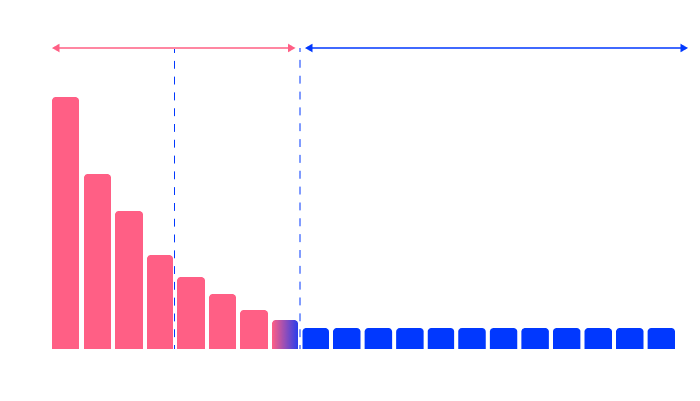
Over 90% of search and AI demand is in the long tail. Ahrefs reports that 94.74% of keywords get 10 monthly searches or fewer.
A pillar page is a core category URL supported by detailed pages on those lower-volume topics. That structure suits category and collection pages that need to capture many specific queries, not just the obvious head terms.
Here is where manual content production hits its ceiling. You can keep hiring writers and publishing pages.
The volume grows in a straight line. But covering the long tail properly, thousands of specific queries across a category, requires a different kind of system.
A content team is fast. An automated content system changes how much coverage is possible.
More writers doing it the old way gets you more of the same. A different architecture gets you somewhere the old method cannot reach.
In this context, an SEO content plan means designing that architecture first, then filling it at a scale no manual team can match.
Leave room for updates
Categories do not stand still. New query patterns keep appearing as products, language and search behaviour shift.
A practical SEO content writing guide treats content freshness as part of ongoing performance, not a one-time task. A scalable SEO platform needs room for refreshes, new supporting pages and internal link updates as the category evolves.
Close gaps with an operational model
CMAX targets the vast majority of search demand sitting in the long tail with Full Body SEO, a working model built for search and AI visibility. Within CMAX’s operational model, topical map SEO becomes the working coverage plan for Full Body SEO and ongoing updates.
CMAX is trained on human-reviewed, client-approved content, so the pages that fill those gaps are on-brand and accurate.
Frequently Asked Questions (FAQ)
How many articles do I need to build topical authority?
There is no fixed number. What is topical authority?
It is covering the important subtopics, comparisons and questions around a category well enough that Google reads your site as a reliable source on that topic. The right count is whatever supports your core category and collection pages without producing thin or repetitive URLs that add noise instead of coverage.
How long does it take to see results from topical mapping?
For topical mapping, topical authority SEO is a medium-term content strategy. Timelines depend on the site, its competition and how the work is done.
Most SEO programmes run by conventional agencies, using outdated methods, tell clients to expect results in six months. CMAX’s methods allow clients to start seeing clicks in 6 to 8 weeks.
Can I have multiple topical maps for one website?
Yes. Each distinct category, audience or product area can carry its own map.
Clear boundaries and internal links make topical map SEO a practical way to support multiple categories without overlapping intent. This is also how SEO for mortgage brokers works in practice: separate maps for different loan types, audiences and questions, each supporting one commercial page.
Topical Map SEO Starts With The Category Page
Topical map SEO works best when it starts with the page that matters commercially, then expands into the subtopics, comparisons and questions around it. That is how a plan becomes broader coverage, clearer internal linking and more ways to be found across the specific searches buyers actually type.
CMAX is the Agentic SEO Platform built around that same model. Commercial teams often lose ground because important category coverage is missing.
A clear SEO content marketing strategy turns those gaps into connected, continuously updated long-tail coverage. For commercial teams, CMAX connects SEO for lead generation with expanding long-tail coverage, continuously updated content and reporting tied to sales.
Components of SEO that used to require a large team, including content production, internal linking and freshness updates, run inside the platform.
The simplest next step is to find out exactly where your category coverage has gaps. Book in a Missing Customer Map review with our Growth Team to see what you are currently missing across search and AI.
If you’re curious as to how you’re performing on AI, book in a Missing Customer Map review with our Growth Team.
Author
Jeremy Tang
Founder and CEO of CMAX
Jeremy Tang is the Founder and CEO of CMAX. With over 2 decades of experience in business consulting and digital marketing, he has successfully driven seven startup businesses, six of which achieved $1 million in revenue from zero in less than 16 months, 5 of which grew to multi-million dollar a year ventures without any external funding. Jeremy's expertise lies in streamlining business processes through technology and leveraging digital (in particular SEO) for business growth. He resides in Australia, travels extensively, and draws inspiration from his global experiences.