Effective website search optimisation covers content, site structure and internal links, so more of your pages appear for the queries buyers use. Most sites win on a handful of broad terms.
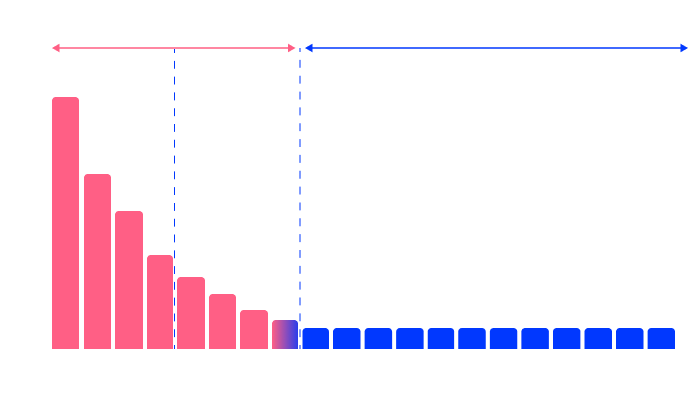
Even brands that rank first rarely capture more than 5% of the real search demand in their category. Nike shows how far that goes: its first-place ranking for running shoes captures under 1% of 8.5 million monthly US searches.
That is why website search engine optimisation has to reach past head terms.
The gap is rarely one missing ranking. It is thousands of specific, long-tail questions your site has no page to answer, plus the pages you do have that nobody revisits or connects.
Website search engine optimisation is a coverage problem. Picture a mechanic whose only sign says “Car Repairs”.
Most drivers arrive with something specific, like a rattle in a 2014 Corolla on cold mornings or a brake squeal in the wet. The mechanic with an answer on the wall for each fault gets the call, and the sign gets a glance.
In this context, long-tail coverage means giving each specific fault its own answer, so the driver with the squeal finds your workshop and not a sign that just says car repairs.
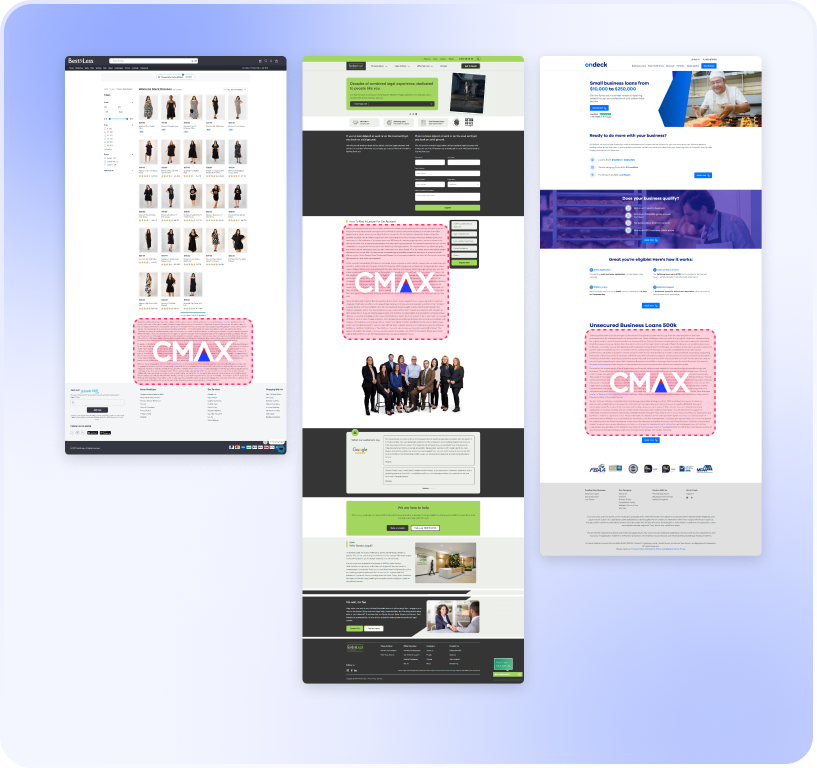
CMAX works inside your existing site to close that gap. It adds long-tail content and keeps it connected and current, with no rebuild.
Website search optimisation helps your site show up for more of the searches that matter
In practical terms, website search optimisation means improving your site so it appears more often, and more relevantly, in Google for the searches buyers use. If you’re asking what is search optimisation, that is the answer in one line.
Optimising search engines is a loose phrase, because you can’t optimise Google. You optimise your site for it.
The work covers content, internal linking, indexing and page relevance. Google crawls pages, adds the ones it keeps to its index (its list of known pages), and serves results based on relevance and quality.
Improve visibility through site signals
Stronger visibility starts with making your site easy for Google and buyers to interpret. Google finds new pages through links from pages it already knows.
Internal linking therefore decides which pages Google finds and how it reads their connections. When you assess search engine optimisation companies, ask whether they can connect a category page, a product guide, a comparison page and a support article.
That is a useful test of how well each one handles internal relevance. Google can also show different local results in Brisbane than for website optimisation Perth.
SEO is more than keywords
Keyword targeting only works if the page can be crawled, indexed and judged relevant enough to serve. A four-question audit makes on page optimisation concrete.
Can Google access the page? Can it index it?
Does the page answer a distinct intent? Do related pages link to it?
A SEO diy guide and a handful of web optimisation tools can run that audit, but someone has to ACT on what it finds. Google doesn’t promise to crawl or index every page.
It cites low-quality content, blocked access and indexing controls as reasons pages may not appear in search.
The strongest programmes expand long-tail coverage and keep content fresh
Strong website search optimisation programmes grow content surface area. The web search optimisation question is simple: for how many of the ways customers search do you have a useful answer?
Across product types and use cases, the aim is a useful answer for each specific demand.
Long-tail coverage drives growth
Over 90% of search and AI demand is in the long tail. That means the specific, detailed searches buyers type, like “washable linen quilt cover for summer” or “contract management software for procurement teams.”
A useful SEO checklist starts there, then maps the missing pages and internal links.
Freshness supports ongoing performance
Content goes stale. If you need to define search engine optimisation for your CEO, include upkeep, because buyer language, stock, pricing and competitor questions keep changing.
A local SEO strategy needs refreshed pages on a crawl schedule, not one publication date. Google uses an algorithmic process to decide how often to crawl a site.
Update existing pages as well as publishing new ones.
CMAX adds scale and connected content
CMAX is trained on human-reviewed, client-approved content. Its Agentic SEO Platform supports Dynamic Internal Linking and Full Body SEO.
Unlike a one-off page refresh, website search optimisation through CMAX keeps long-tail content connected and current without migrating your CMS.
A revenue-focused approach measures whether visibility turns into qualified visitors and conversions
A useful website search engine optimisation definition doesn’t stop at impressions. The commercial test is whether broader coverage brings visitors who engage with your site, view relevant product or service pages and move towards an enquiry, a checkout or another measurable action.
That keeps SEO tied to revenue. A monthly report full of positions nobody acts on is an expensive screensaver.
Measure queries, clicks and engagement
Search Console, Google’s free tool showing which searches your site appears for, reports impressions, clicks and average position. It is the first place to check whether your work is reaching the right demand.
A B2B SEO strategy becomes measurable when you pair those queries with page-level visits, product engagement, enquiries and sales.
SEO and AI visibility work together
SEO, AEO and GEO draw on the same work: structured, current coverage. A practical definition of website search optimisation is coverage that supports both your position in Google and the smaller searches AI engines retrieve.
AI tools run several smaller Google searches and build responses from what ranks. In practice, generative search optimisation relies on useful, clearly structured coverage.
Focus on scale without migration
The right programme improves content surface area, internal links and freshness inside the operating model you already use. It adds and improves useful content, connects related pages and gets important pages revisited more often, with no full site rebuild.
CMAX scopes each website optimisation service through a 3-day review of Google Analytics and Search Console data. It then works across your existing CMS as an extension of your marketing team.
Frequently Asked Questions (FAQ)
How long does SEO take to show results?
Timelines depend on the site, its competition and how the work is done. Most SEO programmes run by conventional agencies, using outdated methods, tell clients to expect results in six months.
CMAX’s methods allow clients to start seeing clicks in 6 to 8 weeks. The same applies to an AI SEO strategy built on long-tail coverage.
Can publishing new pages hurt existing positions?
Publishing new pages doesn’t automatically hurt the positions your current pages hold. The risk is thin, overlapping or poorly linked pages.
Five near-identical pages aimed at one buyer question may lead Google to pick one canonical version instead of rewarding the group. New content should answer a distinct question and link clearly into your internal linking structure.
Add one item to your SEO strategy checklist: do these near-identical pages need distinct questions, consolidation or clearer internal links?
Can a website rank without backlinks?
Yes, for specific long-tail searches where the page closely matches the query and the site has strong internal relevance. Google still uses links to discover pages and read the connections between them.
Internal linking and crawlability matter even when link building isn’t the focus.
Website Search Optimisation, Wider Coverage Drives Revenue
Website search optimisation works best when it widens the set of useful searches your site can answer, instead of fixating on a few obvious terms. In commercial terms, search engine optimisation means expanding the useful searches a site can answer.
CMAX is built on that idea. Most missed organic growth sits in the long tail, where buyers search with specific product, use-case, comparison and problem-based queries.
The Agentic SEO Platform helps teams grow content surface area across existing and new pages, keep it fresh and connect related pages. An LLM SEO strategy benefits from Dynamic Internal Linking, which joins product, use-case, comparison and problem-based pages across your site.
That gives Google more current paths into your site. It also ties SEO to the commercial question: does broader visibility turn into qualified visitors and sales?
The quickest way to find out is to map where your site has no answer today. The review is diagnostic, and what you do with it is up to you.
If you’re curious as to how you’re performing on AI, book in a Missing Customer Map review with our Growth Team.
Author
Jeremy Tang
Founder and CEO of CMAX
Jeremy Tang is the Founder and CEO of CMAX. With over 2 decades of experience in business consulting and digital marketing, he has successfully driven seven startup businesses, six of which achieved $1 million in revenue from zero in less than 16 months, 5 of which grew to multi-million dollar a year ventures without any external funding. Jeremy's expertise lies in streamlining business processes through technology and leveraging digital (in particular SEO) for business growth. He resides in Australia, travels extensively, and draws inspiration from his global experiences.