SEO for ecommerce gets judged on one thing: does more of your catalogueue appear for the searches customers already type? Good ecommerce SEO matches broad searches like linen quilt covers with category pages, and detailed searches with product pages. That is what SEO services for ecommerce website should do.
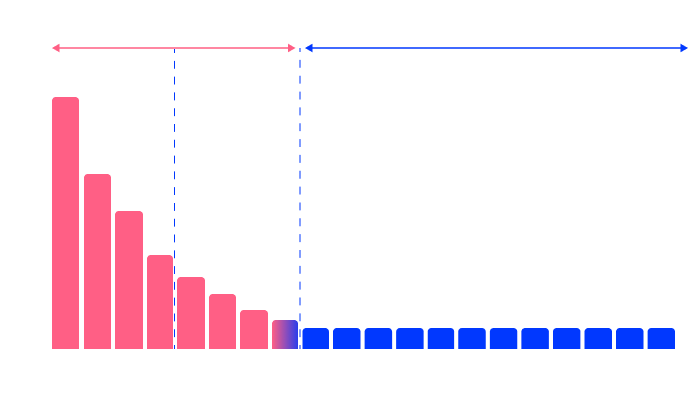
Most retailers think this means ranking for a handful of head terms. That is a small slice of the opportunity. Useful ecommerce SEO tips start with the detailed category and product searches. Over 90% of search and AI demand is in the long tail.
Even Nike, ranked first for running shoes in the US, captures under 1% of total search demand in that category. Imagine a bakery that only displays their white sandwich loaves. Customer simply pass by the window looking for olive focaccia, seeded rye and sourdough and assuming the bakery doesn’t offer them. They don’t see what’s behind the display.
In this context, the long tail means displaying the various loaves you have, and SEO services for ecommerce website means putting a page on your shelf for each one your catalogueue can back.
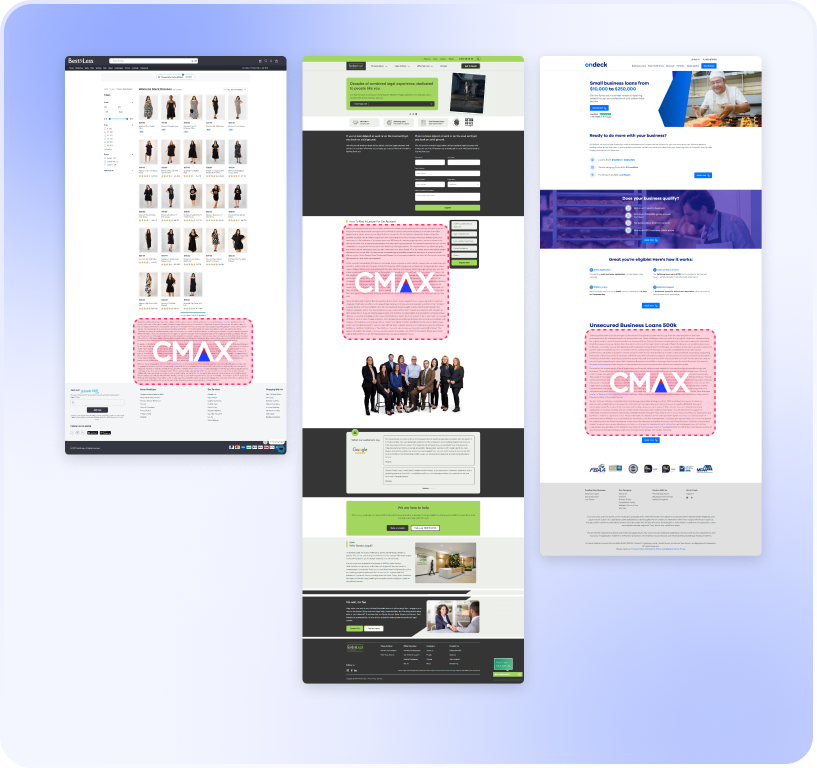
CMAX works on this problem. We build and refresh category and product coverage so more of that demand has somewhere to land. A practical ecommerce SEO guide links category coverage, product support and refreshed internal links, and ignores the pull of head terms.
This page is for ecommerce brands that need more category and product visibility at scale.
Category and product discovery
Effective SEO services for ecommerce website pair broad searches with category pages and detailed searches with product pages. Google recommends linking from menus to category pages, then down to sub-categories and products. Every important page should be reachable through normal navigation.
Why the long tail matters
Growth comes from widening your content surface area, meaning how many of those detailed searches your site can answer. CMAX targets the bulk of search demand that sits in the long tail. We scale SEO for ecommerce stores by adding useful answers across categories, sub-categories and detailed product questions.
The strongest ecommerce SEO work connects technical cleanup with revenue-linked coverage.
Categories first, products support
Category pages come first because they match broader buying intent. Product page SEO supports the detailed searches beneath them and gives shoppers a path into a range. A strong category page explains the range, shows sub-categories, answers buying questions and links clearly to products.
Google notes that without direct links from category pages to products, Googlebot may not find all products through crawling alone. A product Google can’t find is a very quiet product.
Crawl paths and catalogueue control
Large catalogueues need ecommerce SEO services that handle crawl paths, canonicals, internal links and faceted navigation. Faceted navigation is the set of filters shoppers use for colour, size, brand and price. Google infers page importance partly from internal link paths and link volume. So the service decides which filtered pages deserve to be indexable because they match real search demand, and which stay as shopper-only filters.
How CMAX keeps coverage moving
CMAX is the Agentic SEO Platform, and CMAX is trained on human-reviewed, client-approved content. That keeps output aligned with your brand, legal and regulatory requirements. We use Dynamic Internal Linking and Full Body SEO.
A scalable ecommerce SEO strategy connects category, sub-category, buying-guide and product-support content. We refresh content and internal links at least every six to eight weeks, based on performance.
The right service should fit your CMS, your compliance needs, and your reporting standards.
CMS fit and delivery pace
The service should slot into your existing CMS, merchandising calendar and approval process. It should not demand a rebuild first. An ecommerce SEO consultant works with your collection templates, product templates, buying guides and landing pages as they stand.
If you’re on Shopify, the same applies to shopify SEO: the work happens inside your current setup. The best shopify SEO apps cover on-page fields well, but they can’t decide which categories deserve a page. That call is strategy.
Most SEO programmes run by conventional agencies, using outdated methods, tell clients to expect results in six months. CMAX’s methods allow clients to start seeing clicks in 6 to 8 weeks. Timelines still depend on the site, its competition and how the work is done. We define SEO services for ecommerce website as strategy and implementation shaped by a three-day review of Google Analytics and Search Console.
Read search data with revenue signals
Search Console shows which searches your site appears for, with impressions, clicks and position. We ground an ecommerce website SEO strategy in that data, plus category revenue, assisted conversions, add-to-cart rate, average order value and margin. A visitor lift on a low-margin informational page carries far less weight than qualified demand landing on “oak dining tables.”
Close gaps, then keep pages fresh
Map your priority category and product pages against the searches visible in Search Console. Then find where demand exists but no strong page does: a missing sub-category, a thin collection page, a range with no buying guidance. Ecommerce keyword research does this job. If you want to know how to do SEO for ecommerce website work properly, start with keyword research for ecommerce site demand, matched to the pages you already have. Once the gaps are closed, freshness drives ecommerce SEO marketing, because content goes stale as your catalogueue and market shift.
Should I keep out-of-stock product pages on my site?
Usually yes. If a page has earned links, search positions, visitors or reviews, removing it discards those signals. A useful SEO product description keeps the distinctive specifications and buyer language on the page. State stock status clearly, offer back-in-stock alerts and link to the closest alternatives.
For discontinued products, keep the page with status messaging or redirect to a true replacement. Redirecting to the homepage gives shoppers a poor experience and sends Google a weaker relevance signal.
Do product reviews help SEO?
They can. Reviews add unique, refreshed content in the language real buyers use, which supports long-tail visibility. Among product page SEO best practices, keeping unique reviews and valid product schema is one of the most useful. Product schema is hidden code that tells Google details like price, availability and rating. With it in place, SEO for ecommerce websites can also use reviews to earn richer presentation in search results.
Will I lose search positions when I migrate my ecommerce site?
You can, if key signals change at once: URL paths, internal links, canonicals, templates, structured data or navigation depth. The danger drops sharply with page-by-page redirects and post-launch monitoring of Search Console, crawl behaviour, search positions and revenue. Put SEO services for ecommerce website into the migration plan before launch.
SEO Services For Ecommerce Website Start With Categories
SEO services for ecommerce website work best when category pages do the heavy lifting first. They match broader commercial searches, give Google clear crawl paths into the catalogueue and create a stronger route to product pages.
That is how we approach search growth: as a coverage problem across the searches shoppers already use. Most demand sits in detailed searches across categories, sub-categories and product questions. Performance comes from expanding useful content, then keeping it fresh and connected as the catalogueue changes. CMAX provides shopify SEO services without requiring migration, using category-led coverage and ongoing updates informed by real performance data.
For ecommerce teams, that means tying technical decisions to revenue pages. At scale, ecommerce category page SEO depends on category-led coverage, internal linking and updates based on real performance data.
The quickest way to see where your catalogueue has gaps is to look at them on a map. The review shows which searches your pages miss today, and where AI engines send shoppers elsewhere.
If you’re curious as to how you’re performing on AI, book in a Missing Customer Map review with our Growth Team.
Author
Jeremy Tang
Founder and CEO of CMAX
Jeremy Tang is the Founder and CEO of CMAX. With over 2 decades of experience in business consulting and digital marketing, he has successfully driven seven startup businesses, six of which achieved $1 million in revenue from zero in less than 16 months, 5 of which grew to multi-million dollar a year ventures without any external funding. Jeremy's expertise lies in streamlining business processes through technology and leveraging digital (in particular SEO) for business growth. He resides in Australia, travels extensively, and draws inspiration from his global experiences.