A good AI SEO strategy still runs on the same fundamentals that have always driven organic visibility. Effective SEO strategies still depend on matching intent, answering the topic clearly, and using the words your customers actually search.
What changes is scale and speed. Search behaviour shifts constantly, so a strategy built around last quarter’s keywords will always be playing catch-up.
A responsive SEO content strategy accounts for new queries appearing every day.
For a brand in a regulated or reputation-sensitive category, that speed creates a real question: how do you cover more ground without losing control over accuracy and compliance?
Our AI powered SEO services ensure that the models we use are trained on human-reviewed, client-approved content. That provides us precise control even at high output volumes, allowing us to deliver at scale without compromising standards.
AI SEO strategy still starts with SEO fundamentals.
Search behaviour changes, SEO basics remain.
AI changes how buyers phrase questions, compare options, and stack related searches. Visibility still depends on matching intent, answering the topic clearly, and using the words customers actually type.
Good content for SEO reflects how buyers move through those questions, not how your category manager describes your products.
Google sees around 15% brand-new queries every single day. Think of your content as a menu: if a customer walks in asking for something that is not on it, you lose the table.
Answering the full topic, not just a handful of head terms that looked important last quarter, is what a practical what is SEO strategy answer looks like.
Human review protects accuracy and compliance.
For brand-sensitive categories, an AI SEO audit carries more weight when editors can check claims, wording, product details, and required disclosures before anything goes live.
Google’s people-first guidance favours content made to help users. A governed SEO and content marketing strategy balances that guidance with editorial checks on claims, wording, and disclosures.
The two objectives are not in conflict; the review step is what keeps them aligned.
Coverage, freshness, and internal links drive measurable visibility.
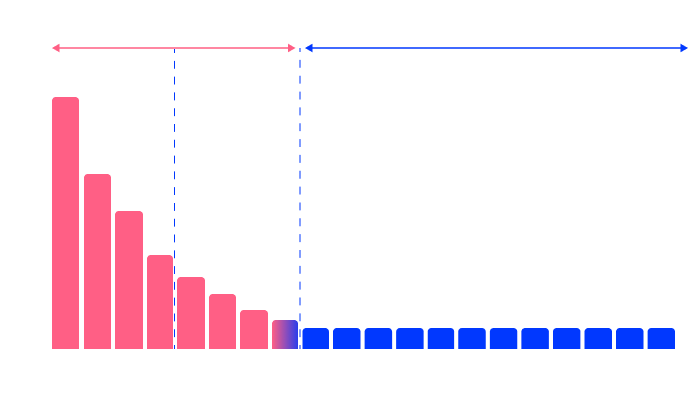
Long-tail coverage captures buyer demand.
Over 90% of search and AI demand is in the long tail, meaning the specific, detailed searches people type when they are close to a decision, as opposed to short general terms. Our approach to SEO for AI search starts by mapping those detailed comparisons, use-case searches, and problem-led queries.
New searches appear every day. Covering them is not a one-time exercise.
Internal links and updates strengthen visibility.
Dynamic Internal Linking strengthens an SEO content marketing strategy by connecting related pages faster and improving how Google’s software moves through each topic cluster. Google states that links help it discover new pages and judge relevance, and that every page you want in its library needs at least one link from another page on your site.
Product details, search language, and search-result features shift constantly. Even a well-built generative AI SEO service can quietly become thin without regular updates.
Publishing is the start of the process, not the end.
Agentic execution keeps content useful after publishing.
Agentic systems keep content alive.
An agentic approach keeps AI SEO audits useful by checking performance data continuously, refreshing weak pages, and extending coverage where new demand appears. For teams applying generative AI in marketing, that means refresh cycles can respond to shifts in demand rather than waiting for a fixed editorial calendar.
Brand-trained generation reduces drift.
Our platform generates content trained on your approved brand assets, preventing hallucinations and off-brand output. That matters when legal wording, product accuracy, or approval workflows are involved.
Gone are the days when teams used to ask, “What is AI generated content?” Nowadays, the concern has shifted to “What makes good AI-generated content?” The answer may be more straightforward than you’d expect: the material is grounded in approved sources and quality-checked before publication.
Frequently Asked Questions (FAQ)
How do I check if AI crawlers can access my website?
Start with your robots.txt file, a small configuration file that tells software bots which pages on your site they are allowed to read. OpenAI’s OAI-SearchBot and GPTBot can be managed separately within that file.
An AI SEO guide would then connect crawler access with content coverage, internal links, and ongoing updates.
How do you measure AI search visibility beyond search positions?
Search positions alone do not show whether your pages appear inside AI-generated features or earn impressions from those surfaces. A practical measurement framework combines Search Console (Google’s free tool showing which searches your site appears for) with landing-page engagement and AI-feature reporting.
Google Search Console now provides dedicated reporting that supports SGE AI SEO audits across AI Overviews and AI Mode, covering impressions, pages, countries, devices, and dates. Pairing those impressions with engagement data on your landing pages identifies coverage or freshness gaps before they cost you sales.
Can AI mention your brand without linking to your website?
Yes. AI engines retrieve from Google and other sources, then assemble answers from multiple pages, reviews, or directory listings.
Your brand can appear in that answer without a click ever arriving at your site.
Mention tracking, assisted conversions, and consistent brand information across the web make an AI powered SEO strategy accountable beyond referral clicks alone.
Coverage beats confidence.
An AI SEO strategy only works if it answers the questions your customers are actually typing, not the ten terms your last agency reported on. Matching intent, answering topics clearly, and using the language customers type are what drive SEO and sem strategy decisions worth making.
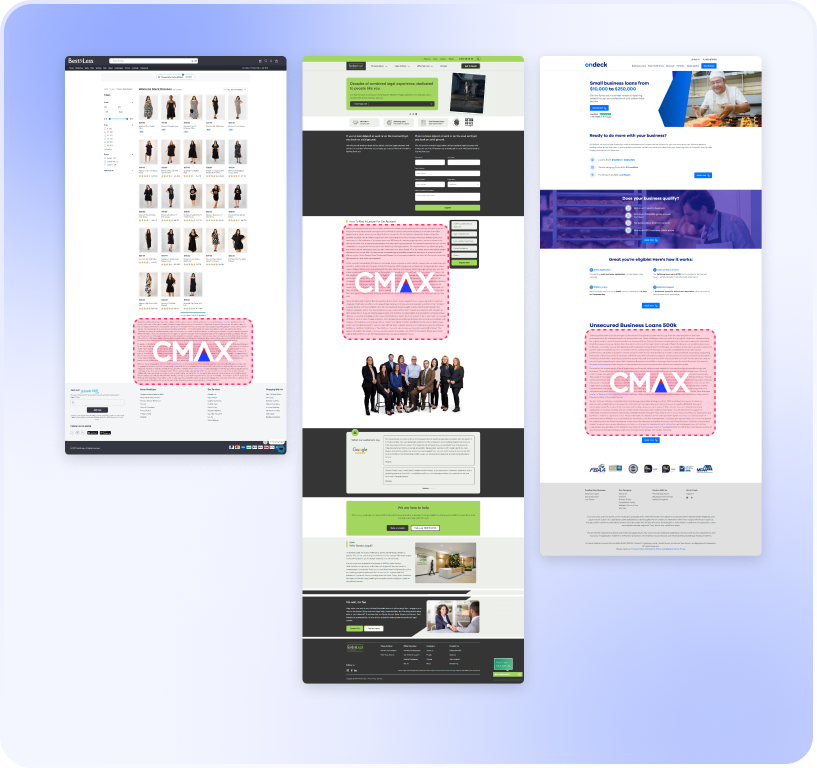
CMAX is the Agentic SEO Platform. Our agents publish and keep updating content across the long tail of search and AI, the thousands of specific ways buyers search that most sites never cover.
A SEO strategy example built this way treats publishing as the start of the process: every piece passes human review before it goes live and stays subject to ongoing updates, which protects brand accuracy and compliance without slowing output.
Creating pages is easy. Putting accurate, useful content on them and keeping it that way is the hard part, which is why the review step exists.
Rather than acting like an AI SEO consultant who hands over a report and disappears, we keep building coverage, watch what performs, and refresh pages as search behaviour shifts. That is what turns content momentum into organic performance you can show your CEO.
A generative AI SEO service framed around SEO content marketing strategy and SEO and content marketing strategy gives you coverage that compounds. What is AI marketing, in practice?
It is the difference between running one campaign and building an asset that keeps working. Our approach to what is AI generated content means every output is brand-trained and human-checked.
For teams who want to see where they stand before committing, our AI in marketing examples and Free SEO Fast Track show exactly where the long-tail gap is. Full Body SEO is how we close it.
Author
Jeremy Tang
Founder and CEO of CMAX
Jeremy Tang is the Founder and CEO of CMAX. With over 2 decades of experience in business consulting and digital marketing, he has successfully driven seven startup businesses, six of which achieved $1 million in revenue from zero in less than 16 months, 5 of which grew to multi-million dollar a year ventures without any external funding. Jeremy's expertise lies in streamlining business processes through technology and leveraging digital (in particular SEO) for business growth. He resides in Australia, travels extensively, and draws inspiration from his global experiences.