Whether you’re looking for an SEO agency Hobart or a partner in Sydney, category growth depends on answering the questions customers actually type. Most shoppers don’t search one obvious keyword.
They search a specific mix of material, size, use case or comparison, and those long-tail searches make up most of category demand. Good ecommerce SEO services plan for that mix.
A category page that ranks for one head term still misses most of the demand if nothing supports it.
Picture a shoe shop that stocks only the bestselling size 9 in black. Shoppers who want a size 6 in tan or a wide 12 find nothing on the shelf, so they buy from the shop down the road that carries the full size run.
In this context, long-tail coverage means having a page on the shelf for each size and finish shoppers ask for, beyond the bestseller.
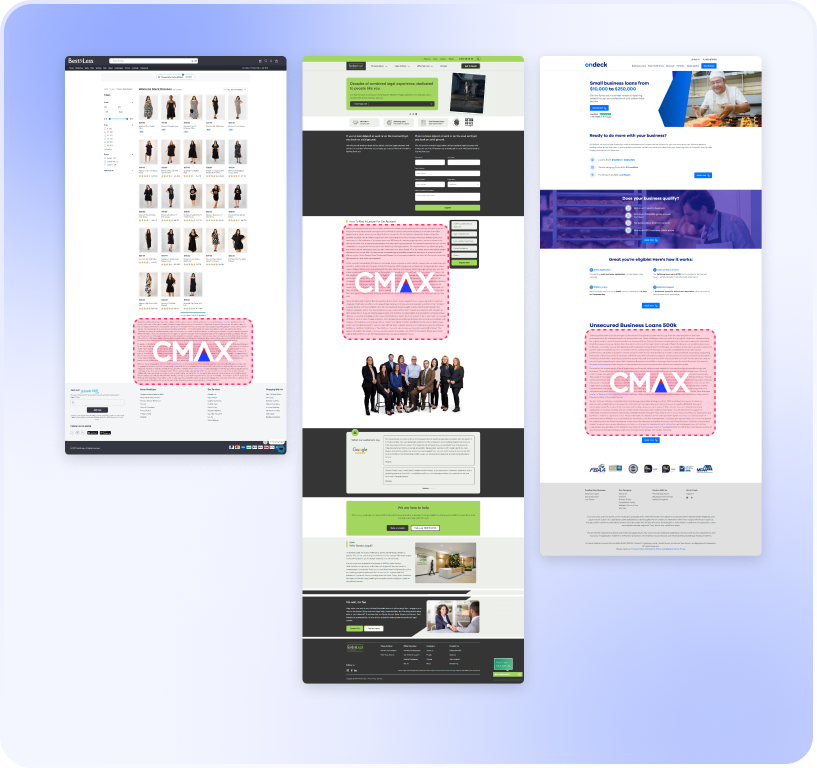
The agencies worth comparing, including any ecommerce SEO company, treat category pages as hubs connected to buying guides, comparisons and product support. CMAX works from the same logic.
We build long-tail coverage around category and collection pages so growth doesn’t depend on a handful of top terms.
Ecommerce SEO agencies win by covering the searches that drive category revenue.
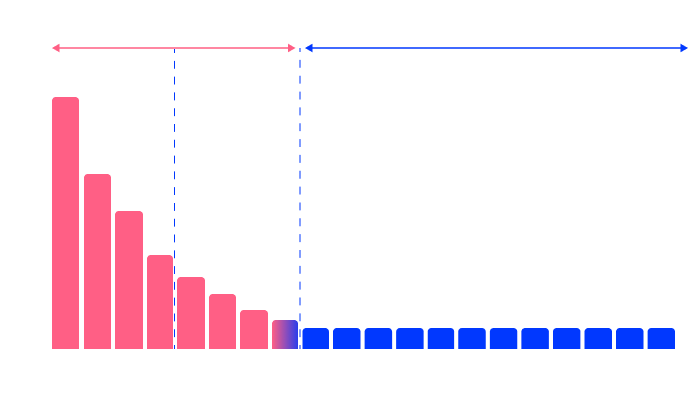
Long-tail demand drives category growth.
Over 90% of search and AI demand is in the long tail. So ecommerce SEO agencies that want to grow a category must cover it.
A practical ecommerce SEO strategy maps materials, use cases and care advice to the detailed requests that search and AI engines retrieve answers for.
The practical test, whether you’re comparing B2B SEO agencies or ecommerce specialists, is content surface area. Count how many of the ways your customers search you have a useful answer for, across category, collection and product-support pages.
Start with category pages.
Category pages sit closest to revenue. Ecommerce SEO services should line them up with shoppers who know the product type they want but haven’t picked a brand, size or finish.
Any ecommerce SEO guide worth reading starts here.
Google recommends consistent internal linking, sitemap and canonical signals (which version of a page is the official one) for ecommerce URLs. That lets it tell which pages matter and which version to index.
A strong ecommerce SEO company treats category pages as commercial hubs. It then links buying guides, comparison content, variant pages and product-support content back to those hubs, so authority isn’t scattered across isolated URLs.
The best agencies prove value with fresh content and useful reporting.
Freshness matters after breadth.
Once a store has enough relevant pages, freshness is the next lever. Shopify SEO tips often stop at setup, yet ranges, prices and seasonal demand keep changing after setup.
A shopify SEO agency should plan for that after the first batch of pages goes live. You can ask Google to re-index changed URLs, but it may take days or weeks for those updates to be crawled and processed.
Report on revenue.
A B2B SEO agency may connect organic performance to qualified leads and pipeline. Ecommerce reporting has to show whether organic search is selling more bedding bundles or dining tables.
SEO for ecommerce stores is judged on sales.
Revenue reporting for ecommerce SEO Australia uses Australian dollars, while comparable US store reports use US dollars when attributing category sales. Direct visits belong in the picture too, since visits from AI assistants often arrive without clear referral data.
How CMAX keeps pages current.
If you’re weighing up an ecommerce SEO agency, ask how pages stay current. CMAX is trained on human-reviewed, client-approved content.
Unlike ecommerce SEO agencies built around audits and development backlogs, the Agentic SEO Platform uses Dynamic Internal Linking and Full Body SEO to deploy and refresh content across existing pages. It keeps connected pages current on any CMS, without rebuilding templates or waiting on a development sprint each time search demand shifts.
Buyers should compare how each agency works, not just what it promises.
Delivery speed depends on method.
Searching for ecommerce SEO services near me shows you where agencies sit. Method decides what they deliver.
There are many partners that optimize online stores, specializing as ecommerce SEO agencies, but method is what distinguishes them. Useful ecommerce SEO tips separate an audit backlog from an operating model that can publish, link, refresh and measure content. An audit backlog is a very organised way of not publishing anything.
Most SEO agencies using conventional, outdated programmes would tell clients to expect results in six months. CMAX’s methods allow clients to start seeing clicks in 6 to 8 weeks. Timelines still depend on the site, its competition and how the work is executed.
Long-tail coverage drives commercial relevance.
Well-structured shopify SEO services keep content connected, compliant and commercially relevant across category and collection pages. Ask any shopify SEO company how its work protects the wider category, because the long tail is where the demand sits.
AI engines retrieve from Google, so GEO and AEO are SEO in practice. A sound ecommerce website SEO strategy expands coverage while keeping canonical signals, internal links and page purpose clear.
Effective SEO agencies do this instead of producing isolated pages that never strengthen the wider category.
Frequently Asked Questions (FAQ)
How do you handle SEO for product pages that go out of stock?
If a product is temporarily unavailable, keep the URL live, show the stock status clearly and update the page’s structured data (the code that tells Google a page’s price and availability). That way Google can read the current stock position.
If the item won’t return, redirect to the closest substitute or parent category. Google recommends relevant redirects.
Sending every old URL to the home page doesn’t help.
How do you protect SEO during an ecommerce platform migration?
For any complex website, including one supported by a saas SEO agency, migration planning should map every old URL to its new destination. Redirects, canonicals, internal links and sitemaps need updating before launch.
The highest-risk failures for ecommerce sites are broken category paths, lost faceted URLs (the filter pages) and product pages that move without a one-to-one redirect.
How should ecommerce sites handle product variants for SEO?
Google recommends giving each meaningful variant its own identifiable URL, so search engines can surface the version a shopper wants. Only variants with separate search demand justify separate optimisation.
The rest should support the main product or category page, because thin URLs dilute it. Clear variant URLs show why ecommerce SEO agencies must balance specific product demand against the risk of thin pages.
Ecommerce SEO Agencies Start With Category Coverage
When ecommerce SEO agencies are judged on category growth, the useful question is how much demand they can cover. CMAX is built around that question.
Stores lose sales to competitors who answer more of the searches.
Beyond retail, ecommerce SEO agencies need controlled expansion. A healthcare SEO agency faces similar constraints, where approved source material and compliance-ready content shape what can be published.
Our Agentic SEO Platform helps brands expand useful content across category, collection and product-support pages, then keeps those pages fresh and connected as search demand shifts. We work with stores searching for shopify SEO Melbourne and Sydney, where local results differ by the city attached to the request.
That suits ecommerce teams that want a SEO strategy for ecommerce tied to sales, with fewer audits, backlog tickets and ranking reports that never show what moved revenue.
You can’t close a coverage gap you can’t see. The review shows which searches your store already answers and which it misses.
If you’re curious as to how you’re performing on AI, book in a Missing Customer Map review with our Growth Team.
Author
Jeremy Tang
Founder and CEO of CMAX
Jeremy Tang is the Founder and CEO of CMAX. With over 2 decades of experience in business consulting and digital marketing, he has successfully driven seven startup businesses, six of which achieved $1 million in revenue from zero in less than 16 months, 5 of which grew to multi-million dollar a year ventures without any external funding. Jeremy's expertise lies in streamlining business processes through technology and leveraging digital (in particular SEO) for business growth. He resides in Australia, travels extensively, and draws inspiration from his global experiences.