An ecommerce SEO agency helps your store capture more of the searches buyers already make. Most of those searches happen at the category and collection level, not on the homepage.
Good ecommerce SEO services start with those pages, because a search like “oak dining tables” shows clearer buying intent than a homepage visit.
You can compare an ecommerce SEO agency against SEO agency Hobart providers on category strategy and implementation depth. Postcode matters less.
Google can vary local results for ecommerce SEO Perth compared with Melbourne, but category strategy and sales-linked reporting are still the better test.
A shopper searching “oak dining tables” or “outdoor rugs for balconies” already knows roughly what they want. That makes these pages some of the most valuable on your site.
Ecommerce SEO marketing earns its keep here.
The question of how to do SEO for ecommerce website builds has a short first answer. Build clear category structure and internal links (the links between your own pages) before you touch individual product pages.
The agencies worth hiring start there.
CMAX works this way. Our agents expand coverage across the thousands of specific ways homewares shoppers search, rather than a short list of obvious head terms.
An ecommerce SEO agency helps your store capture more of the searches buyers already use
Category, collection and product visibility
For category growth, an ecommerce SEO agency should link collection pages like “oak dining tables” to the products inside them, using paths Google can follow. Google reads the links from menus to category pages, and from category pages to products, to work out which pages matter most.
B2B SEO agencies may organise sites around solutions and industries instead of collections and products. Both models depend on clear structure and a complete path to purchase.
Long-tail revenue growth
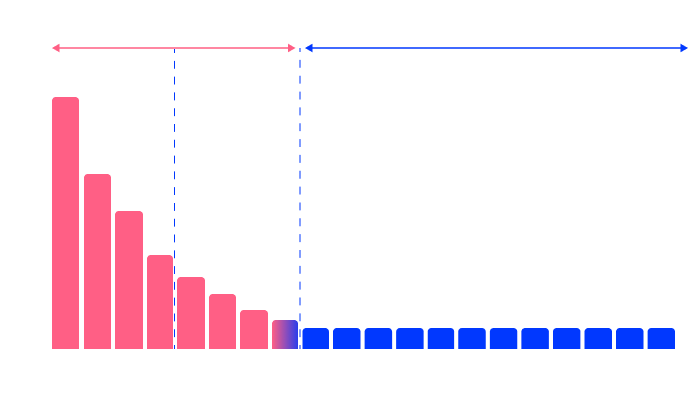
Over 90% of search and AI demand is in the long tail. The long tail is the huge number of very specific searches that each have few searchers and together make up most of the demand.
Enterprise ecommerce SEO has to cover attributes such as size, material, colour, room, price point and season, not only 20 head terms. A plan built around 20 obvious keywords leaves most buying situations unanswered.
CMAX targets that long-tail demand, where most of the searching happens. We expand coverage across the thousands of ways customers search and go beyond the head terms every competitor can already see.
The right approach expands coverage, keeps pages fresh, and fits your platform
Content surface area and freshness
Content surface area is how many of the ways customers search you have a useful answer for. Strong SEO for ecommerce stores maps collection pages to buying paths like “small bedside tables” and “bedside tables for narrow rooms”.
A B2B SEO agency may map the same kind of demand across industries and use cases.
A collection page that was accurate six months ago can go thin or out of date as ranges, prices, stock and seasonal demand change. A serious ecommerce SEO agency shows how it will publish and keep updating pages, and how it tests the results.
It doesn’t hand over a keyword map and a launch batch. A keyword map in a drawer has never sold a sofa.
Platform fit and analytics
Unlike a general consultancy, an ecommerce SEO agency works across Shopify, BigCommerce, Magento and custom CMS setups. The platform affects category templates, faceted navigation, schema, internal links and how fast anything ships.
Schema is hidden code that labels a page’s product, price, availability and reviews so Google can read them accurately.
Search Console is Google’s free tool showing which searches your site appears for. Strong ecommerce SEO agencies place that data next to revenue data, connecting clicks, impressions, queries and click-through rate with sales.
A focused ecommerce SEO audit can combine those signals to show whether the work is expanding demand capture or only moving a handful of keyword positions in a report.
CMAX Brings an Agentic SEO Platform Approach to Category Growth
Human-reviewed, self-updating content
We define an ecommerce SEO agency as a strategy and implementation partner that expands collection coverage. CMAX is trained on human-reviewed, client-approved content, which keeps that expansion aligned with brand, legal and regulatory requirements.
The approach also scales past what a manual content calendar can sustain.
Programmatic SEO builds templated pages and walks away. An Agentic SEO Platform keeps analysing performance and refreshing content.
It also strengthens the pages connected to your important categories as demand and stock change. That is one of the ecommerce SEO best practices worth asking about.
Faster early click visibility
Most SEO programmes run by conventional agencies, using outdated methods, tell clients to expect results in six months. CMAX’s methods allow clients to start seeing clicks in 6 to 8 weeks.
Outcomes depend on the site, its competition and how the work is executed. That gives an ecommerce SEO agency a practical route to shipping category work early.
The most useful of all ecommerce SEO tips costs nothing. Ask any of the SEO agencies on your shortlist what ships in the first 30 days and which categories come first.
The best ecommerce SEO agency can answer both, and can explain how the programme keeps expanding and refreshing after launch.
Frequently Asked Questions (FAQ)
Should I noindex faceted URLs on my ecommerce site?
Not by default. Faceted URLs are the filtered versions of a category page, by size, colour, material or price.
The real decision is which filtered pages match genuine search demand and deserve to appear in Google, like “white linen curtains”. The others add no distinct value and should be managed, like a rare colour, size and price combination with no demand or stock.
Good ecommerce product SEO depends on category paths Google can index, and filtered pages stay visible only where genuine demand exists.
What should I do about seasonal collection pages?
Keep one stable URL and update it before demand peaks each year. A Shopify SEO agency can apply the same lifecycle to recurring event and annual-planning pages, and a SaaS SEO agency might do the same for software content.
A page like “Christmas tableware” or “winter bedding” keeps its history and relevance signals while the copy, products and metadata get refreshed. After the season, fill the page with related evergreen categories, next-season messaging or email capture rather than leaving an empty product grid.
What should I do about out-of-stock products?
Don’t remove every out-of-stock page automatically. Local results for ecommerce SEO Melbourne can differ from Sydney.
Google’s Merchant Centre still requires availability to match the landing page, checkout and structured data, with the price still clearly visible when stock is unavailable. If the product is coming back, keep the page live with accurate messaging and back-in-stock capture.
If it’s permanently discontinued, redirect to the closest substitute or parent category.
Ecommerce SEO Agency Starts With Collection Coverage
An ecommerce SEO agency should be judged on how much buying intent it helps your store cover, especially across category and collection pages. That is the logic behind CMAX.
Buyers search in thousands of specific ways, so growth comes from answering more of those searches with useful, connected and current pages. Stores that count as ecommerce with best SEO usually answer the most of them.
When strict rules apply, judge an ecommerce SEO agency on how a healthcare SEO agency manages approved claims and legal requirements as content changes.
We focus on content surface area and freshness, because organic performance usually stalls when a store talks about only the obvious terms and lets key collections age. For an ecommerce SEO company, that means self-updating content and internal linking, with sales-linked reporting across new and existing category pages.
Our Agentic SEO Platform expands and updates content across those pages, so category growth is measured by demand captured rather than a short ranking list.
The quickest way to find your gaps is to compare the searches your buyers use against the pages you already have. That comparison shows where the missing customers are.
If you’re curious as to how you’re performing on AI, book in a Missing Customer Map review with our Growth Team.
Author
Jeremy Tang
Founder and CEO of CMAX
Jeremy Tang is the Founder and CEO of CMAX. With over 2 decades of experience in business consulting and digital marketing, he has successfully driven seven startup businesses, six of which achieved $1 million in revenue from zero in less than 16 months, 5 of which grew to multi-million dollar a year ventures without any external funding. Jeremy's expertise lies in streamlining business processes through technology and leveraging digital (in particular SEO) for business growth. He resides in Australia, travels extensively, and draws inspiration from his global experiences.