Generative engine optimisation sounds like a new channel with its own budget line. It isn’t one.
It makes your content findable and citable when customers ask AI tools questions before they buy. Effective AI search optimisation gives an engine specific source material for a question like “best sofa fabric for pets” before it builds an answer.
If your site never answers that question, or “machine washable rugs for kids,” the engine has nothing of yours to pull from. AI engines retrieve from Google, among other sources, so a page missing from Google is often missing from the answer too.
Most vendors skip that part when they show you your brand missing from a ChatGPT result. Using ChatGPT for SEO checks shows you the gap in the answer.
It can’t show you which page would close it.
The content gap is the same on any CMS. LLM SEO depends on useful answers sitting on clearly structured pages.
CMAX is the Agentic SEO Platform, a search engine optimisation platform that works across any CMS to close that gap. We use long-tail content and performance data instead of a one-off plan, so your site has answers ready for the searches your customers run.
Generative engine optimisation helps brands show up in AI answers and search.
GEO makes content easier to cite.
Generative engine optimisation, or GEO, means improving content so AI-generated answers can retrieve, interpret and cite it. For a retailer, that means a useful, specific answer for “best sofa fabric for pets” and a separate one for “machine washable rugs for kids”.
AI answers need clear source material for each intent, and one broad category page can’t cover both.
GEO complements SEO.
GEO sits inside SEO. If you’re asking what is search engine optimisation, it’s the work of earning pages a place in Google’s results, and good search engine optimisation already covers the searches behind AI answers.
Imagine an open-plan office where Google sits at one desk and the AI engines sit at the desks around it. When Google sneezes, which is a change in what ranks, the nearby desks catch a cold, which is a shift in what AI answers say.
Handing out tissues to every desk while the sneezer stays at work is a poor use of budget. In this context, GEO means keeping the sneezer healthy: earn your pages a place in Google’s results, and the desks downstream pick up less of a cold.
The desks also get some of their information elsewhere, so they don’t copy Google exactly.
A generative engine optimisation agency can build source pages for the smaller Google searches behind an AI-generated response. When an AI tool builds a response, it often runs several smaller Google searches and pulls from what ranks.
When a site doesn’t address one of those searches, SEO optimisation techniques have no relevant source page to work with.
CMAX focuses on long-tail coverage, freshness, and connected content that AI can cite.
Long-tail coverage drives visibility.
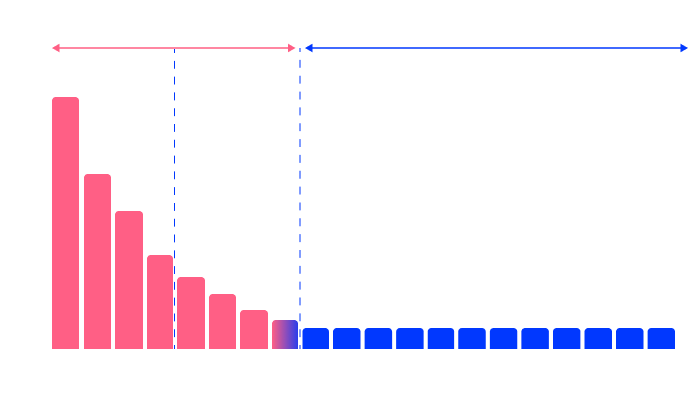
Over 90% of search and AI demand is in the long tail: the specific, detailed queries people type when they’re comparing options, checking fit or looking for reassurance before they buy. Across thousands of these questions, CMAX applies generative engine optimisation to expand content beyond the obvious head terms.
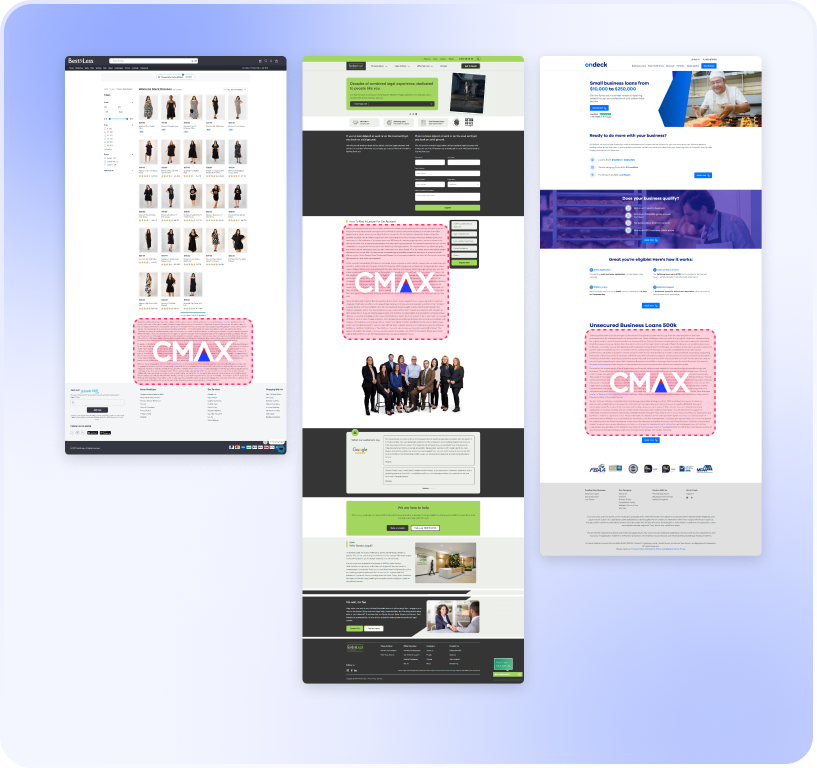
Most brands already have pages for those head terms. They miss thousands of profitable questions about use cases, materials, locations, compatibility and buyer objections.
Fresh, connected content performs better.
Search behaviour keeps changing after a page is published, so content momentum drives organic performance. CMAX supports answer engine optimisation services through Dynamic Internal Linking, Full Body SEO and updates informed by changing page performance.
Google’s crawl budget guidance confirms that update frequency and page value influence how often Google returns to read a site. CMAX uses Dynamic Internal Linking and Full Body SEO to connect related pages around a topic.
Our search engine optimisation platform gives Google a clear view of a section’s depth instead of one isolated answer.
Human-reviewed inputs support brand safety.
CMAX is trained on human-reviewed, client-approved content. That matters when product, compliance or legal wording can’t be left to generic AI output.
A practical answer to what is generative engine optimisation begins with approved language that AI engines can retrieve, interpret and cite accurately. The goal is to scale the language, claims, tone and product knowledge a brand already trusts, with a review layer before any new or refreshed content goes live.
CMAX deploys GEO content on any CMS and updates it using live performance data.
Any CMS, scoped from live data.
A one-off content plan goes stale, so a search engine optimisation platform needs to read live data instead of a static brief. CMAX applies generative engine optimisation across any CMS and opens with a 3-day review of Google Analytics, Search Console and direct visit data.
That review maps your content surface area: how many of the ways customers search for you have a useful answer, and which existing pages need clearer, deeper or more connected content. Location also changes the competitive set.
A search for a SEO consultant newcastle faces different rivals than one for a Sydney provider, even when both reviews use the same analytics sources.
Pages are updated from performance signals.
CMAX defines generative engine optimisation as deployable content improvement across existing and new pages, scoped through the 3-day analytics review and updated through live page data. Our approach to AI search visibility optimisation reads impressions, clicks, crawl frequency and page performance to decide what gets updated next.
Dashboards from AI search engine optimisation tools show where you’re missing. The live data decides which page to write or update to close that gap.
A page pulling impressions but few clicks gets sharper relevance. A topic cluster with demand but thin coverage gets expanded.
Faster early traction than conventional programmes.
Most SEO programmes run by conventional agencies, using outdated methods, tell clients to expect results in six months. CMAX’s methods allow clients to start seeing clicks in 6 to 8 weeks.
We deploy across new and existing pages and improve from live data, rather than waiting months to find out whether a static SEO strategy was right. For LLM SEO Australia work, we scope with Australian spelling and dollars.
US deployments use American spelling and dollars.
Frequently Asked Questions (FAQ)
What metrics should you track to measure GEO success?
Start with Search Console: impressions, clicks, landing pages and query patterns. Cross-reference the pages gaining visibility with qualified sessions, assisted conversions and enquiries.
Google’s generative AI performance report in Search Console shows impressions for links appearing in AI Overviews and AI Mode directly. A cited page pulling high-intent visitors carries more commercial weight than a broad mention that never reaches a buyer close to purchasing.
Taken together, Search Console impressions, qualified sessions and assisted conversions show whether generative engine optimisation adds commercial value.
Why does AI give different answers to the same question?
AI systems retrieve different supporting documents, weigh context differently and generate language probabilistically. Anthropic’s documentation confirms that identical inputs can produce different outputs across API calls, even at temperature 0.
A resilient LLM SEO strategy builds current source material across the eight to twelve smaller Google searches an AI question can trigger. In a specialist field such as SEO for recruitment agencies, the stronger strategy is building enough useful, current source material across the searches behind the answer.
Do AI citations always generate referral visits?
No. A citation can build awareness without an immediate click. The user may get enough from the AI answer, search the brand later or convert in a session analytics can’t trace back.
For answer engine optimisation Australia work, CMAX writes in Australian spelling and dollars, and US content uses American spelling and dollars. Track Search Console impressions, branded search growth and engagement on pages built to answer long-tail questions.
Generative Engine Optimisation Starts With Search Coverage
Generative engine optimisation works when your site gives AI systems clear, useful source material across the specific searches buyers make. If you don’t talk about a search, you’re unlikely to be cited for it.
CMAX can optimise content for AI search by expanding specific source material across new and existing pages on any CMS.
That is why CMAX, as an SEO company, focuses on content surface area, freshness and connected pages instead of a small set of obvious terms. On any CMS, we deploy and update content across new and existing pages based on live performance data, so coverage keeps pace with how people search across Google and AI.
The simplest way to find your gaps is to look at the searches where you have no answer yet. A review maps them for you.
If you’re curious as to how you’re performing on AI, book in a Missing Customer Map review with our Growth Team.
Author
Jeremy Tang
Founder and CEO of CMAX
Jeremy Tang is the Founder and CEO of CMAX. With over 2 decades of experience in business consulting and digital marketing, he has successfully driven seven startup businesses, six of which achieved $1 million in revenue from zero in less than 16 months, 5 of which grew to multi-million dollar a year ventures without any external funding. Jeremy's expertise lies in streamlining business processes through technology and leveraging digital (in particular SEO) for business growth. He resides in Australia, travels extensively, and draws inspiration from his global experiences.