A search engine optimisation platform is software that plans, runs and measures your search engine optimisation. Done well, it grows organic sales without constant changes to your website or workflow.
For most mid-market and enterprise teams, SEO stalls at one point: approved content can’t move efficiently into the existing CMS.
Your current reports might tell you what’s missing. Search engine optimisation software has to go further and connect writing, approval, publication and performance-led updates.
Left to separate teams, those steps stall.
CMAX works inside the CMS you already have. We close the gap between insight and published content, so your team can execute and measure against sales.
It gives enterprise teams a clearer way to plan and scale SEO content
Map long-tail demand
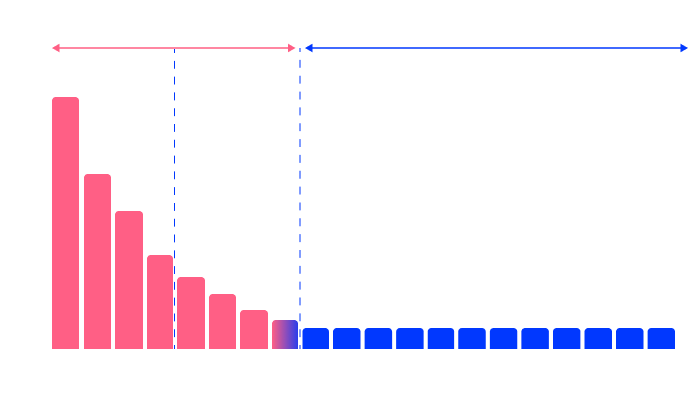
For enterprise teams, a search engine optimisation platform should turn long-tail demand into a prioritised plan for product, category, location and comparison pages. Over 90% of search and AI demand is in the long tail.
That means the specific searches buyers actually type, like “washable wool rug for apartment living room” instead of “rug.” Visibility depends on content surface area: how many of those searches your site has a useful answer for.
Generative engine optimisation planning draws on the same long-tail gap analysis. It covers gaps in existing pages, opportunities for new pages, and commercial topics with no useful answer yet.
Many keyword research tools identify page opportunities. CMAX also turns approved long-tail priorities into content for the existing CMS.
Anyone asking how to do search engine optimisation at this scale starts with that gap list.
Scale without rebuilding CMS
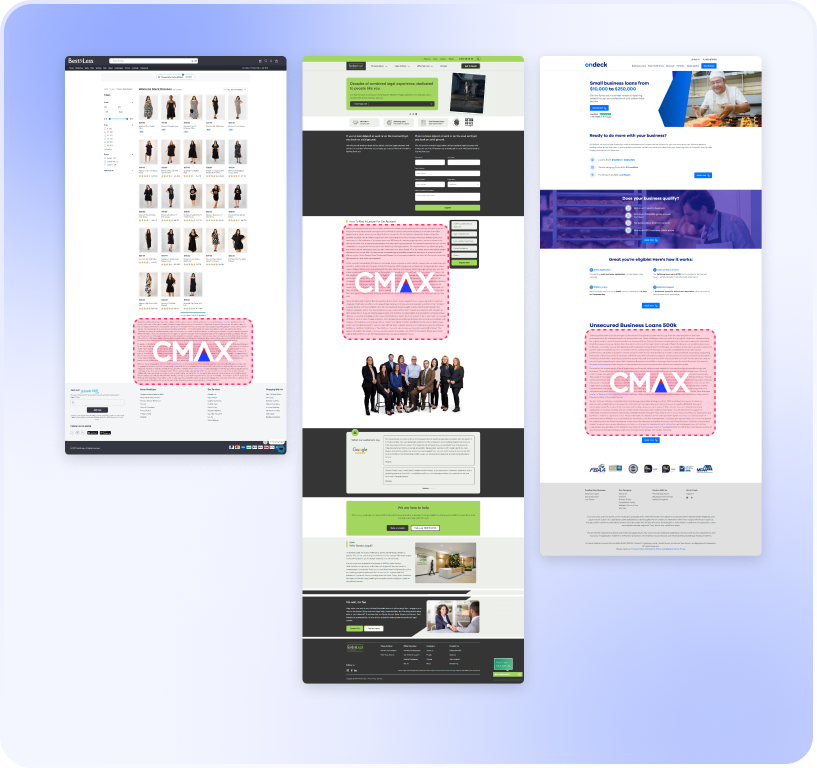
Large brands need to grow coverage across product, category, location and comparison pages. They shouldn’t have to touch their CMS or join the development queue to do it.
CMAX operates as a scalable SEO platform: we add approved content to those pages without a CMS migration. The practical test for any search engine optimisation platform is simple.
Can it add and improve approved SEO content on existing pages without creating a parallel site, breaking governance or sending every update through engineering?
It runs content execution and freshness as well as reporting
Move from insight to live
Most SEO platforms stop at the recommendation. Tools like semrush show you what’s missing, and so does any SEO agency platform built around reporting, including many entity SEO services offerings.
The audit lands and the dashboard updates. Someone still has to write the page, get it approved, publish it and link it.
Nobody has ever sold a rug because a dashboard refreshed.
Let’s say you need to move goods across the country. You can breed a faster horse every year.
You still won’t end up with a car. The horse is a content team, and breeding faster horses is hiring more writers: output rises in a straight line, and the long tail is far wider than that line.
The car is an automated content system that publishes and maintains pages on its own schedule. Your writers still steer, and they approve every page.
In this context, a platform that publishes and maintains content means the car: it moves approved pages onto your site and keeps them running, while a report only tells you how far the horses have left to go.
CMAX creates approved content and deploys it to new or existing pages inside the CMS workflow your team already uses. A SEO management platform becomes actionable when performance data decides which published pages get refreshed, expanded or replaced.
Keep pages up to date
Google runs freshness systems to surface current content for queries where users expect it. Prices shift.
Product specs change. Competitors add better answers.
A page that ranked well last year can quietly become the weakest result on the page. CMAX provides a search engine optimisation service that uses live performance data to keep prices, product specifications and commercial content current.
It scales with governance and measurable growth
Govern content across any CMS
Getting content live at scale is half the problem. Governance matters when you assess SEO AI tools, because brand, legal, compliance, product and regional teams may each need to approve a page before it publishes.
Regional rules matter too: governance for AI SEO Brisbane work may involve Australian compliance requirements alongside other market-specific rules.
CMAX is trained on human-reviewed, client-approved content, so output stays within the factual accuracy, tone and claims the business has already cleared. A reporting dashboard can’t do that.
A search engine optimisation platform can apply human-reviewed, client-approved content across financial services, healthcare and legal pages, where AI-assisted content that invents claims or overstates benefits creates real liability.
Expand coverage and page connections
An effective SEO enterprise platform helps Google interpret a brand through the depth and connectivity of useful pages around each commercial page. Backlink reports show who links to you from outside.
The pages inside your own site need connecting too.
The best SEO ecommerce platform connects product, category and commercial pages, and expands coverage beyond a short list of obvious terms. The result is a broader SEO strategy for search and AI visibility across the specific searches buyers make before they convert.
Frequently Asked Questions (FAQ)
How long does it take to onboard an SEO platform?
It depends on your setup. A site with clean analytics and straightforward approvals moves faster than a multi-country enterprise with legal review and legacy tracking issues.
CMAX starts with a 3-day review of your Google Analytics and Search Console data. (Search Console is Google’s free tool showing which searches your site appears for.) That gives your team an early view of demand gaps and the pages most likely to benefit.
Most SEO programmes run by conventional agencies, using outdated methods, tell clients to expect results in six months. CMAX’s methods allow clients to start seeing clicks in 6 to 8 weeks.
Can an SEO platform import historical data?
It can, if it connects to Google Analytics and Search Console. That history shows which queries produce impressions without clicks, which pages are declining, and where long-tail searches have no strong content behind them.
Google’s Search Console holds up to 16 months of data, enough to choose SEO optimisation techniques that prioritise content actions instead of repeating charts you’ve already seen. A global SEO platform can use that history to prioritise declining pages and underserved long-tail demand.
Can one SEO platform support multiple countries and languages?
It can, if it manages locale-specific pages and the signals that tell Google which version belongs to which audience. Google recommends hreflang tags to identify localised versions.
Translation and localisation differ: search demand, product names, compliance wording, seasonality and buying triggers vary by market. The benchmark is whether the platform can create and maintain useful local answers at scale, with each country’s pages governed and aligned with approved content.
That’s the standard an enterprise search engine optimisation platform must meet.
Search Engine Optimisation Platform Scales Existing CMS Content
A search engine optimisation platform is most useful when it turns search demand into approved content that goes live in the CMS you already use. That’s the gap CMAX focuses on: broader coverage across the thousands of specific ways customers search, with publication and updates connected to your team’s workflow.
Pricing questions look similar to those Australian teams ask when comparing SEO services Perth: do costs scale by market, page volume or retained hours? CMAX scopes search engine optimisation cost against market coverage, page volume and implementation requirements, with reporting as only part of the scope.
CMAX is the Agentic SEO Platform, built to add and improve content on new and existing pages without a CMS migration. It keeps that content current over time, because search performance comes from content momentum, and a one-off publish has none.
You can find out where your site has no answer for a buyer before you decide anything else. The review shows the gaps and commits you to nothing.
If you’re curious as to how you’re performing on AI, book in a Missing Customer Map review with our Growth Team.
Author
Jeremy Tang
Founder and CEO of CMAX
Jeremy Tang is the Founder and CEO of CMAX. With over 2 decades of experience in business consulting and digital marketing, he has successfully driven seven startup businesses, six of which achieved $1 million in revenue from zero in less than 16 months, 5 of which grew to multi-million dollar a year ventures without any external funding. Jeremy's expertise lies in streamlining business processes through technology and leveraging digital (in particular SEO) for business growth. He resides in Australia, travels extensively, and draws inspiration from his global experiences.