A team that specialises in generative engine optimisation gets your brand found in three places: the classic Google links, the AI answers built from Google’s results, and the questions customers ask AI tools directly.
This matters because AI engines retrieve from Google. When a customer asks ChatGPT a question, it quietly runs several Google searches in the background and stitches the results into one answer.
AI search optimisation has to account for each of those searches, not just the one the customer typed.
Picture a potluck dinner. A guest asks for “something to eat” but quietly needs a dish that is vegetarian and nut free.
If every dish on the table is chips, that guest leaves hungry, however good the chips are. In this context, query fan-out means one customer question becomes several smaller searches, and your pages are the dishes: you need one for each need, not twenty plates of the same chips.
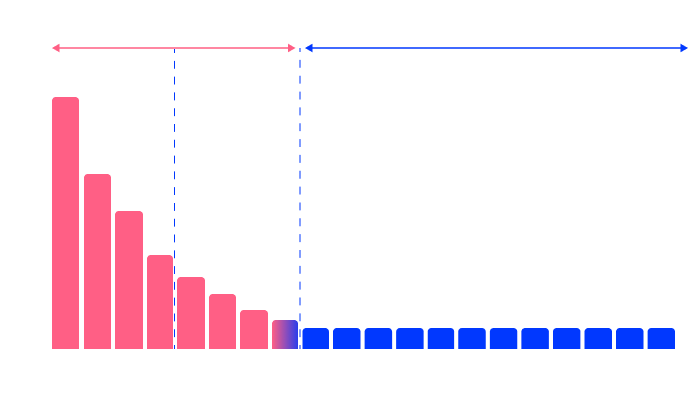
If your pages only cover your 20 or 30 main products or terms, you are invisible for most of that activity. The real demand sits in specific, detailed questions.
Nike’s US running shoe example shows how a search generative experience can expose demand far beyond one high-ranking head term.
A brand that ranks first on its biggest term still captures only a small slice of category demand. Nike does, despite dominating running shoe search in the US.
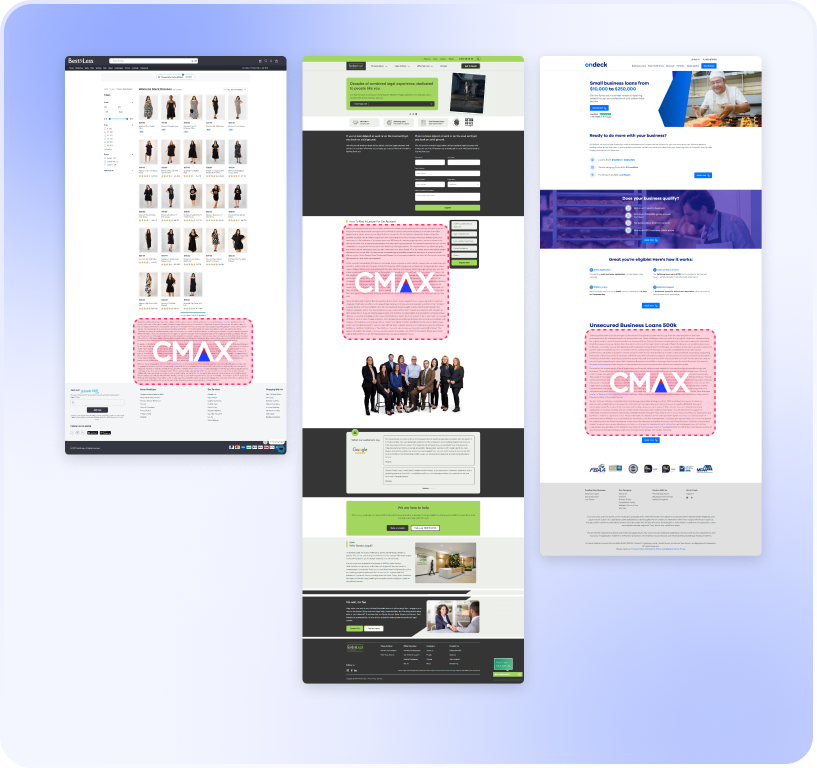
CMAX works from this logic. We build and update long-tail pages so your brand has an answer ready for the specific questions customers and AI tools ask.
Generative Search Optimisation Means SEO for AI-Mediated Search
Long-Tail Searches and AI Answers
For detailed Google questions, a generative search optimisation agency builds coverage across the retrieval paths that query fan-out creates. Effective LLM optimisation covers questions like “removable covers” and “apartment size” instead of relying on a broad term like “sofa”.
One broad AI prompt creates many retrieval paths. Brands that only optimise for head terms drop out of most of them.
Why Breadth, Freshness and Connections Matter
A generative engine optimisation agency focuses on content surface area. That is the number of ways customers search for you that you have a useful answer for.
A search engine optimisation service needs enough surface area to cover thousands of use cases, objections, comparisons and product details. Google confirms that the same foundational SEO best practices apply in AI features, with no extra technical requirement for inclusion.
You can’t rank for something you don’t talk about. AI has made those missing pages easier to spot.
Broader Coverage, Fresher Pages and Stronger Page Connections Beyond Schema
Query Fan-Out Raises Coverage Demands
An AI answer splits one customer question into several related Google searches. It may retrieve pages on price, reviews, alternatives, eligibility and next steps before it writes a response.
Answer engine optimisation and AI search visibility optimisation both depend on that breadth. Google says AI Overviews and AI Mode may use query fan-out and may find more supporting web pages while a response is generated.
So effective generative search optimisation has to cover more demand than a plan built around 20 to 50 keywords can reach.
Schema Helps, Content Still Does the Work
Schema can help machines recognise a product, review, organisation or FAQ. It won’t make a thin page useful.
Google says no additional technical requirements and no special schema.org structured data are needed to appear in AI Overviews or AI Mode. So a generative search optimisation agency writes accurate answers and builds internal links that make related pages useful to Google.
How CMAX Keeps Content Current
CMAX is trained on human-reviewed, client-approved content. That matters when claims, pricing or product details can’t drift.
Among practical LLM optimisation techniques, our Agentic SEO Platform uses Dynamic Internal Linking and Full Body SEO. Together they expand coverage, strengthen how pages relate and keep content current, because products change, competitors publish and new searches appear constantly.
Compare Evidence, Operating Model and Measurement Before You Choose an Agency
What Strong Measurement Looks Like
Strong agencies combine Search Console (Google’s free tool showing which searches your site appears for) with prompt tracking. Prompt tracking means tools that repeatedly ask ChatGPT questions and record whether your brand appears.
Ask which AI search engine optimisation tools the agency uses for this, and who reads the output. Any team that can optimise content for AI search should answer that without a pause.
The measurement model of a generative search optimisation agency can combine Search Console clicks, crawl frequency, direct visits (sessions your analytics can’t trace to a source) and revenue.
Google defines Search Console clicks as the number of times a user clicked through to your site from Search results. Impressions are how many times your site appeared.
Direct visits have no clear referral source in Google Analytics. They can support an AI discovery story, but they aren’t proof on their own.
Industry-Standard Practice vs CMAX
Timelines depend on the site, its competition and how the work is done. Treat fixed promises and vague monthly reports with caution.
Most SEO programmes run by conventional agencies, using outdated methods, tell clients to expect results in six months. CMAX’s methods allow clients to start seeing clicks in 6 to 8 weeks.
The difference is the operating model. Older retainers prioritise audits, a small keyword set and occasional content delivery.
Teams that optimise content for AI search need an operating model built around breadth, freshness and page connections across the long tail.
Fit for Complex and Regulated Sites
Ask how approved claims are stored, who reviews sensitive content, how updates happen when policies or products change, and how pages connect around priority topics. Ask each agency to answer what is search optimisation in plain words.
A clear answer to “What is search engine optimisation?” should cover approved claims, sensitive content review, updates and connections between priority pages.
Over 90% of search and AI demand is in the long tail, especially when buyers search with specifics: “low-doc business loan eligibility,” “NDIS provider comparison” or “enterprise payroll software for multiple entities.” Expanding useful coverage for specific comparisons is a core responsibility of a generative search optimisation agency.
Frequently Asked Questions (FAQ)
Can a generative search optimisation agency guarantee AI citations?
No. Anyone who asks what is search optimisation and reads search engine optimisation define will find no credible definition of SEO that includes guaranteed AI citations. Google states that AI Mode and AI Overviews may use different models and techniques, so the responses and links they show vary.
A better standard is whether the agency improves the odds of inclusion. That means more indexable coverage, stronger content quality and pages that stay useful across the topics buyers search.
Ask how prompts are tracked over time, how real changes are separated from noise, and how visibility ties back to clicks and revenue.
Why can AI visibility change when my website doesn’t?
The answer is recomposed from different supporting pages each time, and Google confirms the set of responses and links may vary across AI features. Supporting pages and fan-out patterns change between responses, so LLM search optimisation needs current content and ongoing crawl monitoring.
Competitors publish fresher pages. Google recrawls at different intervals.
A slightly different prompt triggers a different fan-out pattern. Any of these can move your position.
Prompt tracking belongs beside Search Console and crawl monitoring.
Does Google penalise AI-generated content?
Google does not treat AI-generated content as automatically bad. It states that not all use of automation, including AI generation, is spam.
Using automation primarily to manipulate search results violates policy. Google’s systems aim to reward original, high-quality content that demonstrates E-E-A-T.
Accurate, reviewed and current pages give a generative search optimisation agency the foundation to expand search and AI visibility. The practical test is whether the final page is accurate, reviewed, useful, current and consistent with approved claims.
Generative Search Optimisation Agency Is a Coverage Decision
Judge a generative search optimisation agency on whether it can grow the coverage your site needs, and give less weight to its AI labels. You lose to the coverage you don’t have.
Coverage now ties directly to AI in search engine optimisation. Answers are built from the pages Google can find, index and trust across many specific searches, and a short keyword list reaches few of them.
An LLM optimisation agency should expand useful content across the long tail, strengthen how pages connect and keep content current as products, queries and competition change. That is the work we do at CMAX.
You can’t fix a gap you haven’t seen. A review shows which customer questions your site doesn’t answer yet.
If you’re curious as to how you’re performing on AI, book in a Missing Customer Map review with our Growth Team.
Author
Jeremy Tang
Founder and CEO of CMAX
Jeremy Tang is the Founder and CEO of CMAX. With over 2 decades of experience in business consulting and digital marketing, he has successfully driven seven startup businesses, six of which achieved $1 million in revenue from zero in less than 16 months, 5 of which grew to multi-million dollar a year ventures without any external funding. Jeremy's expertise lies in streamlining business processes through technology and leveraging digital (in particular SEO) for business growth. He resides in Australia, travels extensively, and draws inspiration from his global experiences.