When a product takes more than a sentence to explain, a generic page stops working. Buyers researching homewares, furniture, or any category with meaningful variants rarely type a broad label into Google.
They search with the specifics that tell them whether your product is worth enquiring about at all: material, dimension, style, use case, compliance. Your website copywriting services need to meet them there.
SEO content writing services do more than describe a product. They map the language buyers actually use to the pages that need to answer those questions, at the depth that earns the click and the enquiry.
CMAX uses search data to show which questions buyers are already asking, giving SEO copywriters the evidence to cover what matters beyond a generic category name.
Why SEO copywriting matters when buyers search in detail.
Long-tail searches drive qualified demand.
Think of your product catalogueue like a restaurant menu. Most customers don’t walk in and say “food please.”
They ask for the gluten-free pasta, or the Monday lunch special, or the half-serve. Your pages need to answer those specific questions, or the customer walks to the restaurant next door.
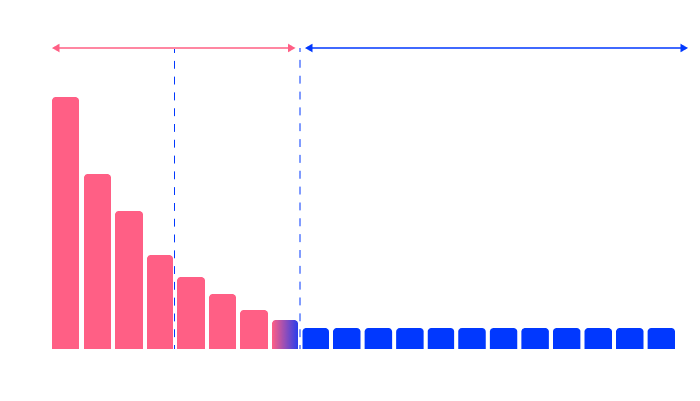
Over 90% of search and AI demand is in the long tail. Buyers add practical modifiers to their searches because those details decide whether a product is worth pursuing: finish, size, lead time, service area, end use.
An SEO copywriter who works from a fixed keyword list misses the questions that shift every time your category evolves. Google reports that 15% of its daily searches are brand new, which means terminology changes whether you plan for it or not.
Web copywriting services that expand coverage across those specific searches attract traffic tied to real buying intent, not just page views.
Thin copy misses commercial intent.
A product page that only names the item leaves out the questions that typically decide the next step. Dimensions, certifications, compatibility, maintenance requirements: these are the details a buyer needs before they enquire, and the details Google uses to judge whether your page is the right answer.
That gap makes it harder for the page to match the search, and harder for the buyer to judge whether the product fits. Website content writing services can close that gap by explaining where a product fits, what constraints apply, and what separates it from alternatives.
In complex categories, interchangeable descriptions also make it hard to distinguish pages for different applications or specifications, which weakens both relevance and conversion confidence. A copywriter for website content adds structure to that specificity, so each page earns its own search position.
Good copy turns product complexity into search visibility.
Mapping intent improves query coverage.
Google Search Console shows which queries already bring users to your site: impressions, clicks, average position. That is real buying-intent data, and most sites under-use it.
Strong SEO copywriting services use that evidence to match individual pages to informational, comparative, and transactional intent, then update those pages as terminology shifts and product ranges expand. Copy planned around assumptions gets overtaken.
Copy planned around data compounds.
Ranking detail supports AI visibility.
AI answer engines surface pages that explain a topic clearly and specifically. Detailed copy gives retrieval systems concrete language to work with.
Pages that cover the exact product types buyers ask about support both traditional search results and AI-assisted discovery. That is why CMAX targets the 90% of search demand in the long tail as a visibility requirement, not an optional extra.
How much does website copywriting cost depends on technical depth: a page written to answer a compliance question costs more to produce than a product blurb, and it earns more too.
CMAX connects that approach to your product marketing.
Brand-safe content for complex categories.
CMAX is the Agentic SEO Platform. CMAX is trained on human-reviewed, client-approved content, which means the copy it produces reflects your approved terminology, sector language, and positioning rather than generic AI phrasing.
In compliance-sensitive categories, SEO website copywriting carries real commercial risk if an off-brand technical claim slips through. That control is what separates a platform trained on your assets from one generating copy from scratch.
Generic output sounds interchangeable across suppliers. Approved output sounds like you.
Technical breadth shapes visibility.
Buyers in detailed product categories search by process, application, constraint, or specification rather than a broad label. Your copy needs enough technical breadth to explain where a product fits, what limitations apply, and which details shift the buying decision.
This is similar to content writing for financial services: controlled terminology and careful treatment of regulated claims are not optional. Industrial SEO copywriting services must cover compliance-sensitive detail and adjacent service queries across the full product range, and the same discipline applies to any category where accuracy has commercial consequences.
A website copywriting agency brings that discipline through a repeatable process rather than one-off briefs, which matters when your product range spans hundreds of SKUs.
Frequently Asked Questions (FAQ)
Can SEO copywriting improve existing pages without a redesign?
Meaningful gains in SEO website traffic do not require a redesign when the existing page structure is usable. Within an existing site structure, CMAX strengthens headings, body copy, internal anchors, and supporting product details.
A structural overhaul is a separate decision. Better copy on an existing page is not.
How do manufacturers measure SEO copywriting results?
Track whether revised pages earn more relevant impressions, clicks, and query coverage in Google Search Console, then connect that traffic to enquiries or assisted conversions in analytics and CRM reporting. Blog content writing services are measured the same way: raw session volume is a weak signal.
For longer sales cycles, specification downloads, quote requests, and sales-qualified leads tell you more.
How long does manufacturing SEO take to work?
A website SEO service can deliver first clicks within 6 to 8 weeks, with programmes typically maturing around month six [editor to verify]. Timing shifts based on existing content coverage, category competitiveness, crawl frequency, and whether current pages can be strengthened before new content goes live.
Website content writers Australia use Australian spelling as standard, which matters for local search relevance. Affordable content writing services often skip that localisation detail, which costs rankings in Australian search results.
After those first clicks appear, SEO copywriting services build broader query coverage as the programme matures.
SEO Copywriting Services Start With Product Detail
Buyers in detailed categories search in specifics. When your pages answer the questions that drive a buying decision, they show up for more of the qualified searches that lead to enquiries: across Google and across the AI tools that retrieve from it.
CMAX addresses requests framed as SEO services for my website by focusing on the long-tail coverage needed to connect product detail with qualified demand. Area Ten supports the work of a SEO copywriting company through CMAX, expanding long-tail coverage using approved brand assets and performance data.
The platform’s Automated Content Generation, Dynamic Internal Linking, and Smart Optimisation capabilities are what make Full Body SEO possible at catalogueue scale, keeping content current as search terms, product language, and buyer questions change. SEO copywriting examples from complex product categories show the same pattern: pages written to answer specific buying questions consistently outperform pages written to describe a product in general terms.
The simplest way to see where your current content is leaving demand uncovered is to map the gaps before committing to a direction. If you’re curious as to how you’re performing on AI, book in a Missing Customer Map review with our Growth Team.
Author
Jeremy Tang
Founder and CEO of CMAX
Jeremy Tang is the Founder and CEO of CMAX. With over 2 decades of experience in business consulting and digital marketing, he has successfully driven seven startup businesses, six of which achieved $1 million in revenue from zero in less than 16 months, 5 of which grew to multi-million dollar a year ventures without any external funding. Jeremy's expertise lies in streamlining business processes through technology and leveraging digital (in particular SEO) for business growth. He resides in Australia, travels extensively, and draws inspiration from his global experiences.