Australian migration agents operate under OMARA advertising rules, which means every page that promotes your services must display the words “Migration Agents Registration Number” or “MARN” followed by your individual number. That requirement makes SEO for migration agents Australia different from Canadian or US campaigns, where registration rules and visa terminology work differently.
Like SEO for lawyers Sydney, migration SEO must connect a regulated practice to clear, compliant service pages, not just cover a few broad phrases.
The people searching for a specific visa subclass or an eligibility scenario are closer to picking up the phone than the person typing “move to Australia.” Getting in front of those searches requires the right page structure, visible MARN details, and content that answers the actual question.
CMAX works as an SEO agent for regulated firms that need compliant, enquiry-focused coverage at scale.
Compliance-first SEO helps Australian migration agents attract qualified visa enquiries
Qualified search coverage
Someone typing “subclass 482 employer nomination eligibility” is already deciding whether to contact an agent. Someone typing “move to Australia” is still browsing the brochure.
SEO for migration agents Australia starts by capturing the first group, not just the second.
Search Console is Google’s free tool that shows which searches are sending visitors to your site. It separates casual research from the queries that produce real visa conversations, so you can see exactly where qualified interest already exists and where pages are missing.
Compared with US campaigns, local SEO Australia requires migration-firm pages to display MARN details under OMARA advertising rules. That is a baseline requirement, and it belongs on every page, not just the contact page.
Trust signals that support enquiries
The Code of Conduct requires online advertising to include “Migration Agents Registration Number” or “MARN” followed by the agent’s individual registration number. A reader who knows what is a migration agent also knows to look for that number, because the official register links every practitioner to a current registration.
When firms assess SEO agents, the compliance check is straightforward: has the proposed approach built MARN visibility into every page, included plain-English next steps explaining what happens after an enquiry, and linked to the Register of Migration Agents? If not, the site is generating trust problems, not enquiries.
Visa-type, scenario, and location pages help you cover the long tail
Long-tail visa and suburb pages
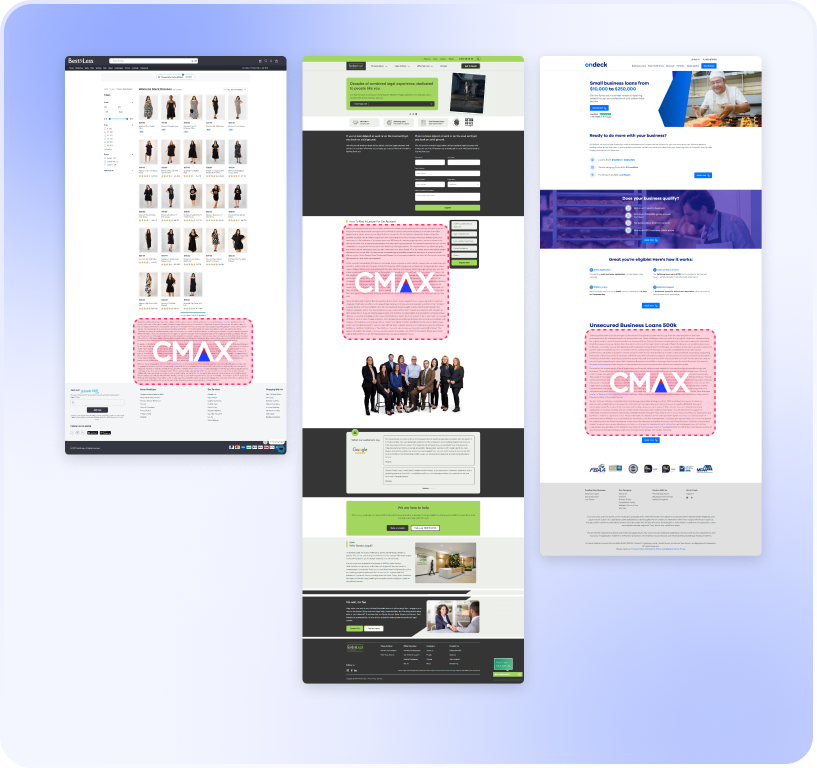
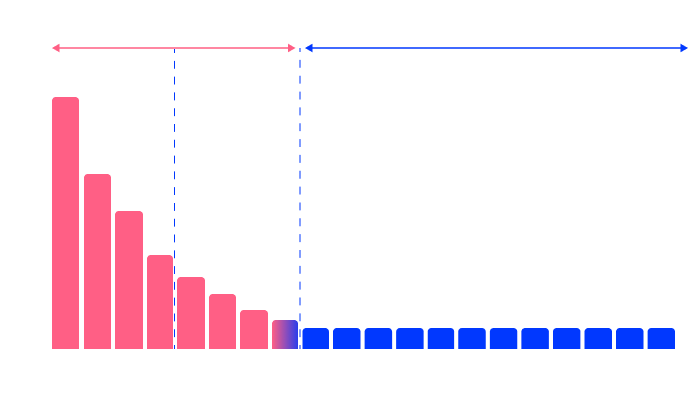
Over 90% of search and AI demand is in the long tail. The long tail means the specific, detailed searches people type when they already know what they want, “subclass 186 regional occupation list electrician Brisbane” rather than “work visa Australia.”
A single generic services page misses most of that demand.
Think of a GP’s clinic that lists every condition it treats on one poster in the window. A patient looking for a bulk-billing doctor who sees children on Saturdays walks past, because nothing on the poster matches what they typed into their phone.
Separate pages for each service, location, and scenario are the clinic’s way of saying “yes, that’s us” to each specific search. Separate subclass and suburb pages make SEO for migration agents Australia more precise in exactly that way.
Local SEO for lawyers separates practice areas and suburbs for the same reason: one page cannot cover dozens of distinct searches. Migration firms apply the same logic around visa subclasses.
The same principle is why SEO for travel agents builds separate destination and service pages rather than one catch-all page.
Fresh, connected content clusters
Visa rules change. Occupation lists are updated.
Search phrasing shifts as user questions evolve. Content surface area, meaning how many of the ways your clients search you actually have a useful answer for, needs to grow alongside those changes.
Search Console groups performance by queries and pages. That tells you which existing pages are already earning impressions but not clicks, which topics are attracting new searches, and which pages need to be connected so the site answers the follow-up question too.
Internal links between related pages help both users and Google move through the content in a logical order.
Scaled content with regulated controls
Here is where the compliance risk becomes a scale risk. A single unapproved change in wording, replicated across hundreds of visa pages, creates regulatory exposure that a one-page fix cannot resolve.
That is what makes unchecked AI content generation a poor fit for regulated practice.
CMAX is the Agentic SEO Platform. CMAX is trained on human-reviewed, client-approved content, so regulated firms can publish more pages without losing control of wording, claims, or sign-off.
Migration marketing requires every page to stay consistent with approved advice and registration obligations. Automated copy that has not been checked cannot reliably do that.
Measurable SEO for migration agents starts with the right signals and the right follow-through
Metrics tied to qualified matters
Positional data tells you where you sit. It does not tell you whether visitors convert to a visa matter.
The right reporting for local SEO services Australia connects Search Console query data, which shows clicks, impressions, click-through rate and average position, with form submissions and intake notes. That crosscheck shows which topics are producing real enquiries and which are attracting researchers who never contact anyone.
For context, SEO for insurance agents faces a comparable challenge: distinguishing policy enquiries from general information searches. Migration firms apply the same logic to separate visa conversations from casual research.
Coverage, linking, and updates
CMAX targets the long tail, which accounts for the great majority of search and AI demand, with Dynamic Internal Linking and Full Body SEO. Dynamic Internal Linking is the connected-page approach used across the site: each page links to the next logical question, so a user reading about subclass 482 eligibility can reach the employer nomination page without hunting for it.
Full Body SEO means optimising every element of a page, not just the title.
Search visibility builds when more pages are connected, more questions are answered, and old pages are refreshed rather than left to decay. For migration agents, where MARN disclosures and visa rules change, that update cycle is not optional.
Faster early click visibility
Most SEO programmes run by conventional agencies, using outdated methods, tell clients to expect results in six months. CMAX’s methods allow clients to start seeing clicks in 6 to 8 weeks.
For migration agents comparing providers, the useful question is whether the work plan can show early signs of query coverage, page growth, and qualified enquiry tracking from the start, not just a promise to revisit in half a year.
Frequently Asked Questions
Can an online-only migration agent get a Google Business Profile?
Yes. Local visibility matters for local SEO for law firms and migration practices alike.
An online-only migration practice can use a Business Profile when it genuinely serves customers at their locations. A genuine service-area profile can improve visibility for migration agent near me without displaying a home address or using an unstaffed virtual office.
Service-area businesses should hide their address from customers and cannot list a virtual office unless that office is staffed during business hours.
Can migration agents use client reviews in SEO content?
Reviews are usable when they are genuine, properly authorised for reuse, and presented accurately. Google prohibits paid, incentivised, or selectively solicited positive reviews.
Any review-led SEO approach must avoid compensation, pressure, or filtering out negative feedback.
Should migration agents create multilingual SEO pages?
Multilingual pages work well for SEO for travel agents describing destinations and itineraries, because translation errors carry low regulatory risk. Migration firms face a different situation: publish multilingual pages only when approved advice can be maintained accurately in every language.
Accurate translations for SEO for migration agents Australia must preserve local spelling, visa rules, and MARN details. Google recommends hreflang to signal language variants and flags pages as duplicates only when the main content stays untranslated, so proper translation and technical implementation carry more weight than a translation widget.
SEO for Migration Agents Australia, Built for Qualified Enquiries
SEO for migration agents Australia works when the site covers the specific searches that signal intent: visa subclasses, eligibility scenarios, occupation lists, and local service terms. Useful, compliant pages built for the ways people actually search protect the enquiries that matter.
As the Agentic SEO Platform, CMAX delivers SEO for migration agents through approved content, connected pages, and ongoing updates guided by real performance data. That approach fits migration practice, where MARN visibility, compliance control, and breadth carry more weight than chasing a handful of broad keywords.
Similar principles apply across regulated professional services: see how we approach SEO for real estate agents and SEO for insurance companies and agents for comparison.
The simplest way to know where your current coverage has gaps is to look at the data before deciding anything. If you’re curious as to how you’re performing on AI, book in a Missing Customer Map review with our Growth Team.
Author
Jeremy Tang
Founder and CEO of CMAX
Jeremy Tang is the Founder and CEO of CMAX. With over 2 decades of experience in business consulting and digital marketing, he has successfully driven seven startup businesses, six of which achieved $1 million in revenue from zero in less than 16 months, 5 of which grew to multi-million dollar a year ventures without any external funding. Jeremy's expertise lies in streamlining business processes through technology and leveraging digital (in particular SEO) for business growth. He resides in Australia, travels extensively, and draws inspiration from his global experiences.