Judge each long tail keyword by what the searcher expects to find.
Think of it like ordering a meal at a restaurant. Saying just “chicken” leaves the kitchen guessing, but saying “grilled chicken, no sauce, gluten free” tells the cook exactly what to plate.
A long tail keyword works like that second line: the detail tells you which page to put on the table.
For a retailer, long tail keywords are the deciding factor when creating category pages, as each one should answer a different buyer’s question.
We have a dedicated breakdown of this topic that compares examples by the intent behind them. It’s a useful reference when you’re deciding what content to build next.
It covers intent, specificity and the page type each modifier requires.
Long tail keywords are specific searches with clear intent
Modifier detail matters more than word count. “CRM for insurance brokers” is a different need than the broad head term “CRM”.
“CRM” is broad. A one-word search is a shrug with a keyboard.
“CRM for insurance brokers” signals an industry page. “CRM with policy renewal reminders” signals a feature or workflow page.
That difference decides what content you build, and Search Engine Optimisation (SEO) long tail keywords sharpen the contrast when a page has to match a specific audience or task.
What Makes a Query Long Tail
A query is long tail when added detail narrows the search by audience, feature, problem, location, compliance need, product attribute or workflow. Long tail keywords are the useful lens for seeing how that detail changes the page a searcher expects.
“Project management software for architects” needs different proof from “project management software”: project stages, drawing approvals, client sign-offs and examples an architecture team would recognise.
Search Console, Google’s free tool, reports clicks, impressions, CTR and average position at query and page level. Longtail keywords show up there too, and the report tells you whether a page is attracting the searches it was built for.
Modifiers create different page types, intent and content angles
Each modifier tells you the searcher’s job to be done. “Best”, “for”, “with”, “near”, “vs”, “compliant” and “how to reduce” each point to a different decision stage.
Together they turn long tail keywords examples into a practical content map.
How modifiers change intent
Audience modifiers such as “for hospitals” or “for enterprise” call for role-specific proof, risk controls and procurement language. A useful keyword research strategy sends “for hospitals” to role-specific proof and “washable cotton quilt cover” to product-led content.
Pain point modifiers such as “stop abandoned carts” fit problem-solution content. Use case modifiers such as “for quarterly board reporting” need workflow detail or process examples, as the buyer is checking whether the solution fits how they work.
When to cluster or split pages
A practical rule in longtail keyword research is to cluster terms on one page when the searcher wants the same answer, proof and next step. “Linen quilt cover”, “flax linen quilt cover” and “100% linen quilt cover” may all belong on one category page.
Split pages by audience, regulation and conversion path. Do that before keyword difficulty decides which cluster enters the content plan first.
How CMAX covers more long tail
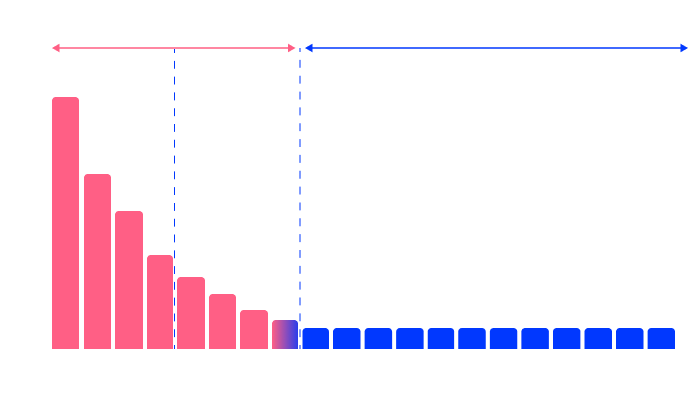
CMAX targets the bulk of search demand that sits in the long tail. Our agents add and improve content across new and existing pages.
The platform uses Dynamic Internal Linking to connect page clusters, which gives long tail keywords examples more structural value than isolated head terms.
Examples help enterprise teams choose topics worth building at scale
Good examples reveal demand patterns. The goal is to spot where specificity adds business value: a more qualified visitor, a clearer page type or a stronger commercial signal.
Most search and Artificial Intelligence (AI) demand sits in the long tail. A narrow SEO keywords list rarely captures the specific searches your site doesn’t yet answer.
High-value patterns by industry
In ecommerce, examples are built from attribute, occasion and comparison modifiers: “machine washable cotton quilt cover”, “queen quilt cover for hot sleepers” or “ceramic vs stoneware dinner set”. Regulated industries lean on standards and audit language: “SOC 2 vendor onboarding checklist” or “NDIS provider compliance software”.
In SaaS and services, long tail keyword research often combines role, workflow, integration and migration terms, such as “Salesforce integration for wealth advisers” or “migrate from spreadsheets to inventory software”.
From clusters to content plans
Effective keyword research for small business starts by grouping examples by intent. Then you assign each group to the page type that can satisfy it: category, feature, use case, comparison, problem-solution or support content.
Link broad pages to narrower pages so users and Google can follow the cluster logic.
Search and AI visibility is built from breadth, freshness and connected content. A thin set of high-volume keywords isn’t enough.
Frequently Asked Questions (FAQ)
Does zero search volume mean nobody searches for a keyword?
No. Keyword tools estimate demand. They don’t give a full census of searches.
Google describes Keyword Planner data as search volume and forecast information used for planning, not exact proof of future visits.
A zero volume query can still be worth testing if it closely matches a product, audience or workflow. This is especially true when the same modifier pattern appears across related searches.
How can you measure the success of long-tail keywords?
Start with the question: what are long tail keywords? Then, measure performance at the cluster level before you inspect individual queries. Single terms are often too small to judge alone.
Use Search Console to review clicks, impressions, CTR, average position and which pages earn which queries. For commercial pages, the real test is whether the cluster brings better-fit visits and stronger downstream actions than broader head terms do.
Why are some long-tail queries missing from Google Search Console?
Google omits queries to protect privacy, particularly those not issued by more than a few dozen users over a two- to three-month period. Display and export limits also mean not every row appears in every view.
Missing query rows don’t always mean missing demand. Privacy filtering can hide individual queries, so assess long tail keywords examples through broader page and cluster performance.
Long tail keywords examples start with intent
Long tail keywords examples are useful when they show what the searcher is trying to do. The number of words in the query matters less.
We ground SEO keywords analysis in that distinction, because the modifier often tells you which page to build, what proof to include and where the visit can go next.
CMAX is built around the same idea: growth comes from covering the specific searches you don’t show up for yet. Our Agentic SEO Platform helps brands find long tail keywords, expand content around them, and keep that content fresh and connected across search and AI.
The quickest way to see which of those searches you’re missing is to visualise them on a map. A review shows you where the gaps are, and what you do about them is up to you.
If you’re curious as to how you’re performing on AI, book in a Missing Customer Map review with our Growth Team.
Author
Jeremy Tang
Founder and CEO of CMAX
Jeremy Tang is the Founder and CEO of CMAX. With over 2 decades of experience in business consulting and digital marketing, he has successfully driven seven startup businesses, six of which achieved $1 million in revenue from zero in less than 16 months, 5 of which grew to multi-million dollar a year ventures without any external funding. Jeremy's expertise lies in streamlining business processes through technology and leveraging digital (in particular SEO) for business growth. He resides in Australia, travels extensively, and draws inspiration from his global experiences.