A generative AI SEO service fixes a problem most retailers have: too few useful pages for the specific ways customers search.
Most sites cover the main category terms and a handful of product pages, then stop.
Picture a cinema with four screens, all showing the same two blockbusters.
Anyone who wants a subtitled documentary or a kids’ matinee walks to the cinema down the road instead. In this context, a coverage gap means screens on your site showing nothing a specific searcher came to see, and the fix is a specific page (or movie) for each of those searches.
SGE AI SEO audits find that gap, and it’s worth finding before competitors, marketplaces and AI engines that retrieve from Google collect the demand you left unserved.
The link between generative AI and SEO is a governed system that creates, connects and refreshes useful pages. Isolated drafts don’t do that.
Broader coverage comes from a system that’s built and maintained, because a one-off batch of articles goes stale.
We treat content as something that needs structure, review and ongoing updates. A folder of AI drafts is still a folder.
Our approach connects AI and SEO through structured review, ongoing updates and approved brand inputs.
Built for brands that need broader search coverage
Content surface area is how many searches your site has a useful answer for. Cover only category terms and a handful of product pages, and you hand demand to competitors, marketplaces and review sites.
An AI SEO content generator produces drafts. A service decides which pages to build, reviews them and keeps them current.
Mapping the long tail
Long tail means the specific searches people type when they know roughly what they want, like “best washable linen quilt cover for hot sleepers” instead of “quilt cover.” Effective LLM SEO covers detailed needs like that one.
Google reports 15% of the searches it sees every day are new, so keyword lists go stale and coverage work is never finished.
From output to governed growth
After an AI SEO audit sets the coverage baseline, a governed service treats content as a system: approved inputs, reviewed drafts, live pages, internal links, performance checks and scheduled updates.
We apply AI SEO optimisation across connected subtopics, comparisons, use cases and objections, because AI tools retrieve information through several smaller searches. Buyers need connected answers for each of those.
The signals that move visibility
Google’s systems evaluate content quality. Useful automated SEO reporting measures relevance, coverage, freshness and commercial performance, and gives a higher word count no credit.
The buying question is direct: does the service improve relevance, coverage, structure, freshness and measurement, or does it produce more words?
An AI SEO analyser can score a single page. It can’t tell you which pages you’re missing.
Even the best SEO automation tools need that coverage picture before they’re useful.
Broader intent coverage
Intent coverage means building pages for the questions, comparisons, alternatives and task-based searches buyers use before they convert. A generative AI SEO service builds specific pages for fit, materials, care, delivery and “best for” searches.
Google’s AI Mode issues multiple related searches across subtopics and data sources, so brands with useful, specific pages across more than one angle get picked up. AI SEO audits show which of those pages you need.
Fresh, connected, readable content
Freshness means updating prices, product details, claims, examples and links so Google’s index keeps seeing current information. We govern programmatic SEO with Dynamic Internal Linking and Full Body SEO.
They connect related pages so Google can map how a topic cluster fits together and find important pages across a large site. A programmatic SEO agency that publishes templates at volume without review leaves thin pages behind.
The test is simple: can a buyer and Google get from a broad category page to a specific answer without a dead end?
Agentic SEO keeps working after publishing
AI powered SEO services continue after publication. They check impressions, coverage gaps, declining pages, missing internal links and weak answers in Search Console, Google’s free tool showing which searches your site appears for.
Unlike generic AI copywriting, a generative AI SEO service uses that evidence to revise pages that get seen but not clicked, consolidate pages competing with each other and add links where valuable pages sit buried too deep.
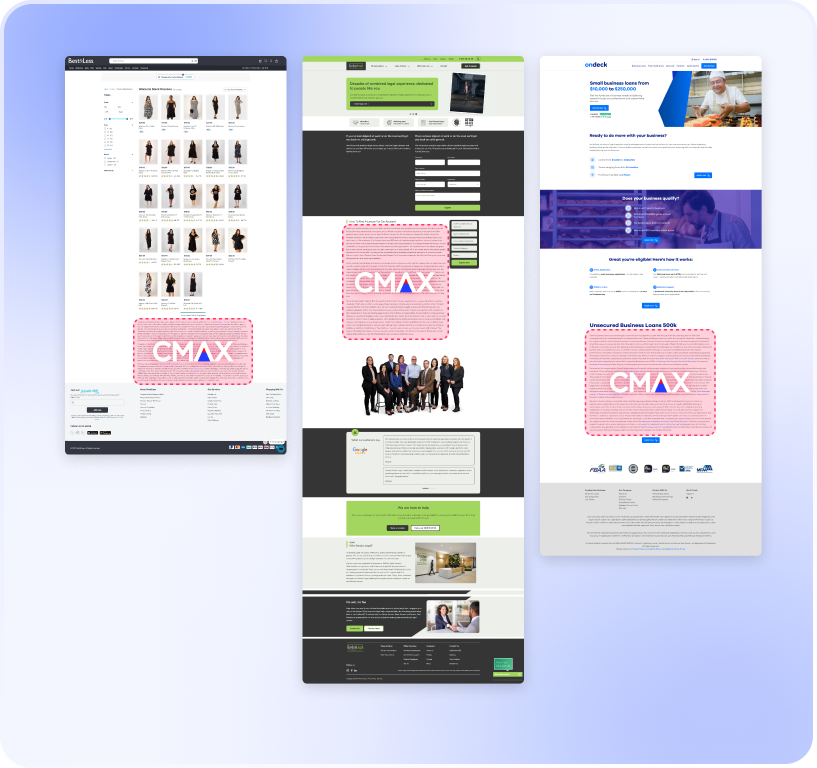
CMAX is an Agentic SEO Platform for teams that need control and scale
CMAX runs AI driven content creation for teams that need control. Enterprise and mid-market brands need approval workflows, brand-safe language, source traceability and reporting that shows whether coverage is expanding.
Trained on approved content
CMAX is trained on human-reviewed, client-approved content, so outputs stay closer to approved terminology, positioning, product facts and compliance requirements than a general model starting from a blank prompt. Documentation about AI marketing Australia uses Australian spelling and dollars, while US materials need American spelling and currency.
This matters in finance, healthcare, legal, education, SaaS and ecommerce, where one loose claim can cause review delays, legal rewrites or customer confusion.
Long-tail demand at scale
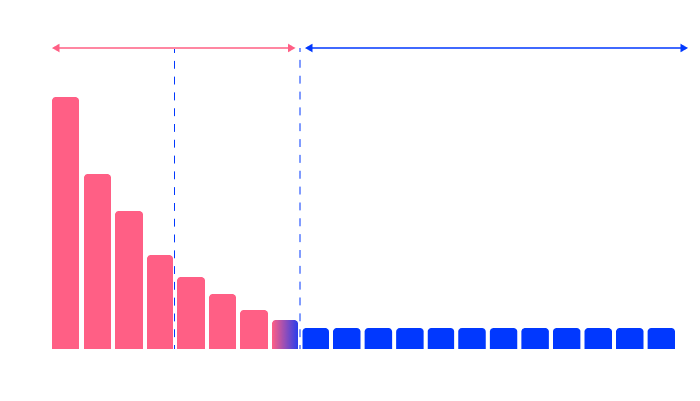
Over 90% of search and AI demand is in the long tail. Most SEO programmes under-cover it, because manual teams can’t economically build and refresh thousands of specific pages at the pace demand changes.
CMAX targets that same long tail, where most of the demand sits. We define a generative AI SEO service as governed production and ongoing optimisation across those specific searches.
A scalable AI SEO strategy creates approved, connected answers for the many ways buyers describe the same need.
Earlier click visibility
Most SEO programmes run by conventional agencies, using outdated methods, tell clients to expect results in six months. CMAX’s methods allow clients to start seeing clicks in 6 to 8 weeks.
Timelines depend on the site, its competition, technical access, approval speed and how quickly recommendations are implemented.
Frequently Asked Questions (FAQ)
Can Google penalise AI-generated SEO content?
Google won’t penalise content simply because AI produced it. Responsible generative AI services and solutions prioritise original, accurate and useful material, because Google targets automation used mainly to manipulate search results.
The test is whether the content is original, useful, accurate and built for people first, with clear review and quality controls in place.
Will an AI SEO service use my data to train its models?
Before work starts, an AI SEO consultant should clarify how the contract, model provider, deployment setup and data processing terms govern the use of your company information. Sound generative AI strategy advisory examines those same terms before approved information enters a workflow.
Ask whether your approved content, product data, customer information and unpublished strategy are eligible for model training. OpenAI states that data sent through its API is not used to train or improve its models by default unless the customer explicitly opts in.
Who owns content created by an AI SEO service?
Commercial ownership should be stated in the service agreement, covering drafts, final pages, source files, prompts, templates, updates and derivative content. Clear ownership of final pages, templates and updates keeps a generative AI SEO service commercially accountable after publication.
Copyright is a separate question: the U.S. Copyright Office states AI-generated material is not protected by copyright unless there is sufficient human authorship in the expression, selection or arrangement.
Generative AI SEO Service Starts With Search Coverage
A generative AI SEO service is only useful if it expands the ways your site can answer real buyer searches. We built CMAX around that idea.
You are usually losing to coverage you don’t have across the long tail.
We ground each LLM SEO strategy in approved inputs, connected pages, performance checks and ongoing updates. Search and AI visibility depend on publishing specific answers, keeping them fresh and linking them well, and SEO for AI search focuses on those practices.
The review is diagnostic. You see which specific searches your site doesn’t answer yet, and you decide what to do next.
If you’re curious as to how you’re performing on AI, book in a Missing Customer Map review with our Growth Team.
Author
Jeremy Tang
Founder and CEO of CMAX
Jeremy Tang is the Founder and CEO of CMAX. With over 2 decades of experience in business consulting and digital marketing, he has successfully driven seven startup businesses, six of which achieved $1 million in revenue from zero in less than 16 months, 5 of which grew to multi-million dollar a year ventures without any external funding. Jeremy's expertise lies in streamlining business processes through technology and leveraging digital (in particular SEO) for business growth. He resides in Australia, travels extensively, and draws inspiration from his global experiences.