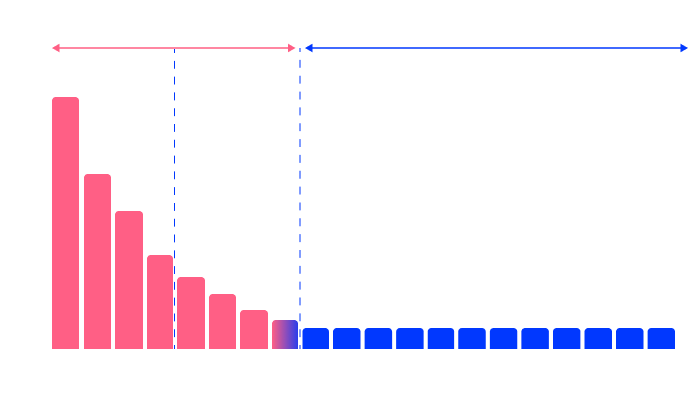
Start with a simple idea: each long tail keyword is a specific request from a real customer. Imagine a bookshop with a front table of bestsellers and thousands of titles on the back shelves.
Browsers drift past the front table, but the person who walks to the back and asks staff for one exact book is ready to buy it. Staff who only know the front table send that person home empty-handed.
In this context, long tail keyword research means finding the exact questions people ask at the back shelves and giving each one a page that answers it.
A short search like “cookware sale” is broad. A specific phrase like “non-stick frypan for induction cooktop Sydney delivery” gives keyword research tools far more to work with.
It tells you what the shopper owns, what they need and where they live. Long tail keyword research turns those details into decisions about which pages to build.
Most retailers chase head terms because they look impressive in a report. Nobody has ever banked a report.
Long tail keyword research shows the problem your customer is trying to solve, and that is where the buying decision gets made.
Google has also said AI tools now run several smaller searches behind the scenes to build one answer. It has said people typing into AI search tend to ask longer, more specific questions.
AI engines retrieve from Google, so the search engine results for each small question shape the answer your customer sees.
CMAX works inside this problem. Our agents help brands use long tail keyword research to build and maintain content across the many specific ways customers search for what they sell.
Long tail keywords capture demand that head terms miss
Plain-English meaning of long tail research
Long tail keyword research maps specific searches such as “non-stick frypan for induction cooktop” to distinct needs and suitable pages. Long tail describes how demand spreads across many specific searches.
Word count has little to do with it. “Cookware” is broad.
The frypan phrase tells you the buyer’s situation, their constraint and their likely next question. The SEO keyword meaning that matters here is a customer need, written as a search.
Deciding whether a search needs a new page, an existing page or no coverage turns the research into an SEO keyword strategy. The job is to decide which searches earn their own page and which belong inside an existing one.
Searches with no commercial relevance get dropped.
Why the long tail drives revenue
Head terms tell you the category. Long tail terms tell you the customer’s problem.
Use case, urgency, location and price expose search intent types that a broad category name can’t separate. A retailer learns more from long tail keywords that include use case, urgency, location or price than from a category name alone.
Google has confirmed that AI search uses query fan-out. It runs several smaller searches to build one answer.
AI users also ask longer, more specific questions with stronger commercial intent. Content surface area is the number of those searches you have a useful answer for.
It is a revenue issue.
A practical workflow separates useful terms from noise
Finding specific searches beyond autocomplete
Autocomplete shows common refinements. The highest-intent searches rarely surface there.
Sales-call language, internal site search, support questions, paid search terms, competitor page gaps and Search Console data give long tail keyword research stronger evidence than autocomplete alone.
A keyword finder or an SEO keyword tool free of charge can start the list, and free keyword research is fine for that job. The evidence above decides what stays on it.
A broad term like “kitchen knives” can branch into “knife set for left-handed cooks” or “carbon steel knife care for new owners”. Those phrases reveal demand your main category pages don’t cover.
Validating intent, demand and fit
A keyword earns its own page when four things align. Revenue relevance, conversion likelihood and competitive difficulty show which keyword suggestions merit that investment.
Before assigning pages to longtail keywords, confirm that the intent is clear and the topic connects to something you sell. Confirm the content can outperform current results and link naturally to nearby commercial pages.
Don’t discard a term because a third-party tool reports zero volume. Niche, seasonal and emerging queries are routinely undercounted.
Keyword difficulty analysis helps prioritise terms alongside conversion likelihood and internal-link value. Prioritise by revenue relevance first, then conversion likelihood, then competitive difficulty.
Then ask whether the topic strengthens a content cluster through internal links.
Clustering and freshness keep coverage efficient
Grouping variants without duplication
Clustering comes next, and longtail keyword research groups keywords by the job the searcher wants done. Collecting isolated phrases gives you a list.
Grouping by the answer each phrase requires gives you a page plan. So “best running shoes for flat feet” and “flat feet running shoes” belong on one page.
“What causes flat feet” and “orthotics for flat feet” do not. The first wants a definition and the second wants a product or treatment.
If you’re asking “What is a long tail keyword?”, this is the answer: a search defined by its intent, whatever its length. Separate pages make sense when search results show different expectations.
Think of definition versus comparison, beginner guide versus implementation checklist, product category versus feature page, or informational question versus pricing intent. That separation avoids thin duplicate pages and gives Google clearer, connected coverage across the topic.
How CMAX covers the long tail
Over 90% of search and AI demand is in the long tail. At that scale, what are long tail keywords stops being a definition question and becomes an operations question.
Thousands of pages must stay accurate, connected and fresh as new searches appear and older pages lose relevance.
We run the Agentic SEO Platform. CMAX is trained on human-reviewed, client-approved content.
It supports whatever long tail keyword research tool you already use through scaled content updates, Dynamic Internal Linking and Full Body SEO. Your long tail coverage stays live instead of abandoned on a spreadsheet.
Frequently Asked Questions (FAQ)
How do I track long-tail keyword performance?
Start with Search Console. It shows the exact queries generating impressions, clicks, average position and page-level visibility from Google Search.
That is the measurement stage of long tail keyword research. Review by cluster, because one strong page often ranks for dozens of close variants.
If impressions are rising but clicks are flat, check whether the title, snippet, page intro and internal links match the searcher’s exact problem.
Are zero search volume keywords worth targeting?
Yes, when the query reflects a real buyer need your business can answer, sell or support. Sales calls, support tickets and Search Console impressions can validate demand even when reported keyword search volume is zero.
Skip the term when it duplicates an existing page or has no commercial connection.
How many keywords should I include on a page?
Build each page around one primary intent, then cover the close variants a reader needs to make progress. Reviewing concrete long tail keywords examples shows whether two searches deserve one stronger page because customers expect the same answer.
Page-level visibility and average position help you assess keyword competition before you refine titles, snippets, introductions and internal links. If the answer, product set, location or level of detail differs, split the searches into separate pages and link them clearly.
Long Tail Keyword Research, Built For Broader Coverage
Long tail keyword research matters because most demand doesn’t sit in a handful of obvious terms. It sits in the specific searches that show what the customer needs and what they’re ready to buy.
That is the gap we built CMAX around. It gives you an SEO strategy example in practice: fresh, connected coverage across specific Google and AI demand.
We focus on the coverage you don’t have, helping brands build and keep useful content across the many ways customers search on Google and AI.
The point is to find long tail keywords and then turn relevant demand into useful content that stays fresh and connected. That adds content surface area, so your site can show up for more of the demand your main category pages miss.
Most brands can’t see which specific searches they have no page for. The review maps those gaps, so you know what’s missing before you decide anything.
If you’re curious as to how you’re performing on AI, book in a Missing Customer Map review with our Growth Team.
Author
Jeremy Tang
Founder and CEO of CMAX
Jeremy Tang is the Founder and CEO of CMAX. With over 2 decades of experience in business consulting and digital marketing, he has successfully driven seven startup businesses, six of which achieved $1 million in revenue from zero in less than 16 months, 5 of which grew to multi-million dollar a year ventures without any external funding. Jeremy's expertise lies in streamlining business processes through technology and leveraging digital (in particular SEO) for business growth. He resides in Australia, travels extensively, and draws inspiration from his global experiences.