Long tail SEO, also known as long-tail search engine optimisation, captures the buyers who already know what they want.
For example, a specific search such as “SEO for lawyers” tells you the service and the industry people are interested in, whereas a broad search for “SEO” tells you almost nothing about what they want.
Many retailers chase the big category terms, watch visits flatten and pay more to Google Ads to fill the gap. Paid ads cost more every year, with the same spend buying less reach. Meanwhile, the demand was in thousands of specific product questions.
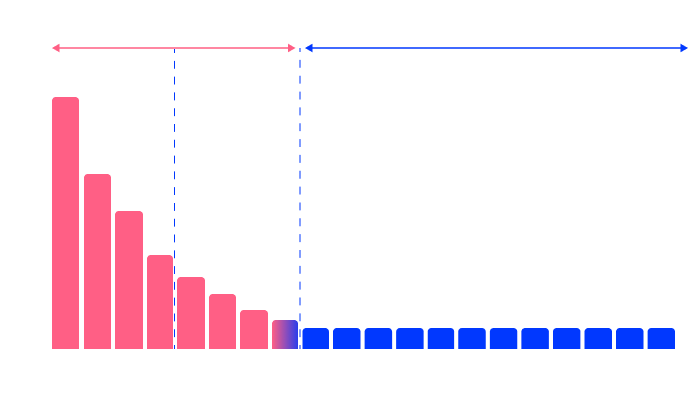
Brands that rank number one on their most important terms rarely capture more than 5% of the organic search opportunity in their category. According to SEMrush, even Nike, which ranks number one for running shoes in the US, only captures around 70,900 visitors a month from non-brand searches related to running shoes, out of more than 8.5 million monthly US searches in the category.
That is under 1% of the actual search demand for the most dominant brand in the market, both offline and online. The rest is spread across the SEO longtail.
CMAX, the Agentic SEO Platform, is built around this problem. We expand the pages your site has, so you answer the many ways customers actually search and not only the obvious broad terms.
Why long tail SEO captures more of the demand you are missing
What long-tail searches signal
Long tail SEO starts with specific queries such as “best nonstick pan for induction cooktop.” Keyword research for small business operations and larger enterprises works best when it separates constraints like induction compatibility from broad product categories, where intent is harder to read.
Why coverage changes demand capture
Long tail SEO is a coverage play across thousands of queries and is not a bet on one keyword.
Amazon shows the pattern in retail, where 46.9% of its non-brand organic search traffic comes from long-tail pages. Keyword research for Amazon listings is a separate exercise from Google, but it also demonstrates how demand is spread across many specific searches.
Whether the work stays in-house using an SEO DIY guide or SEO strategy training or moves to a managed SEO service, the question is the same: do you have a useful page for each of the many ways buyers describe the same need?
How long-tail coverage turns search intent into stronger visit quality
Match intent, not longer phrases
We apply long tail SEO by grouping searches by the decision behind them. Search intent types describe what the searcher is trying to do, such as learn, compare or buy. A query with “best,” “alternatives,” “pricing,” “dimensions” or “near me” usually needs a different answer from your category page.
Matching intent matters more in Artificial Intelligence (AI) search. AI engines retrieve their answers from Google, with AI tools turning each question into eight to 12 smaller Google searches, also known as query fan-out, and building their answer from what they find across related subtopics.
If your site only covers the broad term, a competitor’s page is more likely to fill the gap in that answer.
How CMAX expands content surface area
Content surface area is how many of the ways customers search you have a useful answer for. In a B2B SEO strategy, CMAX increases that surface area by injecting content onto new and existing pages, starting with collection and category pages, with product pages in support.
It uses Full Body SEO and Dynamic Internal Linking to expand relevant pages and connect them to supporting content. That helps Google read how your products, categories, use cases, comparisons and buying questions relate.
In competitive categories such as SEO for startups, broader coverage can answer questions about growth stage, budget, market fit and scalability. No single page has to carry every intent.
Why CMAX is built for scale, freshness and controlled execution
Scaling long-tail coverage with freshness
Though over 90% of search and AI demand is in the long tail, that demand keeps changing because new searches keep appearing.
New product launches, seasonal queries and competitor comparisons all generate searches your team never planned for. An AI SEO strategy needs current coverage because AI answers are built from Google searches, and those searches keep changing.
CMAX updates content continuously, refreshing or replacing it based on real performance data from Search Console. It targets that same long tail of search demand and is trained on human-reviewed, client-approved content.
Speed, control and regulated execution
Conventional SEO agencies using outdated SEO programmes usually tell clients to expect results in 6 months. CMAX’s methods allow clients to start seeing clicks in 6 to 8 weeks. That applies to CMAX clients, not to SEO in general. Timelines vary by site, market and execution.
Control runs alongside speed in our LLM SEO strategy. Humans calibrate the initial content with your business, and CMAX then generates output closely based on that approved content. Custom models for regulated industries build your compliance requirements into the process.
Frequently Asked Questions (FAQ)
Are long-tail keywords with no reported search volume worth targeting?
Sometimes, yes. A useful SEO strategy checklist tests buyer relevance alongside reported volume. A zero-volume label may reflect incomplete measurement, as keyword research tools may not see every query.
Zero volume can mean “not measured” and not “nobody searches this.” Because measured volume is incomplete, effective SEO automation must also ask whether a question helps buyers choose, compare, configure or trust a product.
Can one page target multiple long-tail keywords?
Yes, when the searches share the same intent. A page that answers one underlying question in plain language can rank for several related phrases.
“Best nonstick pan for induction,” “nonstick pan warranty” and “how to season a cast iron pan” all concern cookware. Each implies a different decision. Combining them muddies relevance and risks your own pages competing with each other for the same search.
How do you measure the performance of long-tail keywords?
To evaluate longtail SEO, start with Search Console. It shows impressions, clicks, click-through rate and average position for the searches and pages your site appears for. Afterwards, check quality by looking for pages that assist conversions and for lower dependence on paid clicks in the same product areas.
Long tail SEO, more qualified demand at scale
Long tail SEO works when you treat it as a coverage problem. If buyers search in thousands of specific ways, organic growth depends on how many of those decision points your site answers well. A local SEO strategy gains useful coverage when pages answer specific service, location and decision questions, it integrates semantic SEO well, and no single broad category term carries the load.
You can’t fix a gap you can’t see. A review of where your site is missing customers is a direct way to find out.
If you’re curious as to how you’re performing on AI, book in a Missing Customer Map review with our Growth Team.
Author
Jeremy Tang
Founder and CEO of CMAX
Jeremy Tang is the Founder and CEO of CMAX. With over 2 decades of experience in business consulting and digital marketing, he has successfully driven seven startup businesses, six of which achieved $1 million in revenue from zero in less than 16 months, 5 of which grew to multi-million dollar a year ventures without any external funding. Jeremy's expertise lies in streamlining business processes through technology and leveraging digital (in particular SEO) for business growth. He resides in Australia, travels extensively, and draws inspiration from his global experiences.