AEO stands for Answer Engine Optimisation. It has nothing to do with Aéropostale (we can’t help you find jeans).
We can however, tell you how to improve your website for AEO: improving your content so Google and AI answer engines can retrieve and cite it.
So what is answer engine optimisation in practice for a homewares or services brand? You structure content so Google and AI tools can find the right page when a customer asks something specific.
“Best running shoes for female athletes in their 50s” is specific. “Shoes” is not.
That gets harder at scale. Enterprise sites carry thousands of products, categories and locations, and most of that detail never gets a dedicated answer.
If you run an enterprise marketing team, comparing an AEO Australia agency with US providers means weighing differences in regulation, market language and customer demand.
One SEO consultant Newcastle can cover a local market, but thousands of products and locations need a different scale.
The teams getting surfaced in AI answers have pages that match how customers actually ask. Site size matters less.
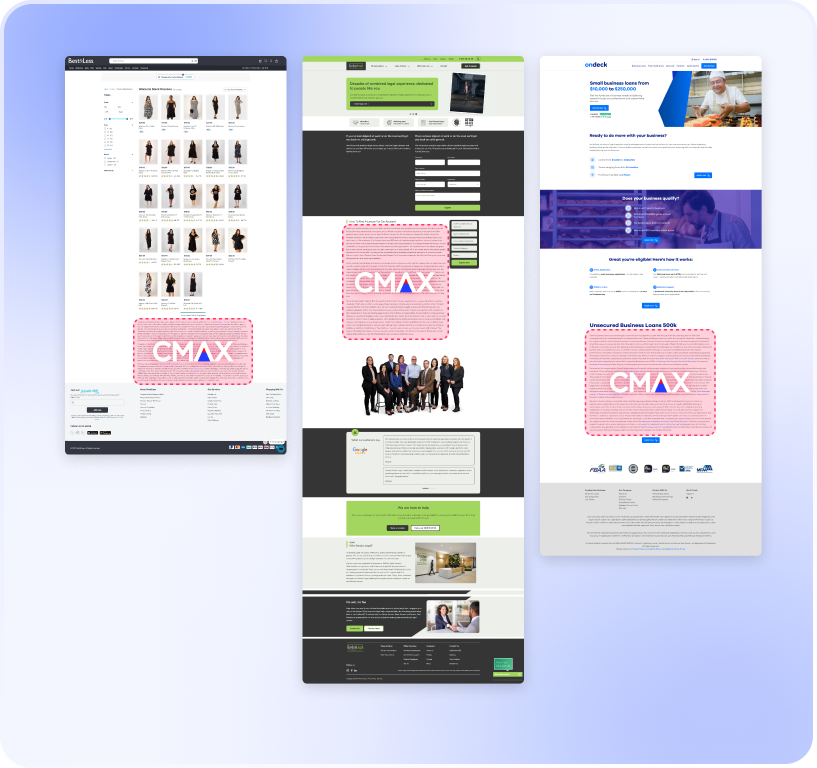
CMAX works with enterprise marketing teams on this problem. We build long-tail coverage and page structure so more of that specific demand has somewhere to land.
AEO means making your content easy for answer engines to find and cite
For commercial sites, AEO structures product and category content so Google and AI answer experiences can retrieve the right page when a buyer asks something specific. Think “best modular sofa for small apartment” instead of “sofa”.
AEO helps answers retrieve pages
Each page needs to match a clear question, product category, problem, audience and next step. To optimise content for AI search, match each page to one question, one category, one audience and one next step.
Google’s generative AI features pull from its index, the set of pages Google already knows about. If your site has no useful page for the exact way a customer asks, answer systems have nothing relevant to retrieve.
SEO basics still power AEO
AEO runs on the same foundations as SEO: crawlable pages, clear headings, useful content, internal links and pages built around real search intent. A search engine optimisation platform that supports AEO still depends on all of them.
Any search engine optimisation platform you assess should cover those basics first, and a plain answer to what is search optimisation starts there too. A search engine optimisation platform that skips them leaves AEO nothing to build on.
Google explicitly advises site owners to keep prioritising foundational SEO best practices, and its generative AI features rely on pages retrieved from that same index. For a marketing team, AEO extends the search and AI visibility work you already fund through your search engine optimisation platform.
The pages that get surfaced are specific, structured, and easy to trust
Answer engines favour pages that solve one clear problem and name the product, service, audience or use case directly. AEO gives each page one problem, one audience and one next step to interpret.
A page that tries to cover homewares, sofas, returns policy and interior styling ideas gives answer systems less certainty than a page built around one narrow question. That page has a direct answer, supporting detail and relevant internal links.
Long-tail coverage creates more opportunities
Long-tail searches are the specific, detailed queries buyers actually type. A page that directly answers “machine washable linen quilt cover king size” has a better chance of matching that intent than a page chasing “quilt covers”.
The same page shape suits a featured snippet, or what some people search for as feature snippets.
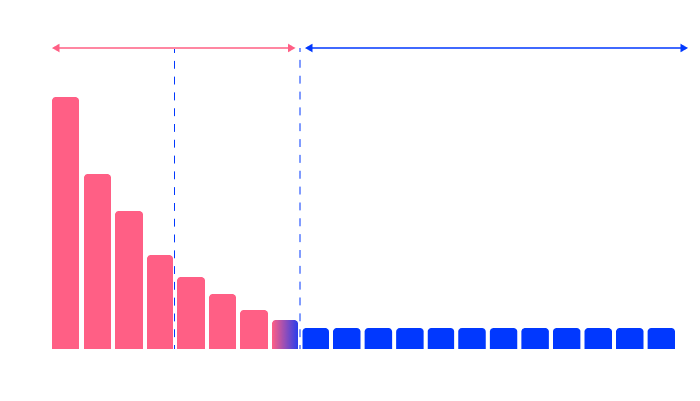
Over 90% of search and AI demand is in the long tail. That is why visibility stalls when a site targets only obvious category terms.
AI widens the gap. When a buyer asks a question, an AI tool runs several smaller Google searches and builds its answer from what it finds across those results.
Picture a hotel guest who asks the concierge one question: where should we eat tonight? Behind the desk, the concierge makes a dozen or so calls to restaurants and taxi firms, then gives the guest one answer.
Only the places that picked up the phone make it into that answer. The real thing has no person deciding: the AI runs the searches automatically, and the set varies between runs.
In this context, query fan-out means the guest’s one question becomes a dozen or so calls, and your pages have to be on the end of those calls to appear in the one answer.
A single broad page rarely covers enough of those narrower searches. An SEO company focused only on broad pages will rarely cover them either.
The number of specific questions your site answers is a direct commercial advantage.
Structure clarifies context for engines
Answer systems decide whether to use a page partly by how clearly it signals what it covers. Google confirms structured data is a machine-readable way to share information about content.
Effective generative AI search engine optimisation uses answer-first headings, explicit product entities, internal links and schema to clarify page context.
The avoidable mistake is polished copy that never names the buyer problem, the category, the use case or the proof points clearly enough for an engine to ACT on.
CMAX pairs AEO structure with ongoing content updates
Basic AEO checklists stop at formatting: add FAQs, shorten answers, mark up schema, tidy headings. Those steps help.
They don’t solve the bigger enterprise problem: customers search in thousands of detailed ways, new searches keep appearing, and older content loses relevance.
CMAX is the Agentic SEO Platform that treats aeo as an operating model for search and AI visibility. It combines long-tail coverage, answer-first page structure, internal linking and performance-based updates.
When you compare an answer engine optimisation platform, ask whether it keeps content current after launch. When you read a list of best generative engine optimisation tools, ask what each one does about pages you don’t have yet.
CMAX keeps pages connected and current
CMAX is trained on human-reviewed, client-approved content, so scaled AEO work stays aligned with approved claims, terminology, product language and compliance requirements.
If you’re asking what is generative engine optimisation, a good answer covers retrieval, approved claims and structured content, and promises no citations. Dynamic Internal Linking connects related pages so Google can read the surrounding topic cluster.
Full Body SEO adds and improves useful content across new and existing pages.
CMAX focuses on long-tail demand
CMAX targets that same long tail, where an SEO content writing agency would focus on the specific needs, constraints and comparison criteria buyers reveal there.
For generative engine optimisation GEO work, we start from demand identified in Google Analytics and Search Console. Then we deploy and update content across the relevant gaps.
Most SEO programmes run by conventional agencies, using outdated methods, tell clients to expect results in six months. CMAX’s methods allow clients to start seeing clicks in 6 to 8 weeks.
Frequently Asked Questions (FAQ)
How do you measure AEO success?
Enterprise teams define aeo as measurable retrieval coverage across qualified impressions, long-tail positions, assisted conversions and revenue contribution. Answer engine optimisation services should report against the same measures.
Leading signals show up first. They include growth in qualified impressions, more pages appearing for narrow-intent searches, stronger long-tail positions and improved crawl frequency.
Lagging signals show up later: referral visits from search and AI surfaces, assisted conversions, revenue contribution, and direct visits your analytics can’t trace to a source.
Why is generative engine optimisation important? Because it gains visibility for the specific questions that accurately describe what a business sells.
Generative engine optimisation services should report on the same signals.
How long does it take to see AEO results?
Timelines depend on the site, its competition and how the work is done. A site with strong technical foundations and clear product demand moves faster.
Teams that can find long tail keywords and map them to clear pages are better placed than teams working with thin content or unclear page structure.
Credible generative engine optimisation services assess technical foundations, competition and page structure before setting expectations. Our own timeline for first clicks is set out in Section 3.2.
Can AEO guarantee AI citations?
No credible AEO programme can guarantee AI citations. Answer engines decide what to retrieve, rank and cite through systems no vendor controls.
Prompt tracking tools can be one signal, but they shouldn’t anchor the whole measurement plan. A badge such as an aeo certification doesn’t control those systems either.
CMAX uses aeo to improve retrieval odds through specific, connected pages.
AEO Needs Coverage More Than Checklists
AEO works when your site has useful answers for the many specific ways buyers search. Cleaner headings on a handful of pages won’t do that.
We deliver answer engine optimisation services through long-tail coverage, connected pages and content built from approved brand assets. The gap we focus on is coverage you don’t have yet, across search and AI.
Search visibility is a content coverage problem, and international SEO services add the need to align that coverage with each market’s language and demand. The platform deploys and updates content across new and existing pages, keeps related pages connected with internal linking, and builds from approved brand content so the work stays aligned with how the business needs to speak.
AI engines retrieve from Google. If there is no page for the question, there is nothing to cite.
You can find your gaps before you spend anything on fixing them. A review of the customer questions your site doesn’t yet answer is the plain way to see them.
If you’re curious as to how you’re performing on AI, book in a Missing Customer Map review with our Growth Team.
Author
Jeremy Tang
Founder and CEO of CMAX
Jeremy Tang is the Founder and CEO of CMAX. With over 2 decades of experience in business consulting and digital marketing, he has successfully driven seven startup businesses, six of which achieved $1 million in revenue from zero in less than 16 months, 5 of which grew to multi-million dollar a year ventures without any external funding. Jeremy's expertise lies in streamlining business processes through technology and leveraging digital (in particular SEO) for business growth. He resides in Australia, travels extensively, and draws inspiration from his global experiences.