The pairing of SEO and AI pays off only when it covers more of what your customers search for. Faster page production does nothing for that on its own.
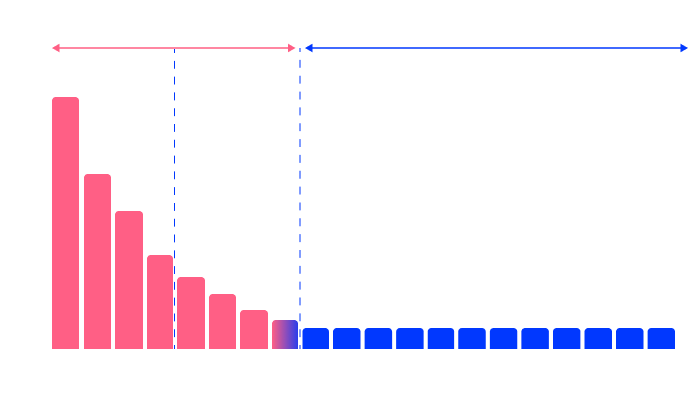
At CMAX, AI for SEO means adding pages across the specific, detailed searches. Over 90% of search and AI demand is in the long tail.
Most searches that matter to a homewares retailer are specific: comparisons, use cases, “best for small apartments” and the questions people type just before they buy. Broad terms like “sofas” or “dining tables” sit on top of them.
Good AI software for search has to cover those specific searches, and the best AI for SEO optimisation matches a credible answer to each one.
So ask your agency a plain question: how many of the thousands of searches your customers already make do you have a page for?
CMAX approaches AI for SEO from that angle. We use performance data to find and close coverage gaps, and volume follows from that.
AI for SEO works when it expands coverage
Long-tail searches drive most SEO value
Most search demand sits in the long tail. These are the specific searches people type when they compare products, check use cases, look for alternatives or justify a purchase.
A credible AI SEO service adds pages across the specific searches a brand can answer accurately. The test is whether you have useful pages for the searches your customers already make.
AI helps, humans decide
AI speeds up research, first-pass briefs, internal linking ideas, content updates and gap analysis. Humans decide positioning, claims, compliance and what the brand stands behind.
A controlled AI SEO strategy has people approve positioning, claims and compliance before automation scales production.
Google’s guidelines confirm that appropriate use of AI is not against its policies. Using automation mainly to manipulate search results is.
Before an AI SEO company scales your coverage, your people still need to define the positioning, approved claims and commercial priorities its systems follow.
CMAX uses agentic SEO to keep content fresh from performance data
Trained content, linked and updated
CMAX is trained on human-reviewed, client-approved content. Every output stays anchored to your approved product language, claims, exclusions, tone and commercial priorities.
An AI SEO analyser can find isolated page issues. We go further with Dynamic Internal Linking and Full Body SEO.
They connect product pages, comparison pages, buying guides, FAQs and location pages, so those pages support each other and stop competing for the same search.
Long-tail targeting from performance data
CMAX targets the long tail, where most search demand sits. Performance signals decide what we expand, refresh and connect next.
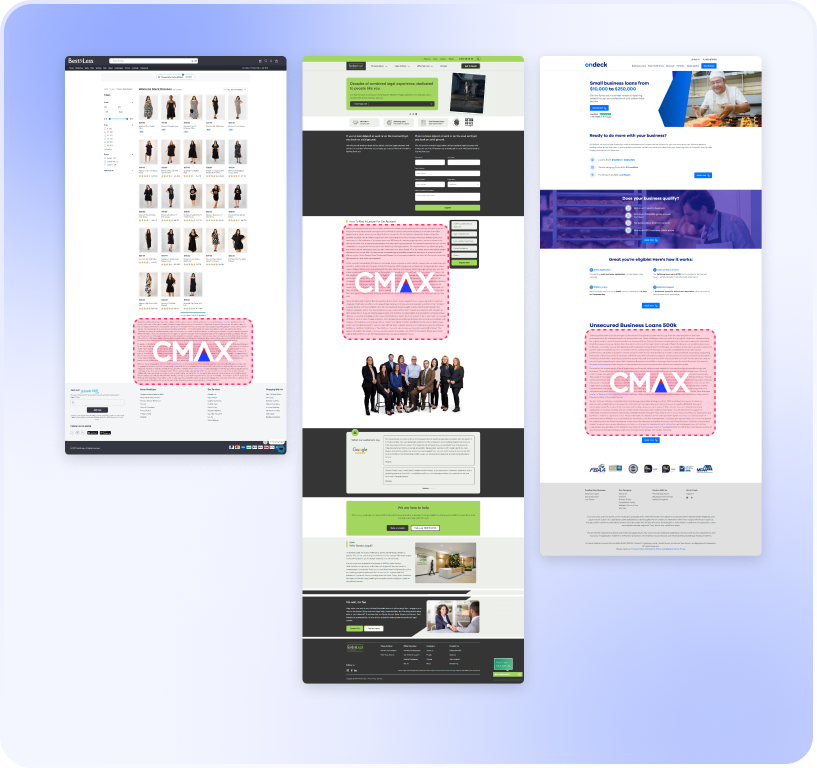
When Search Console shows new impressions, missed clicks or emerging coverage gaps, the platform refreshes the pages affected. Any SEO automation platform worth paying for should work from this kind of data.
Programmatic SEO publishes from templates and then leaves pages alone. CMAX keeps updating content as new searches, impressions and coverage gaps appear.
The same data shows regional gaps. Country-level Search Console trends can separate demand for AI SEO Australia from similar patterns elsewhere, which helps teams prioritise real coverage opportunities.
The difference shows up in coverage and revenue
Faster early traction than old programmes
Most SEO programmes run by conventional agencies, using outdated methods, tell clients to expect results in six months. CMAX’s methods allow clients to start seeing clicks in 6 to 8 weeks.
Long-tail searches move faster because they’re more specific, less crowded and closer to what customers type when they’re ready to buy.
Broader category terms still take longer. Reliable automated SEO reporting keeps early long-tail traction separate from broader terms, whose timelines depend on competition.
Measure business impact
Word count and page count aren’t the scorecard. A pile of unvisited pages is still a pile.
Track keyword positions, Search Console impressions and clicks, revenue from organic search, assisted conversions, and coverage across product, category, problem, comparison and location searches. That includes demand for AI SEO Brisbane and equivalent patterns in other cities.
Compare the best AI SEO platforms on whether they report coverage as well as keyword positions.
More pages only move the needle when each one is distinct, useful, internally connected and mapped to real search demand. Software like Semrush can show keyword positions, but distinct pages and correct canonical signals decide whether expanded coverage compounds.
Google picks one canonical version from near-duplicate pages, so volume without differentiation doesn’t compound.
Frequently Asked Questions (FAQ)
Does Google penalise AI-generated content?
Google does not penalise content created with AI for SEO because AI helped create it. Google’s own guidance states that appropriate use of AI or automation is not against its guidelines.
AI content can perform well when it is useful, helpful, original and satisfies E-E-A-T. The risk is flooding a site with thin pages built mainly to manipulate search results.
A practical test: would your compliance lead, your sales team or a real customer recognise the page as accurate and useful?
Can Google index AI-generated content?
Indexable means Google can store a page and show it in results. Pages produced through AI SEO services stay indexable when they are useful, crawlable and free of standard blockers such as noindex tags, weak canonical signals or poor duplication handling.
The best SEO automation tools still need useful, crawlable pages. Thin, copied or overlapping pages struggle because they give Google little reason to keep or surface them.
Can AI-generated pages cause keyword cannibalisation?
They can. Cannibalisation happens when your own pages compete for the same search.
It usually starts when teams publish near-duplicate pages for the same intent with minor wording changes, for example “best sofa bed for apartments,” “best apartment sofa bed,” and “small apartment sofa beds” as separate pages. Google will usually select one canonical version from similar URLs.
The fix is editorial. Give each page one clear job, merge overlaps and use internal links to show which page should rank for which search.
Clear page roles, merged overlaps and deliberate internal links keep AI for SEO scalable without multiplying near-duplicate URLs.
AI for SEO Starts With Search Coverage
AI for SEO creates value when it expands the number of customer searches your site can answer. Drafting faster is a side effect.
That gap is what CMAX is built for: coverage you don’t have yet, across the long-tail searches that drive most demand in Google and AI. Search Console can separate local demand for AI SEO Melbourne from Sydney patterns, so CMAX can prioritise real regional coverage gaps.
CMAX is the Agentic SEO Platform. It deploys content across new and existing pages, connects related pages through internal linking and keeps that content fresh from real performance data.
The purpose of AI for SEO is useful coverage, connected content and a clearer path from impressions and clicks to revenue, which is what AI SEO work should deliver.
A review is the quickest way to see which of your customers’ searches you have no page for. It shows the gaps before you decide what to do about them.
If you’re curious as to how you’re performing on AI, book in a Missing Customer Map review with our Growth Team.
Author
Jeremy Tang
Founder and CEO of CMAX
Jeremy Tang is the Founder and CEO of CMAX. With over 2 decades of experience in business consulting and digital marketing, he has successfully driven seven startup businesses, six of which achieved $1 million in revenue from zero in less than 16 months, 5 of which grew to multi-million dollar a year ventures without any external funding. Jeremy's expertise lies in streamlining business processes through technology and leveraging digital (in particular SEO) for business growth. He resides in Australia, travels extensively, and draws inspiration from his global experiences.