SEO for banks stalls when marketing teams and compliance teams work in sequence instead of together. Every product page, rate comparison, and branch listing carries YMYL weight, which means a single unapproved claim can pull more than rankings. The banks that build momentum are the ones that bake legal review, E-E-A-T signals, and technical hygiene into the workflow from the start, not as a final gate. CMAX helps banking teams scale that kind of structured, compliance-first content production without losing speed or search visibility.
Bank SEO succeeds when compliance shapes every page.
YMYL-Safe Content Controls
Effective SEO for banks starts with compliance controls that protect every published page. Google classifies banking content as Your Money or Your Life material, which means product pages, rate tables, eligibility criteria, and comparison content face a high editorial bar. A page that describes loan eligibility in ambiguous terms can read as financial guidance, and that carries regulatory risk before it carries an SEO risk.
The safest workflow builds legal review, plain-language disclaimers, and citations to relevant regulators into the publication process before a page goes live. This applies most directly to the pages closest to conversion: rate pages, product detail pages, eligibility summaries, and any content that compares one product against another. Retrofitting compliance after publication is slower and more expensive than building it into the template from the start.
SEO for banks must adapt as Google AI Search reshapes how financial queries are answered at the top of results, making YMYL-safe, well-cited content even more critical for earning inclusion in AI-generated overviews.
E-E-A-T Signals for Banks
Google’s quality raters look for visible accountability on YMYL pages.[1] For banks, that means content needs to show who wrote it, what qualifies them to write it, which sources the claims rely on, and when the page was last reviewed.
Named authors with role-relevant credentials, primary-source citations (regulators, official rate disclosures, product terms), and clear review dates are the practical signals that satisfy this standard. These details do not need to be buried in a footer. A byline with a title, a “last reviewed” date near the top, and linked citations within the body copy give both Google and readers the accountability trail they are looking for. Each signal reinforces the others: a named reviewer with a compliance title and a dated update carries more weight than any one element alone.
A bank SEO playbook works best in a fixed order.
Five-Step Bank SEO Checklist
Sequence matters in bank SEO. Running steps out of order wastes budget and creates compliance exposure, so the programme follows a fixed progression: fix technical blockers, standardise high-intent page templates, expand local branch coverage, add trust signals, then measure lead quality and visibility against a baseline. For teams running SEO in Australia, the same fixed order applies regardless of market size or product mix.
Start with technical health because everything downstream depends on it. Rate pages, calculators, branch finders, and application forms sit closest to conversion intent, and crawl errors, indexing gaps, certificate warnings, or broken forms on those pages cost you qualified traffic before a single piece of content goes live. Resolve those issues first so Google can access them reliably and users reach working, current conversion paths. Effective SEO for banks is grounded in the same fundamentals as broader website search optimisation, meaning technical health, crawlability, and structured content hierarchies must be resolved before any content scaling effort can compound effectively.
With technical foundations stable, standardise templates for high-intent pages: home loan, savings account, term deposit, and personal loan pages all carry similar decision-stage queries and need consistent structures for fees, eligibility, rates, and required documents. Templates also make compliance review faster because legal signs off on a structure once rather than page by page.
Local branch coverage comes third. Whether the focus is SEO in Sydney or SEO in Melbourne, branch pages built on an approved template, fed from a single location data source, and synced with Google Business profiles scale without introducing data inconsistencies that erode local pack visibility.
Trust signals, including named reviewers, update dates, and regulator citations, layer on top of pages that are already technically sound and structurally consistent. Adding them earlier, before templates are stable, means rework. Building a scalable bank SEO programme often means evaluating how SEO AI tools can accelerate content production while keeping every output within compliance-approved templates and source standards.
Measurement closes the loop. Track organic leads, assisted conversions, and local pack visibility against a pre-programme baseline so performance claims hold up under CFO scrutiny.
Technical Health for Bank Pages
Calculators, rate pages, branch finders, and forms sit one step from an application. Broken indexing, stale structured data, certificate warnings, or inconsistent canonical rules at that stage damage both search visibility and user trust simultaneously.
Branch Pages for Local Intent
Local branch coverage is one of the highest-leverage components of SEO for banks. Schema markup, on-site location data, business hours, maps, staff or service details, and review signals must stay aligned across the site, local listings, and actual branch operations. When those sources conflict, search engines and customers see different versions of the same branch.
Product Pages for Banking Queries
A page targeting banks offering 5 deposit mortgages should answer eligibility, fees, and comparison criteria directly.[1] Product pages perform better for specific banking searches when they answer the decision questions directly: fees, eligibility, comparison criteria, required documents, rate context, and account or loan FAQs that reduce uncertainty before an application starts.
Compliance-Heavy SEO Proof Point
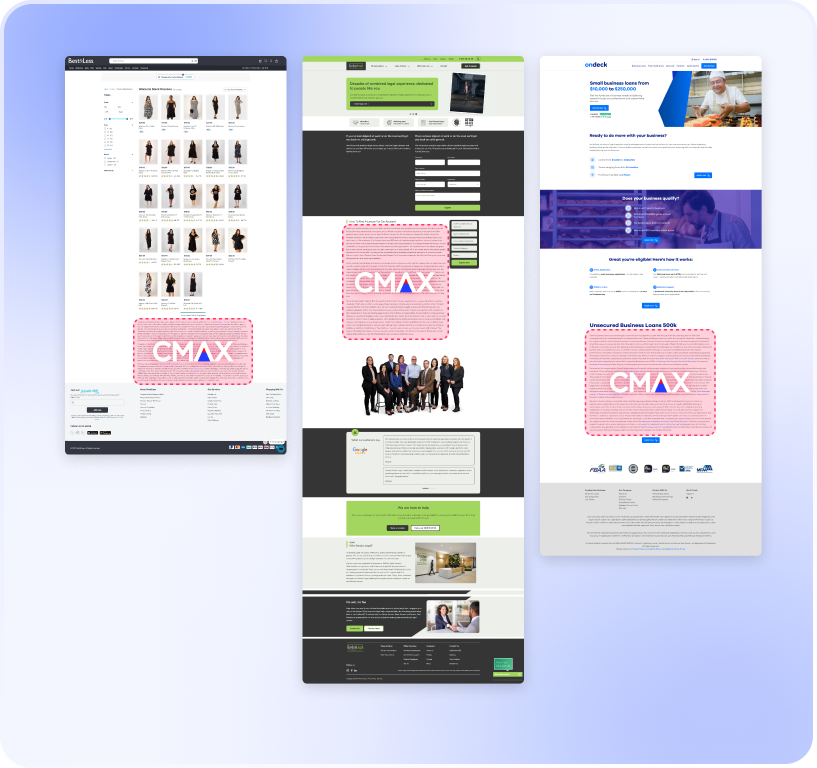
In one CMAX engagement, an online pharmacy scaled from 1,200 to 5,200 pages in two weeks using content trained only on compliance-approved copy. Like SEO for lawyers, banking SEO operates under strict content rules; enterprise SEO adds scale complexity on top of that compliance layer. Banks face the same constraint: approved source material, controlled templates, and human review before sensitive pages can scale.
Controlled AI Content Workflows
AI content can be used in banking when it drafts from approved materials and humans review every page for factual accuracy, disclosures, citations, and product-specific wording.[2] Human reviewers then check factual accuracy, disclosure placement, citations, and page-level intent before publication, so every page meets the standard SEO for banks demands.
SEO for banks must account for how AI search retrieves and summarises financial information, making it critical that each page defines its topic clearly, cites primary sources, and uses extractable formats that AI systems can confidently surface.
Metrics That Show SEO Compounding
Organic leads, assisted conversions, local pack visibility, and SERP feature share show more than traffic volume alone. They reveal whether SEO is improving qualified discovery, expanding long-tail coverage, and influencing banking decisions that typically span multiple visits.
Evidence for Legal and Executive Review
Audit summaries, source logs, and methodology notes show what changed, when it changed, which sources support each page, and how every performance claim was calculated. That paper trail makes SEO reporting defensible before it reaches legal or executive review.
How to Scale Local SEO for Multiple Bank Branches?
Use one approved branch-page template and sync location data from a single source of truth. Update schema, hours, maps, service details, and Google Business information together so each branch page stays accurate, locally relevant, and distinct.
Can AI Content Meet YMYL Standards for Banks?
AI content can be used in banking when it drafts from approved materials and humans review every page for factual accuracy, disclosures, citations, and product-specific wording. The same human-review requirement applies to SEO for ndis, where unverified claims carry similar regulatory weight. AI should not publish unverified financial guidance or unsourced product claims independently.
How to Optimise Banking Content for AI Search?
Each page should define its topic clearly, answer one intent fully, cite primary sources, and use extractable formats: FAQs, comparison tables, eligibility summaries, and concise definitions that AI-driven search systems may surface.
SEO for banks now extends into generative engine optimisation, where structuring product pages with clear definitions, eligibility summaries, and FAQ formats helps AI-driven systems extract and cite bank content accurately in generated responses.
Best Way to Target Long-Tail Keywords for Financial Services?
Combine product type, audience, location, and decision stage into dedicated pages: account eligibility, branch-specific services, fee comparisons, or loan use-case queries that broader product pages rarely answer with enough specificity.
How to Balance Compliance with SEO Growth?
Unlike generic optimisation programmes, SEO for banks requires pre-approved content blocks and source-backed updates. Approve reusable content blocks once, apply them through controlled templates, and require source-backed updates for sensitive topics. That approach removes the need to rewrite every page from scratch each time compliance requirements shift.
SEO for Banks Requires Scale, Speed, and Precision
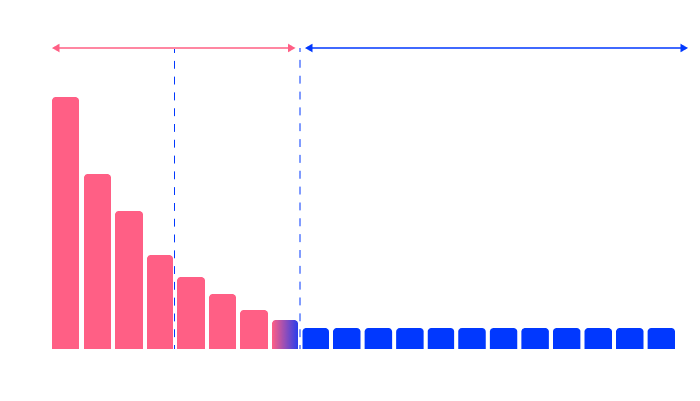
Most bank SEO programs stall at the same point: a small team, a handful of high-competition keywords, and content that never keeps pace with how customers actually search.
CMAX is the agentic SEO platform built to capture the 90% of search demand that sits in the long tail, the thousands of product, location, and intent variations bank teams rarely have bandwidth to target. Our AI agents deploy and continuously update YMYL-safe content at a scale and speed manual workflows can’t match, with results visible in as few as six weeks. Two lines of code connect CMAX to your site; from there, every new page strengthens the net that pulls in high-intent organic traffic.
If your board wants measurable organic growth without a headcount debate, CMAX is where that conversation starts.
References [1] – https://services.google.com/fh/files/misc/hsw-sqrg.pdf [2] – https://developers.google.com/search/docs/fundamentals/creating-helpful-content
Author
Jeremy Tang
Founder and CEO of CMAX
Jeremy Tang is the Founder and CEO of CMAX. With over 2 decades of experience in business consulting and digital marketing, he has successfully driven seven startup businesses, six of which achieved $1 million in revenue from zero in less than 16 months, 5 of which grew to multi-million dollar a year ventures without any external funding. Jeremy's expertise lies in streamlining business processes through technology and leveraging digital (in particular SEO) for business growth. He resides in Australia, travels extensively, and draws inspiration from his global experiences.