Most enterprise Shopify stores have thousands of products indexed, yet lose visibility on the long-tail queries where buying intent is strongest. The problem is usually structural: duplicate URL paths, weak internal linking, and collection pages that only cover broad category terms. Fixing it means diagnosing what Shopify’s architecture actually exposes to search engines, then building the right page types to fill the gaps. CMAX works with large-catalogue Shopify stores to generate unique, brand-trained long-tail pages at scale.
Enterprise Shopify SEO needs platform-specific diagnosis.
Shopify Visibility Constraints
What shopify SEO services must address first is how search engines interpret catalogue URLs. Shopify’s architecture creates a specific crawl problem at scale. Search engines encounter multiple URL paths for the same product: collection-scoped URLs, direct product URLs, variant parameters, and filtered views. Without clear signals about which URL carries authority, crawl budget gets diluted across paths that compete with each other rather than reinforce the pages that should rank.
As a shopify SEO Melbourne store or a shopify SEO Sydney retailer scaling nationally, the internal linking problem compounds quickly. Large catalogues often rely on navigation menus and featured collections to carry link equity, leaving thousands of product and variant pages with weak or no internal signals pointing to them. Product schema coverage tends to be inconsistent at this scale too, which limits how well search engines interpret product relationships, attributes, and category context.
A platform-specific diagnostic covers indexation paths, crawl access, internal linking depth, and schema coverage across the full catalogue. That’s the starting point for any Shopify SEO services engagement worth running. For any shopify SEO Australia operation with a large product catalogue, this diagnostic is the foundation every other optimisation layer builds on.
Shopify SEO services address catalogue-level indexation, internal linking, and schema coverage as part of a broader website search optimisation strategy that keeps product and collection pages discoverable at scale.
Long-Tail Query Gaps
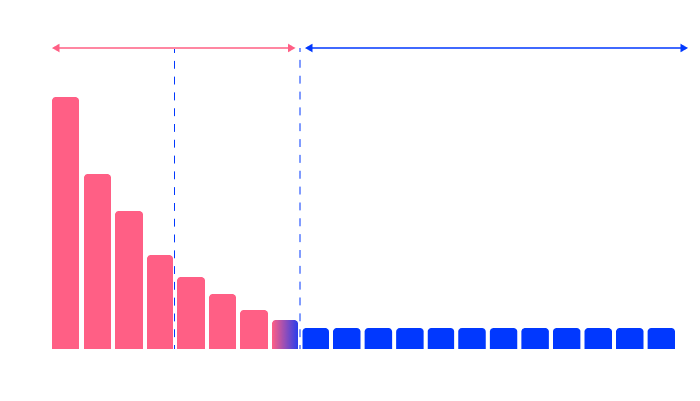
Standard Shopify collection and product pages are built around core category terms. They cover the obvious queries. What they don’t cover is the much larger volume of searches that combine product type with a specific attribute, use case, or buyer context.
A shopper searching for “commercial-grade stainless prep tables for catering kitchens” is expressing clear purchase intent. A generic collection page for “prep tables” won’t capture it. Multiply that pattern across thousands of products and attributes, and the gap between what the catalogue contains and what buyers are actually searching becomes substantial. Based on CMAX’s analysis, over 90% of search demand sits in these long-tail combinations, and many Shopify stores have no page type built to reach them.
Shopify SEO services built around traditional crawl signals may need to be re-evaluated as AI search engines begin surfacing product and category content through generative result formats rather than standard blue-link listings.
The right service model should fit catalogue complexity.
Matching Services to Constraints
Technical SEO, collection-page strategy, and scaled landing-page creation each address a different failure point. They are not interchangeable, and applying the wrong one to the wrong constraint wastes budget without moving rankings.
If crawlability is the problem, technical SEO is the priority: fixing how search engines access, interpret, and prioritise URLs across a large catalogue. If collection pages exist but target broad or misaligned terms, collection-page strategy closes that gap. If the catalogue has depth that no existing page covers, scaled landing-page creation is what generates visibility for specific product and attribute combinations.
Knowing how to optimise SEO on shopify at catalogue scale starts with matching the right service model to the constraint. The right mix depends on an honest diagnosis of where growth is actually blocked. A store with 10,000 SKUs and weak internal linking needs a different intervention than one with strong crawl access but no pages targeting attribute-level buying queries. Shopify SEO services designed around long-tail page coverage and differentiated content are more resilient to the visibility shifts introduced by Google AI Search, which increasingly synthesises product and category information before a shopper clicks through.
Unique Long-Tail Page Generation
Programmatic SEO suits large Shopify catalogues when the pages it produces have a clear search purpose and genuinely differentiated content.[2] That means each page targets a distinct query intent and draws on specific product or category data, not a repeated template with swapped keywords. Shopify SEO services that operate at catalogue scale often incorporate SEO AI to generate, govern, and differentiate long-tail landing pages across thousands of product and attribute combinations.
The practical test is whether a generated page gives a shopper something a generic collection page does not: attribute context, use-case relevance, or a combination of product characteristics that matches how they actually searched. Pages built from approved rules and differentiated data inputs meet that bar. The risk comes from mass-publishing near-duplicate pages that target overlapping queries, which can cause pages to cannibalise each other’s rankings. Pages that reproduce the same thin structure across thousands of terms do not, and search engines treat them accordingly.
A four-step Shopify SEO rollout reduces delays.
Four-Step Rollout Plan
Based on CMAX’s engagement model, a structured shopify SEO services engagement moves from diagnosis to launch in 4 to 6 weeks. Scope, data inputs, approval workflows, and page-governance rules defined before build work starts, that’s what keeps a Shopify SEO rollout on track.
Step 1: Run a Shopify SEO diagnostic. Among ecommerce SEO services deliverables, the diagnostic is the most critical starting point. Cover indexing status, crawl paths, site speed signals, internal linking, and product schema coverage. The diagnostic tells the team exactly where visibility is being lost, whether that’s technical access failures, URL duplication across variants and filtered views, or weak page relationships that leave products isolated from relevant collection signals.
Step 2: Map long-tail opportunities. Segment by product type, collection structure, attributes, and buying-intent modifiers. This step grounds page creation in real search behaviour, what shoppers actually type when they’re close to a purchase decision, rather than expanding pages based on catalogue structure alone.
Step 3: Train approved page rules and content patterns. Feed in brand, legal, and merchandising inputs so every new page stays aligned with approved language, category logic, and governance requirements. This is what keeps programmatic output defensible internally and consistent at scale.
Step 4: Launch with controls in place. Indexation controls, QA checks, and KPI tracking by page type let the team see which page patterns earn visibility and which need refinement, covered in detail in the next section.
Front-loading governance work in steps one through three is what compresses the timeline. For SEO services Australia teams delivering rollouts at this pace, skipping this stage means spending weeks reworking pages after launch.
Launch pages with indexation controls, QA checks, and KPI tracking for rankings, traffic, and revenue by page type, so the team can see which page patterns earn visibility and which need refinement.
Low-Overhead Implementation
Scaling a large Shopify catalogue does not require a developer sprint every time a new collection, attribute combination, or long-tail landing page enters scope. CMAX deploys via a light code snippet, which means the implementation footprint stays small while the page output scales.
Structured data inputs and clear page-governance rules do the heavy lifting. Once those rules are trained on approved brand, legal, and merchandising inputs, new pages generate within the same framework without triggering a fresh build cycle. That architecture is what separates catalogue-scale SEO from the one-page-at-a-time model most Shopify stores are still running.
Indexation controls determine which pages enter the index and when, so the team is not managing thousands of URLs reactively. QA checks catch template drift, thin variation, or canonicalisation conflicts before they compound.[1] KPI tracking by page type, covering rankings, traffic, and revenue, gives the team a clear read on which page patterns are earning visibility and which need refinement. That granularity is what makes the case internally: revenue attributed to a specific page group is a defensible number in front of a CFO, where aggregate organic traffic figures rarely are.
Shopify SEO services that track rankings and revenue by page type are well placed to extend that governance framework toward generative engine optimisation as AI-driven result formats become a larger share of organic traffic.
For large Shopify stores, this model removes the bottleneck that typically stalls catalogue SEO: the dependency on developer capacity every time the product range or targeting strategy shifts. That scalability is exactly what well-structured shopify SEO services deliver at catalogue level.
Proof and Decision Criteria Should Guide Selection
Enterprise Catalogue Proof Point
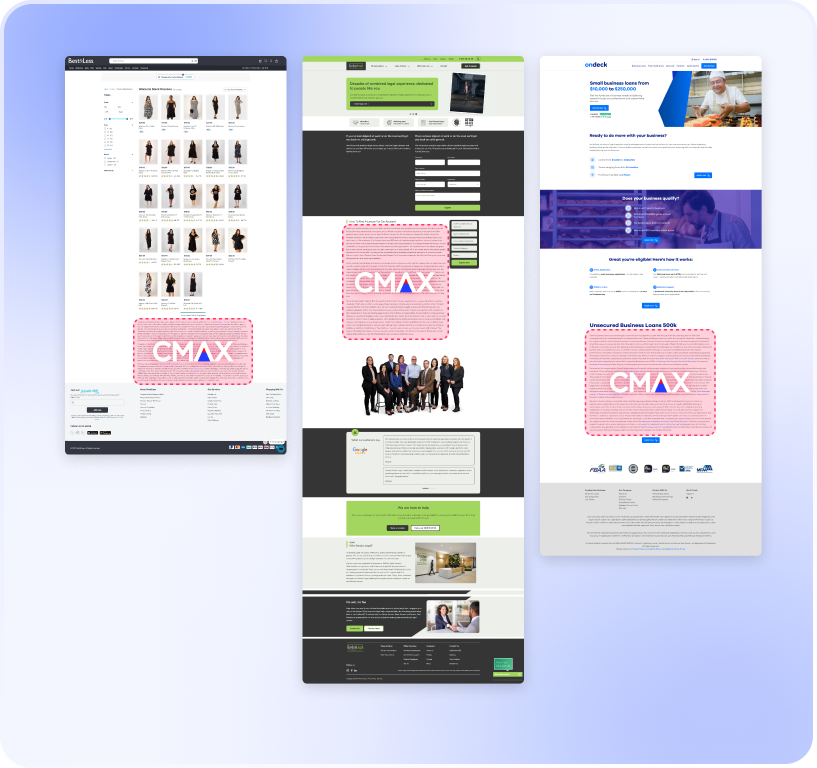
One CMAX engagement with a B2B omnichannel hospitality retailer produced 5,000 long-tail product pages and $1M+ per month in incremental SEO revenue within 8 months. That outcome follows a predictable catalogue-scale dynamic: standard collection and product pages cover a narrow band of queries, while thousands of fragmented buying searches go unaddressed. Enterprise Shopify stores with large product catalogues face the same gap. The buying intent is there; the pages to capture it are not.
Selection Criteria That Matter
What separates effective shopify SEO services is whether page coverage can be defended on revenue logic. Pricing, reporting cadence, and success metrics only tell part of the story. The sharper evaluation runs against indexable page volume, margin by category, and revenue by page type. Those three factors answer the questions a CFO will ask: Is additional SEO coverage commercially worthwhile across this catalogue? Which page groups return the most on investment? Can the service model be defended on revenue logic rather than traffic volume alone?
A shopify SEO company that reports on sessions without tying performance to page type and category margin is giving you half the picture. Before committing to any Shopify SEO service, confirm that reporting is structured around the metrics that connect organic visibility to commercial outcomes. That framing is what turns an SEO investment into a board-ready business case.
Shopify SEO services that demonstrate revenue impact by page type are better positioned to adapt as AI search reshapes how buying-intent queries are matched to product and category content. A credible SEO agency shopify merchants can evaluate on revenue metrics will tie reporting directly to these commercial outcomes.
Is programmatic SEO safe for Shopify stores?
Yes, when it’s built correctly. Programmatic SEO suits Shopify stores when pages are generated from approved content rules, unique query intent, differentiated data inputs, and controlled indexation logic.[2] The risk comes from mass-publishing near-duplicate pages that target overlapping queries, which can cause pages to cannibalise each other’s rankings. A governed approach, where each page has a defined search purpose and distinct data inputs, sidesteps that problem.
Shopify SEO services increasingly need to account for how search results are changing, and the AI Overview feature in Google’s results is one way to assess how organic visibility may shift for large catalogue stores.
How to avoid thin content penalties in programmatic SEO?
Thin content risk drops when each page targets a distinct search intent and draws on differentiated product or category data. A page earns its place when it gives a shopper something a generic template cannot: attribute context, use-case relevance, or collection-level distinctions that match how they actually searched.
How to fix indexing issues for large Shopify stores?
Start with internal linking, duplicate URL paths, and collection discoverability. Important pages lose visibility when they’re canonically weakened, blocked, or buried behind low-priority navigation. Tightening those signals gives search engines a clearer read of which URLs carry authority.
Does programmatic SEO affect Shopify site speed?
Page expansion alone doesn’t slow a store. What it can do is surface existing issues in templates, scripts, images, or third-party assets. The practical check is whether new pages integrate cleanly with the current theme and template setup without compounding bottlenecks already present.
How to avoid duplicate content in large Shopify stores?
Give every URL a defined role. Collections, filtered views, product variants, and long-tail landing pages each need distinct copy and page rules that stop multiple URLs from targeting the same query or reproducing the same product context. Role clarity at the architecture level is what keeps duplication in check.
Does Shopify work in Australia for SEO purposes?
A common question merchants raise is does shopify work in Australia from an SEO standpoint. The platform itself operates globally, so the real consideration is whether its SEO tooling supports the indexation, structured data, and template control that Australian catalogue stores require. With the right configuration and service layer, Shopify handles programmatic SEO at scale for Australian merchants.
Two Lines of Code, Thousands of Shopify Pages
Most Shopify stores compete for the same handful of head terms while 90% of search demand sits untouched in the long tail.
CMAX is an agentic SEO platform built to capture that gap at scale. It deploys unique, brand-trained long-tail pages across your Shopify store with just two lines of code, no dev sprints, no content bottlenecks, no duplicate-content risk. Our AI agents continuously update those pages so they stay relevant to the thousands of ways your customers actually search.
Teams running CMAX typically see measurable organic traffic gains within six weeks.
References [1] – https://developers.google.com/search/docs/essentials/spam-policies [2] – https://developers.google.com/search/docs/essentials/spam-policies
Author
Jeremy Tang
Founder and CEO of CMAX
Jeremy Tang is the Founder and CEO of CMAX. With over 2 decades of experience in business consulting and digital marketing, he has successfully driven seven startup businesses, six of which achieved $1 million in revenue from zero in less than 16 months, 5 of which grew to multi-million dollar a year ventures without any external funding. Jeremy's expertise lies in streamlining business processes through technology and leveraging digital (in particular SEO) for business growth. He resides in Australia, travels extensively, and draws inspiration from his global experiences.