Most teams shopping for ecommerce SEO services have already done SEO. The problem is that what worked at 500 SKUs stops working at 50,000. Growth stalls across product templates, filtered URLs, and long-tail queries that no page-by-page workflow can keep up with. At that point, the bottleneck is operational, not strategic. You need a model that matches the scale of your catalogue. CMAX was built for exactly that shift, combining programmatic content scale with the technical SEO infrastructure large stores require.
Ecommerce SEO Services Solve Different Growth Bottlenecks
Different Catalogue Issues Stall Growth
When ecommerce SEO services are scoped for a large catalogue, the first step is diagnosing which template-level faults are actually stalling growth. As an ecommerce SEO Perth retailer would recognise, catalogue-level faults differ from site to site. Growth stalls across multiple failure points simultaneously, and fixing one without addressing the others produces limited commercial movement.
The most common cluster: key page templates are not indexed reliably, so a significant portion of the catalogue is invisible before any ranking competition begins. Product pages that do get indexed often fail to answer the specific buying questions that drive purchase decisions, which limits both ranking potential and on-page conversion. Category pages compound the problem when they are built around broad terms and miss the refinement layers customers actually use, such as brand, feature, use case, or compatibility. Each of those refinement patterns represents a distinct query group with its own demand, and a category architecture that ignores them leaves that demand uncaptured.
Ecommerce SEO services must now account for AI search as an additional discovery layer that can intercept high-intent shoppers before they ever reach a traditional organic result.
SEO Plateaus Need a Different Model
Enterprise and mid-market brands typically hit a ceiling with conventional agency models once growth has flattened across thousands of products, faceted URLs, and long-tail queries. A page-by-page workflow cannot keep pace with template changes, indexing management, or the volume of demand sitting outside a small set of head terms.
At that scale, enterprise SEO services need to operate more like a production system than a project list. Template-level decisions affect thousands of URLs at once, indexing signals shift with every crawl cycle, and the long-tail query space is too large for manual content planning to cover meaningfully. The service model has to match the operational reality of the catalogue.
Technical SEO determines scalable ecommerce performance.
Technical signals control page visibility
Crawlability, canonical control, page speed, schema, and internal linking are the infrastructure layer that decides whether your product and category pages get discovered, rendered correctly, and matched to commercial intent. Without that foundation, content investment stacks on top of a leaking base. Pages get missed by crawlers, duplicate URLs split ranking signals, and high-intent queries land on the wrong page or no page at all. Any SEO services Australia retailers rely on must address crawlability and canonical control at template level before scaling content. Effective SEO services for ecommerce increasingly need to account for how product and category pages appear in an AI Overview, since these AI-generated summaries can reshape how organic visibility translates into clicks and revenue.
Five-point technical checklist
Run this checklist before publishing more content. Ecommerce SEO services target the recurring faults that block large stores from earning indexation, rich-result eligibility, and clean paths into revenue-driving pages. The checklist applies to SEO for ecommerce stores of any size, though the faults compound fastest in catalogues with thousands of SKUs.
Indexation status. Confirm that key product and category URLs return indexable status codes. Robots rules, noindex tags, and parameter handling can quietly suppress pages that should be earning traffic.
Canonical accuracy. Canonicals must point to the preferred version of each page. Filtered, paginated, variant, and duplicate URLs that point incorrectly will split signals or surface the wrong page in results.
Schema validation. Product schema and breadcrumb schema need to be valid and consistent across core templates so search engines can interpret page entities, product context, and site hierarchy reliably. An ecommerce SEO company responsible for implementation should validate schema output against each core template, not just a sample page.
Internal link depth. Navigation, category pages, and related-product modules should give profitable pages a short, direct path. Pages buried behind weak template logic or deep click paths lose authority and visibility.
Template speed and rendering. Test key page types for load performance and JavaScript dependency issues. Crawlers and users both need to access product copy, pricing context, and conversion elements without avoidable delay. Ecommerce SEO services address the full technical stack, and website search optimisation sits at the core of keeping product and category pages crawlable, canonicalised correctly, and matched to commercial intent at scale.
Service models shape timelines, costs, and ROI.
Service models change resource demands
Retainer SEO, project-based remediation, and programme-led content expansion are structurally different engagements, and the differences show up immediately in budget and delivery speed. What separates one delivery model from another is how ecommerce SEO services allocate strategist, developer, and publishing capacity.
A retainer model distributes strategist, developer, and publishing capacity across ongoing priorities, which suits stores that need continuous technical governance and content output but have limited internal bandwidth. For any retailer evaluating an ecommerce SEO company Sydney teams recommend, the choice of model should reflect internal resourcing as much as external ambition. Project-based remediation concentrates effort on a defined scope, typically a technical audit and fix cycle, and hands implementation back to the internal team once the work is done. Programme-led content expansion, the model CMAX operates on, shifts the publishing bottleneck away from manual workflows entirely, deploying and updating content at a scale that a retainer or project engagement cannot match without a proportionally larger headcount.
The practical implication: the model you choose determines where delays accumulate. If developer access is constrained internally, a retainer that depends on your team to push changes will stall. When comparing cost structures, SEO services Sydney providers quote will vary significantly depending on whether the engagement is retainer, project, or programme-led. If publishing volume is the ceiling, a project engagement won’t move the needle on long-tail coverage.
SEO results follow different timelines
Early gains typically appear in technical health, crawl activity, and page-level visibility. For technical and content changes, CMAX typically sees results begin showing within 6 weeks. As any provider of SEO services in Sydney will confirm, timeline expectations should be anchored to the type of engagement and the scale of the catalogue.
Category growth and non-brand revenue operate on a longer curve. Ranking movement across hundreds or thousands of queries, successful indexation at scale, and enough conversion data to draw commercial conclusions all take time to accumulate. Presenting SEO ROI to a CFO before that data matures is a credibility risk, so measurement windows should be set by the type of change, not by the pressure to show results early.
Programmatic Scale Changes Long-Tail Ecommerce Coverage
Proof Point from Large-Catalogue Retail
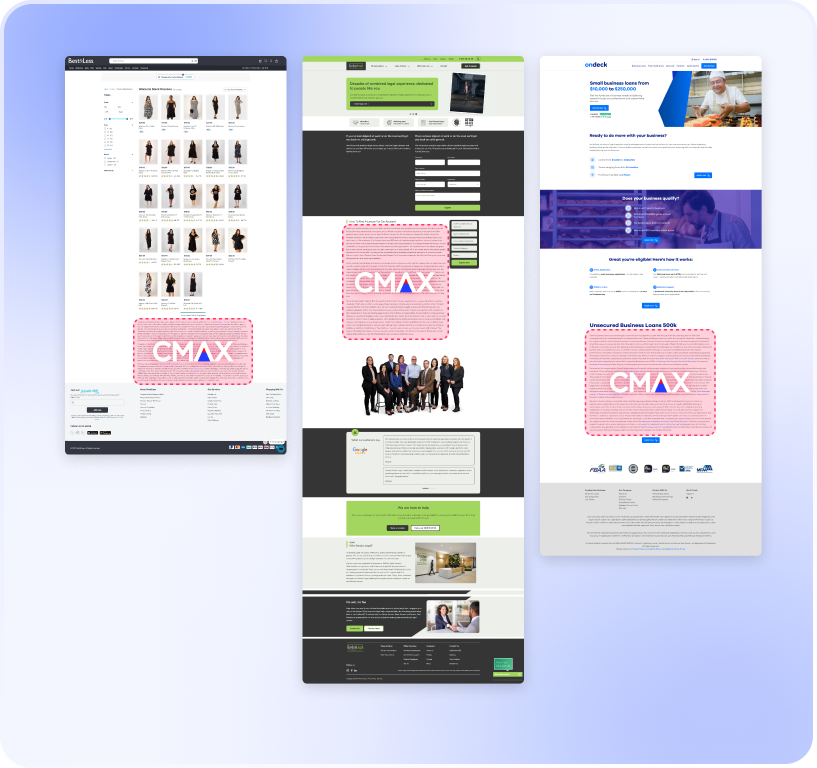
A B2B omnichannel hospitality retailer worked with CMAX to publish 5,000 long-tail product pages, driving $1M+ per month in incremental SEO revenue within 8 months. Keywords were mined from both SEO and Google Ads data, so every page targeted queries with demonstrated commercial intent. This is the mechanism that lets ecommerce SEO services convert long-tail demand into measurable revenue.
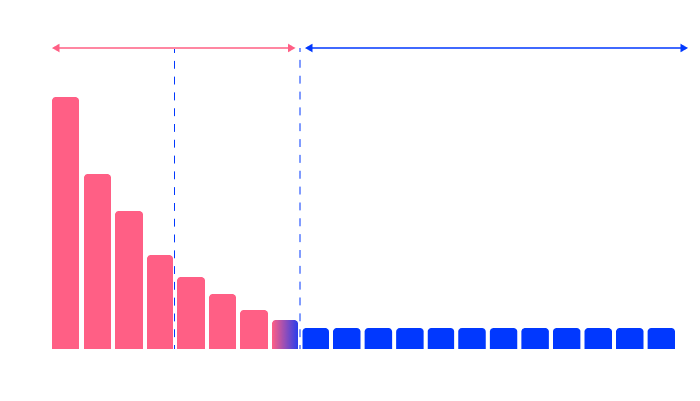
Large-catalogue ecommerce operates on the same mechanism. Customers search across thousands of product-specific long-tail queries, and a standard agency content plan, built around a manageable list of head terms, leaves the vast majority of that demand uncovered. Across CMAX’s client portfolio, over 90% of search traffic sits in the long tail. A conventional publishing workflow cannot reach it at the speed or volume required.
Useful Scale Depends on Page Distinctiveness
Programmatic SEO adds reach when three conditions hold: approved brand assets, repeatable query patterns, and technical governance. Whether the brief is ecommerce SEO Melbourne brands need for long-tail coverage or national catalogue expansion, programmatic scale follows the same mechanism. When those are in place, pages can be deployed at scale without creating the index bloat that comes from near-duplicate templates that swap one keyword and offer nothing else.
Ecommerce SEO services that operate at catalogue scale increasingly rely on SEO AI to identify long-tail query patterns, prioritise page creation, and maintain technical governance across thousands of product URLs.
The pages that perform are the ones that answer a distinct intent. That means product type paired with use case, compatibility, brand, or attribute, where the combination produces content a searcher cannot find on a generic category page. Each page functions as a specific entry point into the catalogue, capturing demand that would otherwise go to a competitor or remain unaddressed entirely. Scale without that distinctiveness is a crawl budget problem, not a growth strategy.
The Strongest Ecommerce SEO Approach Supports Blended Acquisition Efficiency
Shared Search Data Sharpens Priorities
Keyword and query-conversion data does not belong to a single channel. When SEO, paid search, and shopping campaigns share the same data layer, teams can see exactly which product and category pages are generating repeat paid spend on searches that organic could own. That visibility changes budget decisions fast. For teams evaluating SEO services Brisbane retailers depend on for blended acquisition, this shared data layer is what separates reactive budget shifts from proactive ones.
Ecommerce SEO services that integrate shared keyword data across channels are better positioned to adapt when Google AI Search reshapes how product queries are answered and which pages earn prominent placement.
It also works in the other direction. Some high-intent terms convert quickly, carry tight margin windows, or need message control that a ranked page cannot replicate. Those stay paid-led. As a Brisbane SEO services provider would confirm, the goal is to stop paying twice for demand that a well-ranked category or product page can capture reliably.
The Right Mix Depends on Economics
The right ecommerce SEO services mix depends on catalogue size, margin profile, and internal delivery capacity. A store with 500 SKUs and strong margins has different priorities than a retailer managing 50,000 product variants across thin-margin categories. Technical remediation, richer category coverage, and long-tail page scale each carry different cost structures and different return profiles.
Catalogue size, margin profile, and internal delivery capacity all shape which lever moves the commercial needle first. A large catalogue with indexation gaps returns faster on technical fixes. A mid-market store with strong category demand but thin long-tail coverage returns faster on programmatic page expansion.
As ecommerce SEO services evolve, knowing how AI search engines surface product results alongside traditional and paid listings is becoming a meaningful input into blended acquisition strategy.
Prioritise by commercial upside. The channel mix follows from that, not the other way around.
Does Programmatic SEO Risk Google Penalties?
The risk is real, but it comes from execution, not from the approach itself. Programmatic SEO creates problems when teams mass-publish thin or near-duplicate pages that offer little original value, pages that change one keyword in a template and call it done. Google’s helpful content guidance targets exactly that pattern.[1]
The practical distinction is whether each page serves a specific query with content that is genuinely non-interchangeable. A product page optimised for “commercial dishwasher for hotel kitchen” should answer different buying questions than one targeting “commercial dishwasher for catering van”, different capacity requirements, different installation constraints, different compliance considerations. If swapping the keyword phrase is the only difference between two pages, the architecture has a problem.
Three factors separate scalable programmatic SEO from index bloat:
- Distinct intent per page. Each URL should target a query pattern, product type plus use case, compatibility, brand, or attribute, where the content genuinely differs because the searcher’s need differs.
- Clear canonical logic. Filtered, faceted, and variant URLs need canonical tags that consolidate signals to the right page, so the index reflects deliberate architecture rather than accidental duplication.
- A legitimate role in site structure. Pages that earn indexation sit within a coherent hierarchy, receive internal links, and are reachable without deep click paths.
CMAX’s programmatic approach is built around these constraints. Pages are generated from approved brand assets and repeatable query patterns, with technical governance applied at template level before publication.
How to Measure Programmatic SEO Success
Raw URL growth is the wrong scorecard. Publishing thousands of product pages and watching the indexed count climb tells you nothing about whether those pages are pulling in buyers or contributing revenue.
The metrics that matter span five areas:
Indexed page growth confirms new pages are being discovered and retained in the index, not crawled and dropped because they lack sufficient signal or duplicate existing content.
Non-brand rankings show whether programmatic pages are capturing net-new demand. If ranking movement is concentrated in branded queries, the programme is reinforcing existing visibility rather than expanding it.
Qualified organic sessions filter out low-intent traffic. Session volume from product-specific long-tail queries, where a user is searching for a particular type, brand, or attribute, carries more commercial weight than broad category traffic.
Assisted revenue attributes value to pages that appear earlier in the purchase path. A product page that does not close the sale directly may still be the first organic touchpoint before a paid click or direct return converts.
Page-level conversion behaviour identifies which templates are working and which are not. Bounce rate, add-to-cart rate, and time-on-page across page clusters reveal whether content is answering buying questions or just earning a click.
Reporting across all five gives a clear picture of whether ecommerce SEO services are generating commercial output, not just search engine activity.
As ecommerce SEO services mature, teams measuring programmatic success are beginning to track visibility in generative engine optimisation contexts alongside traditional ranking and session metrics to capture the full picture of organic demand.
Most Ecommerce SEO Services Ignore 90% of Your Traffic
The long tail is where high-intent buyers actually search.
CMAX is an agentic SEO platform built to capture that 90% of untapped search demand, the thousands of product-specific, category-level, and niche queries your current ecommerce SEO services aren’t targeting. With just two lines of code, CMAX deploys and continuously updates content at a scale and speed manual teams can’t match. Results start showing in as little as six weeks, giving you real conversion data to bring to the boardroom.
If your organic growth has plateaued, the problem isn’t effort, it’s coverage.
References [1] – https://developers.google.com/search/docs/fundamentals/creating-helpful-content
Author
Jeremy Tang
Founder and CEO of CMAX
Jeremy Tang is the Founder and CEO of CMAX. With over 2 decades of experience in business consulting and digital marketing, he has successfully driven seven startup businesses, six of which achieved $1 million in revenue from zero in less than 16 months, 5 of which grew to multi-million dollar a year ventures without any external funding. Jeremy's expertise lies in streamlining business processes through technology and leveraging digital (in particular SEO) for business growth. He resides in Australia, travels extensively, and draws inspiration from his global experiences.