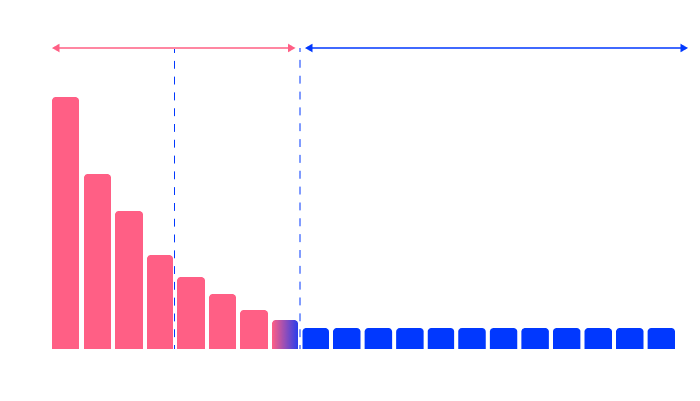
Most B2B SEO strategies stall because they chase high-volume head terms that attract the wrong visitors. The searches that actually build pipeline tend to be specific, lower volume, and spread across hundreds or thousands of variations your core pages were never designed to rank for. Capturing that demand means rethinking how you structure pages, match intent, and measure what matters. CMAX helps enterprise teams scale long-tail coverage with the governance and measurement rigour that B2B growth requires.
B2B SEO Wins on Intent, Not Volume
Buying Cycles Change SEO Targets
B2B SEO wins when keyword selection reflects the actual buying journey, not search volume alone. B2B buyers rarely convert on a first visit. A single deal can involve weeks of problem research, multiple rounds of vendor comparison, internal shortlisting, and a formal handoff to sales before anyone fills out a form. That cycle changes what SEO needs to do.
Keyword selection and page goals have to map to each stage of that evaluation. A page targeting early problem research needs a different structure and call to action than one built for a buyer who is ready to request a demo, download a specification, start a pricing conversation, or contact a sales team directly. Treating every page as a conversion page misreads where most B2B visitors actually are.
Intent Outweighs Search Volume
At its core, what is B2B SEO if not the practice of matching content to the specific intent behind each query? A lower-volume query can outperform a higher-volume one if the wording signals a defined buying job. Searches that frame a specific comparison, check product fit for a named industry, probe implementation requirements, or validate a feature before a sales call carry commercial weight that volume metrics do not capture.
Effective SEO for B2B must now account for how intent signals are interpreted across traditional and AI search environments, where query phrasing and context influence which results surface for evaluation-stage buyers.
Chasing high-volume head terms in B2B SEO often means competing for traffic that is too early-stage to progress into pipeline. Lower-volume, high-specificity queries attract visitors who have already narrowed their options and are actively evaluating. Those visitors convert at higher rates, move through CRM stages faster, and reach sales while the topic is still live in their decision process.
Scalable coverage depends on a clear page system.
Match Page Types to Intent
Scaling a B2B SEO strategy without a defined page architecture produces overlap, cannibalisation, and wasted crawl budget. A well-structured B2B SEO page system matches each template to a distinct intent.
Pillar pages cover a core topic in full, targeting broad informational and commercial queries where a buyer is still orienting. Cluster pages go deeper on specific subtopics or recurring objections, such as integration requirements, compliance considerations, or role-specific use cases. Programmatic long-tail pages capture repeatable high-intent variations across industries, features, locations, or buyer roles, the queries that head pages never fully address because there are simply too many of them to write manually.
Each layer answers a different search. When the layers are clearly separated, a single site can cover the full B2B evaluation arc without any page competing against another.
Keep Scaled Pages Distinct
Publishing thousands of pages creates a technical governance problem. Search engines need to know what each page is about, where it sits in the site hierarchy, and which variant should rank when similar pages exist. Following B2B SEO best practices here prevents scaled content from collapsing under its own weight.
Structured data communicates page type and content context directly. Internal links establish topical relationships and pass authority through the architecture. Breadcrumbs reinforce hierarchy so both crawlers and buyers can orient quickly. Canonical rules resolve ambiguity when programmatic variants share overlapping signals, directing ranking credit to the right page.
Without these controls, scaled page sets become difficult to index efficiently and harder to rank predictably, regardless of content quality. B2B SEO teams managing large programmatic page sets are increasingly turning to SEO AI to maintain content quality, enforce template rules, and identify gaps across thousands of URLs at scale.
Measurement makes long-tail growth worth scaling.
Six-Step Measurement Checklist
Long-tail B2B SEO generates value that rankings and sessions will never show. A workable B2B SEO measurement model follows the visitor from query to revenue stage, so the team can judge performance by pipeline contribution.
B2B SEO measurement frameworks are evolving to capture visibility beyond traditional rankings, and generative engine optimisation introduces new signals, such as citation frequency in AI-generated answers, that forward-looking teams are beginning to track alongside organic SQL contribution.
Step 1: Classify keywords by intent. Group target keywords into informational research, commercial evaluation, and sales-ready searches. Reporting then reflects how close a query sits to revenue, not just how much traffic it pulls.
Step 2: Map intent classes to page templates. Tie each intent group to a specific page type so performance comparisons run across page purpose, not just individual URLs. A cluster page targeting a vendor comparison query should be measured differently from a pillar page covering a broad topic.
Step 3: Apply consistent UTM parameters. Tag organic entry points used in campaigns, sales handoffs, or internal promotion. Traffic that starts in search gets lost the moment a visitor moves channels without a UTM in place.
Step 4: Sync lead sources into CRM stages. Form fills need to land in stages that distinguish raw leads, MQLs, SQLs, opportunities, and closed revenue. Without that structure, organic traffic disappears into a lead bucket with no pipeline visibility.
Step 5: Review assisted conversions. Last-touch attribution penalises early-stage organic pages that open research cycles but hand off to paid or direct before the final conversion. Assisted conversion data keeps those pages in the picture.
Step 6: Compare page groups before scaling further. Conversion rate, sales progression, and time to first contact by page type show which templates generate qualified activity and which ones should not be replicated.
Compare page groups by conversion rate, sales progression, and time to first contact before scaling more templates, so expansion follows page types that generate qualified sales activity.
Use Pipeline Metrics, Not Traffic
Traffic numbers tell you a page is being found. They do not tell you whether the people finding it are worth talking to.
Organic SQLs, assisted pipeline, page-level conversion rates, and time to first contact are the metrics that reveal actual SEO for B2B marketing contribution. Each one answers a question traffic cannot: Did the visit turn into a qualified enquiry? Did that enquiry move through CRM stages? Did sales make contact while the topic was still live in the buyer’s mind?
Time to first contact is particularly telling in B2B. A page that generates fewer sessions but converts them into SQLs contacted quickly outperforms a page with many sessions and leads that stall at MQL. Scaling the first template makes commercial sense. Scaling the second does not.
Run this comparison across page groups before committing to new templates. If a programmatic cluster built around a specific industry or use case is producing assisted pipeline, that is the signal to expand. If a cluster is generating sessions with no CRM progression, the template, the offer, or the intent match needs fixing first. Teams responsible for B2B tech SEO should also verify that crawl efficiency and indexability standards hold across every new template before treating pipeline gains as repeatable.
B2B SEO performance reporting should factor in how Google AI Search surfaces content at the top of the results page, since AI-generated overviews can intercept high-intent queries before a user reaches a ranked organic listing.
Expansion decisions grounded in these metrics keep the programme focused on pages that generate qualified sales activity rather than pages that simply accumulate impressions.
Quality Controls Decide Whether Scaled Pages Earn Trust
Prevent Thin and Duplicate Drift
Scale creates a specific risk: pages that look distinct in a spreadsheet but read as near-identical to both search engines and buyers. The fix is structural, not editorial. Query-specific templates force each page to answer a different search question rather than rearranging the same block of copy. Approved source material keeps factual claims accurate and consistent across thousands of URLs. QA checks catch drift before it compounds, flagging pages that reuse near-identical copy or fail to address the specific intent the template was built for.
Without these controls, a large page set becomes a liability. Search engines reduce crawl priority on sites with repetitive content, and buyers who land on a generic page leave without converting.[1] The controls are what separate a scalable content system from a mass-publishing exercise.
B2B SEO at scale depends on the same foundational principles as website search optimisation, including crawlability, structured data, and page-level relevance signals that keep large content sets indexable and distinct.
B2B Scale Proof Point
The concern that programmatic pages trade quality for volume is addressable with evidence. This B2B SEO case study shows how pairing head terms with long-tail pages drove incremental revenue. In one CMAX engagement, a B2B omnichannel hospitality retailer combined traditional SEO across 50 category terms with 5,000 long-tail product pages. The result was based on CMAX’s case study analysis of this engagement, $1M+ per month in incremental SEO revenue within 8 months.
Enterprise B2B sites carry the same catalogue-scale dynamic. High-intent searches are distributed across hundreds of specific terms that head pages do not cover, and each of those terms represents a buyer at a defined stage. Capturing that demand at scale, with pages that hold up under QA, is where long-tail B2B SEO generates pipeline rather than just traffic.
Sustainable growth comes from alignment, not page volume.
Use Case Studies for Sales
Long-tail search themes and sales objections tend to cluster around the same friction points: implementation risk, compliance requirements, pricing logic, internal approval processes, and fit for a specific industry or role. When content planning is disconnected from those conversations, scaled pages answer questions buyers have already moved past.
Sales-ready case study summaries close that gap. A one-page summary tied to a recurring long-tail theme gives sales a credible, search-aligned asset for active opportunities while feeding content teams a direct signal about which objections are worth addressing at scale. If “ERP integration requirements” keeps surfacing in both search queries and late-stage deal notes, that overlap tells you where to build next.
Scale Only Measurable Pages
Publishing more URLs is not a growth strategy on its own. Pages that cannot stay indexable, cannot hold a distinct answer, or cannot be traced into CRM stages add crawl overhead without adding pipeline.
Strong B2B SEO frameworks apply a clear filter before scaling any template: does this page match a defined buyer intent, does it sit within technical governance rules, and can its performance be measured against a pipeline metric? If any of those conditions are missing, the template is not ready to scale.
B2B SEO frameworks built for long-term growth must account for how AI search engines are changing the way buyers discover and evaluate vendors during the research phase.
That discipline is what separates a content programme that compounds over time from one that accumulates pages and stalls. Scale follows proof, not publishing velocity. B2B SEO frameworks that scale only measurable, intent-matched pages outperform those that chase URL count.
How to maintain lead quality in scaled B2B SEO?
B2B lead generation SEO holds up when scaled pages target narrow commercial intent and match the offer to the exact query. A page built around “enterprise HR software for manufacturing compliance” should speak directly to that use case and route submissions into CRM stages that separate high-fit enquiries from early research or low-fit demand. Without that CRM segmentation, volume inflates the pipeline view while actual SQL rates quietly drop.
How to measure ROI for B2B long-tail SEO?
Tie long-tail pages to organic SQLs, assisted opportunities, and revenue stages in the CRM. That connection lets teams see whether search demand progresses into pipeline rather than stopping at impressions or sessions. Last-touch attribution alone will undercount organic’s contribution; assisted conversion data fills that gap.
Does scaled content impact B2B brand authority?
Scaled content strengthens brand authority when each page covers a real buyer question with accurate, differentiated information. Repetitive pages with weak substance or unclear ownership reduce trust with both search engines and human evaluators, including the procurement teams and technical reviewers who vet vendors before a deal progresses.
How to convert B2B long-tail traffic to leads?
Long-tail traffic converts better when the landing page reflects the exact query, answers the evaluation question without forcing extra clicks, and offers the next step that fits the buying stage: a demo request, pricing discussion, technical resource, or specification download.
Is programmatic SEO effective for high-ticket B2B?
Programmatic SEO is effective for high-ticket B2B when the market contains many repeatable intent patterns and each page is governed by distinct templates, approved source content, and clear conversion paths. Mass-produced generic copy produces the opposite result.
B2B SEO strategies are increasingly shaped by how search platforms surface results, and understanding the AI Overview format helps teams anticipate how their content may be presented before a user ever clicks through.
B2B SEO Demands Scale, Not More Headcount
Most B2B SEO strategies stall at the same point: too many high-intent keywords, too few resources to cover them.
CMAX is an agentic SEO platform built to close that gap. It deploys programmatic content across thousands of long-tail queries, the 90% of search demand where qualified buyers actually look, using just two lines of code. Our AI agents continuously update and optimise every page, so content quality holds as volume grows.
Results start showing in six weeks, not six months.
References [1] – https://developers.google.com/search/docs/essentials/spam-poli
Author
Jeremy Tang
Founder and CEO of CMAX
Jeremy Tang is the Founder and CEO of CMAX. With over 2 decades of experience in business consulting and digital marketing, he has successfully driven seven startup businesses, six of which achieved $1 million in revenue from zero in less than 16 months, 5 of which grew to multi-million dollar a year ventures without any external funding. Jeremy's expertise lies in streamlining business processes through technology and leveraging digital (in particular SEO) for business growth. He resides in Australia, travels extensively, and draws inspiration from his global experiences.