Most search engine optimisation companies describe similar services, so the real differences only show up when you look at how they structure delivery, who owns what, and whether their reporting connects to revenue you can actually trace. That distinction matters more as your catalogue grows and your team’s capacity stays flat. The evaluation that follows is built around fit, not features. CMAX works in this space as a programmatic SEO platform designed for enterprise teams scaling long-tail content under governance constraints.
Search intent usually starts with fit, not promises.
Operating model, scope, accountability
Search engine optimisation companies tend to look similar on a capabilities slide. Most will mention technical SEO, content, and reporting in the same breath. The real differences surface in how those functions are divided, who owns each one, and whether the reporting connects back to revenue or stops at rankings.
A provider that reports keyword positions without tying them to pipeline, assisted conversions, or qualified traffic is measuring activity, not outcomes. Before any shortlist conversation, ask how strategy, technical execution, and content production are separated internally, and who is accountable when a deliverable stalls.
Start with goals and resourcing
When evaluating search engine optimisation services, a credible shortlist starts with your commercial goals, not a provider’s service menu. Sales-cycle length, seasonal demand patterns, and the internal capacity your team has to review content, approve technical changes, and act on data all shape which model of SEO support will actually move.
A programme that requires weekly content sign-off from a team already stretched across three channels will slow regardless of the provider’s capability. Rankings alone won’t tell you whether the programme fits the business, because a ranking that doesn’t align with buyer intent at the right stage of the sales cycle contributes little to revenue.
Search engine optimisation companies are most effective when their scope extends beyond keyword targeting to encompass website search optimisation, so that technical structure, crawlability, and on-page signals all support the commercial goals a business is trying to achieve. Scoping a single search engine optimisation service to the right commercial objective is more productive than layering multiple tactics without a clear revenue link.
Match the scope of SEO support to what your team can realistically govern. That constraint is as important as any technical criterion on the shortlist.
Delivery models shape scale, speed, and control.
Choose by capacity gap
When evaluating search engine optimisation companies by delivery model, the capacity gap determines which option fits. Agency retainers, specialist consultancies, and AI platforms are not interchangeable. Each solves a different bottleneck.
A retainer agency typically provides strategic direction and managed execution through a team of people. That works well when the in-house function is thin and needs external horsepower across research, content, and reporting. A specialist consultancy fits a different gap: teams that have implementation capacity but need a senior strategist to audit, prioritise, and set direction. An AI platform addresses a third problem entirely, one that neither agencies nor consultancies are built to solve at speed: publishing and maintaining large volumes of search-targeted pages across thousands of long-tail queries. Search engine optimisation companies that need to scale content production and technical deployment efficiently are increasingly exploring SEO AI as a way to automate research, page creation, and iterative optimisation at volumes that manual workflows cannot sustain.
For enterprise teams with broad catalogues, the capacity gap is usually the third one. The volume of pages required to cover specific buyer search behaviour outpaces what any manually resourced team can produce and maintain. For a team that needs search engine optimisation melbourne providers can verify locally, delivery-model fit carries even more weight because proximity affects communication cadence and accountability.
Ownership determines scaling speed
Delivery speed in SEO is rarely a strategy problem. It’s an ownership problem.
When content production, technical deployment, and reporting each have a defined owner, the workflow moves. When ownership is ambiguous, pages stall in review, indexation lags, and the iteration cycle that compounds organic growth slows to a crawl. A programme that looks sound on paper can take six months longer than projected simply because no one confirmed who approves a template change or who publishes a new page cluster. Search engine optimisation companies evaluating their long-term delivery models need to consider how content performs across AI search engines, as AI-powered retrieval systems are changing the way pages are discovered, ranked, and surfaced to users.
Before signing with any search engine optimisation company, map the handoff points. Confirm who owns each stage and what the expected turnaround is at each step. For organisations pursuing search engine optimisation australia coverage across multiple cities, clarifying ownership early prevents duplicated effort and conflicting priorities between regional teams.
Evidence Should Show Mechanism, Not Marketing
Enterprise Long-Tail Proof Point
One CMAX engagement with a B2B omnichannel hospitality retailer illustrates what scaled long-tail coverage can produce: 5,000 long-tail product pages deployed, with incremental SEO revenue reaching $1M+/month within 8 months.
The number is specific because the mechanism is specific. Large catalogues fail in organic search when page coverage maps to broad head terms that established competitors already own. Buyers searching for a particular product configuration, use case, or specification use precise queries, and if those queries return no matching page, the traffic goes elsewhere. Coverage has to match the actual ways buyers search, at the granularity they search.
That is the mechanism. Revenue follows when page volume, internal linking, and indexation work together at the query level, not the category level.
Separate Proof from Promotion
The clearest way to judge search engine optimisation companies is by the mechanism behind their reported outcomes. When evaluating providers, the quality of evidence on offer tells you more than the volume of it. First-party case study data, independent validation, and unverified sales claims are three different things, and conflating them is a common evaluation mistake.
A case study that names the client, the mechanism deployed, the timeline, and the revenue outcome is verifiable. A slide deck with percentage lifts and no operating context is a presentation. Ask which pages were created, how they were indexed, and what the reporting cadence looked like. If a provider can answer those questions with specifics, the outcome is traceable. If the answer stays at the level of results, keep asking.
As a search engine optimisation australia buyers increasingly expect, case-study data should be independently verifiable. Search engine optimisation companies presenting case study evidence should clarify whether reported outcomes were achieved under traditional ranking conditions or within the context of AI search, since AI-driven retrieval can alter which content signals drive visibility and conversion.
A five-point checklist reduces selection mistakes.
Five-point SEO company checklist
Most selection mistakes happen before a contract is signed. A practical checklist cuts through vendor positioning by testing whether a provider can actually build topical authority. Before signing with any of the search engine optimisation companies on a shortlist, run each through these five tests:
- Does the company propose a pillar-and-cluster structure rather than isolated articles? Isolated articles produce isolated rankings. A provider worth evaluating will map coverage across a topic category, connecting a central pillar to supporting cluster pages that answer the specific queries buyers use at each stage of a decision.
- Can they show evidence-backed content at scale? Ask for examples where structured coverage drove measurable organic growth across a category. Any credible search engine optimisation business will tie its case studies to commercial outcomes, not vanity metrics.
- Is reporting tied to revenue, or just rankings? Rank movement without assisted conversions, qualified leads, or attributed revenue tells a board nothing useful.
- Who owns technical deployment and content production? If the answer is unclear, scaling will stall. Defined ownership across both workflows is what separates a programme that compounds from one that plateaus. Transparency around search engine optimisation cost should be part of this conversation, covering how fees scale as content volume and technical scope increase.
- Can your in-house team actually govern the output? Approved-source workflows, review rules, and compliance controls need to be built into the delivery model, not bolted on after launch.
A provider that answers all five with specifics, mechanisms, and real examples is worth a deeper conversation. One that answers with process decks and general commitments is not.
Search engine optimisation companies operating in modern search environments should account for how content surfaces in an AI Overview, since featured placements in AI-generated summaries are increasingly shaping which pages earn visibility before a user ever clicks.
Search engine optimisation companies building evaluation checklists for enterprise clients should include criteria for how content is structured to appear within Google AI Search, given that AI-organised results pages are reshaping the visibility landscape beyond conventional blue-link rankings.
Track compounding SEO signals
Organic clicks, time-on-topic, inbound links, and assisted conversions each measure a different layer of SEO performance. Together, they show whether content is pulling in visitors, holding attention long enough to matter, earning references from other sites, and contributing to revenue paths without paid support. No single metric tells the full story; the combination does.
Enterprise teams need governed scale
Publishing across thousands of product, service, or location queries creates real operational risk when review rules are unclear. For providers offering SEO services australia at enterprise scale, approved-source workflows, compliance controls, and scalable long-tail coverage must be built into the production process before pages go live.
Fit depends on operating compatibility
A sound strategy can stall when approvals are slow, implementation capacity is thin, or page volume requirements outpace what the team can govern. The strongest fit is the provider whose delivery model matches catalogue size, risk tolerance, and internal decision speed. That operating compatibility is ultimately what separates search engine optimisation companies that deliver from those that stall.
How long does programmatic SEO take to show results?
Early movement can appear once pages are published, internally linked, and indexed. Meaningful commercial results depend on how quickly high-intent page coverage expands and how efficiently the site iterates from live search data. CMAX is built to help results typically begin within six weeks.
How to measure ROI for long-tail SEO strategies?
Compare content and implementation costs against assisted conversions, qualified leads, or revenue attributed to pages targeting specific non-head-term demand.[1] For any SEO company australia teams rely on for long-tail programmes, measuring at the page-cluster level gives a cleaner read than site-wide averages.
Can AI-driven SEO maintain brand voice at scale?
Yes, when content is generated from approved brand assets, enforced templates, and human-reviewed rules for tone, claims, and terminology. The controls have to be built into the production workflow, not applied as a post-publication audit. As a trusted SEO company sydney brands turn to for scaled content, a provider should demonstrate governance baked into every template.
Search engine optimisation companies advising enterprise clients on future-proofing their content programmes should address generative engine optimisation, as AI-generated answer engines increasingly determine which sources are cited and surfaced without a traditional click.
Is programmatic SEO safe for enterprise websites?
Programmatic SEO is safe when page creation follows indexation rules, content quality controls, and approval workflows that prevent thin duplication, unsupported claims, and uncontrolled template sprawl. The risk sits in the governance model, not the approach itself. For any SEO company brisbane organisations engage for programmatic work, verifying these controls upfront is critical.
What is the difference between an SEO agency and an AI platform?
A typical SEO agency melbourne businesses might engage delivers strategy and execution through people. An AI platform automates research, page production, updating, and scaling at volumes that a people-led model can’t sustain without significant headcount. The two solve different bottlenecks and are not direct substitutes.
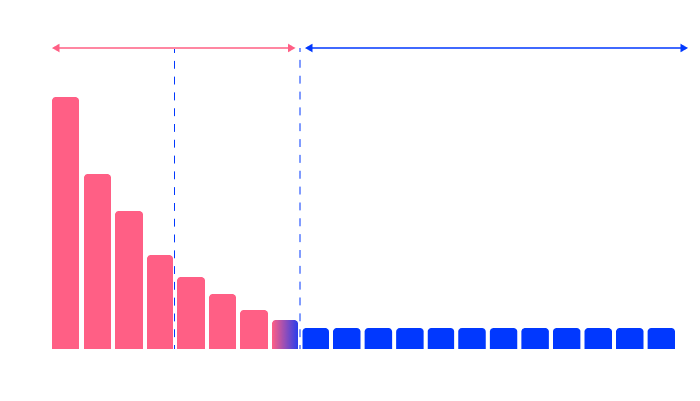
Most Search Engine Optimisation Companies Ignore 90% of Your Traffic
The long tail is where high-intent buyers actually search.
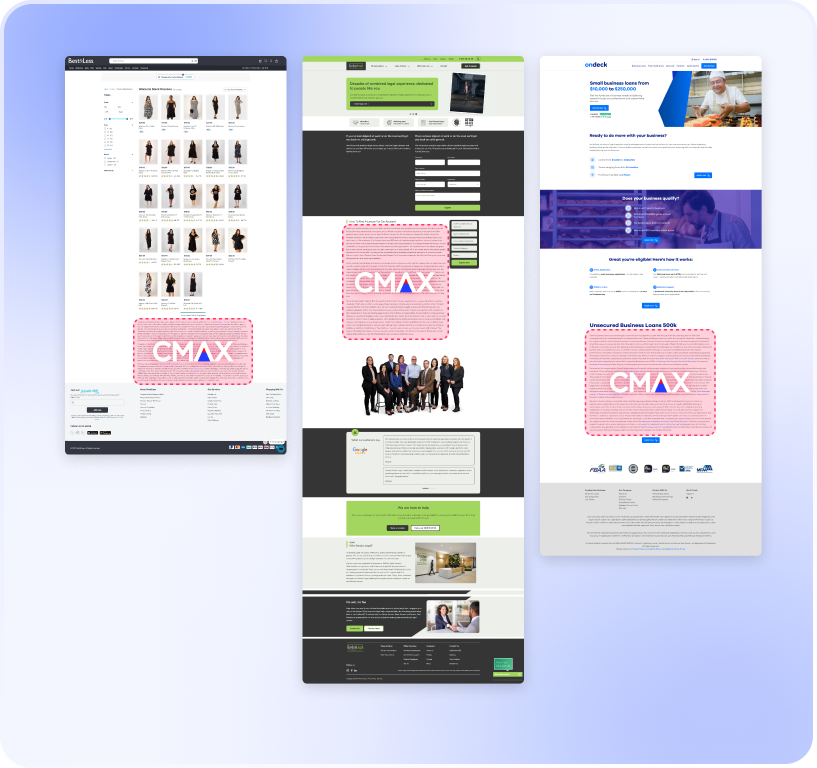
Most search engine optimisation companies focus on a handful of competitive head terms, leaving thousands of specific, conversion-ready queries untouched. CMAX is an agentic SEO platform that deploys two lines of code to programmatically generate and update content across those thousands of long-tail keywords, the ones your competitors aren’t targeting. Results typically start appearing within six weeks, not quarters.
We built CMAX to capture the demand most strategies leave on the table.
References [1] – https://ahrefs.com/blog/long-tail-keywords/
Author
Jeremy Tang
Founder and CEO of CMAX
Jeremy Tang is the Founder and CEO of CMAX. With over 2 decades of experience in business consulting and digital marketing, he has successfully driven seven startup businesses, six of which achieved $1 million in revenue from zero in less than 16 months, 5 of which grew to multi-million dollar a year ventures without any external funding. Jeremy's expertise lies in streamlining business processes through technology and leveraging digital (in particular SEO) for business growth. He resides in Australia, travels extensively, and draws inspiration from his global experiences.