Most SEO content writing services sell you a word count and leave you to sort out the strategy, the briefs, and the quality checks yourself. That split is where pages start to underperform: the keyword research says one thing, the draft does another, and nobody owns the gap between ranking and converting. Before you compare rates, you need to know exactly which deliverables sit with the agency and which stay with your team. CMAX structures that handoff around intent-led briefs, defined QA, and scalable delivery so nothing falls between the cracks.
SEO Content Writing Services Need Clear Deliverables
What the Service Actually Includes
SEO content writing services should define who owns each step of production: keyword strategy, search-intent mapping, briefing, drafting, on-page optimisation, revisions, and final sign-off. When those steps are split across different teams with no single owner checking alignment, pages routinely underperform. The search intent shifts during drafting, the page promise drifts from the brief, and the CTA ends up pointing somewhere the original keyword research never anticipated. Clear ownership at each stage prevents that drift before it reaches publication.
Effective SEO content writing is built on a clear grasp of SEO AI principles, including how algorithms evaluate intent-match, topical authority, and on-page signals before ranking a page. A reputable SEO content writing company will scope these responsibilities upfront so every stakeholder knows who handles what.
What Each Asset Should Specify
A usable content scope goes beyond a per-page or per-word rate. Each deliverable should state whether the page includes the H1, metadata, internal link targets, evidence requirements, CTA placement, author attribution, and an update date. Those fields are what separate a production standard from a word count. With them, buyers can assess the governance model: who reviews factual claims, who approves the final draft, and who is accountable when a page needs updating six months after launch. Without them, two agencies quoting the same rate may be delivering work that differs significantly in quality, traceability, and long-term maintainability. Providers offering SEO content creation services should itemise each of these fields in their statement of work.
Comprehensive SEO article writing services typically encompass website search optimisation as a core deliverable, covering on-page signals, metadata, internal linking, and crawlability alongside the written content itself. Any provider positioning itself as a SEO friendly content writing services supplier should demonstrate how these technical elements are handled within the content production workflow.
Scalable delivery depends on briefs and QA.
Why intent-led briefs matter
Most content rework traces back to a decision made too late: the target keyword, the page’s core promise, the evidence required, and the CTA were all left open when drafting started. Intent-led briefs close those gaps before a single word is written.
When the brief fixes what the page must rank for and what action it should drive, an SEO website copywriter produces to a defined outcome rather than a general topic. Without a brief, SEO content writing services often attract the wrong searcher or rank for a query that has no commercial connection to what the business actually wants the visitor to do next. That mismatch costs traffic quality, not just rankings. Scalable SEO content writing services must now account for AI search behaviour, since the way queries are interpreted and answered in AI search environments affects which content structures and intent signals earn visibility.
SEO Content Brief Template fields
A strong SEO content brief captures ten fields: target keyword, user intent, one-sentence value proposition, primary CTA, H1 and meta description, three-level outline, internal link targets, evidence sources, named author, and update date.
Each field has a job. The one-sentence value proposition stops writers from drifting into adjacent topics. The three-level outline locks structure before drafting, so editorial QA has a fixed reference point. Named authorship and an update date create accountability after publication, not just at launch.
With those fields standardised, multiple writers or teams can produce pages to the same production standard without relitigating strategy on every brief. That’s what makes volume sustainable: repeatable inputs, not faster publishing.
Pricing Reflects Scope, Depth, and Workflow
What Changes Content Pricing
Headline rates tell you almost nothing. What actually drives cost is the research load behind each page, whether a subject-matter expert reviews the draft before it goes live, how many revision rounds are built into the engagement, and whether the work covers individual pages or a repeatable page set produced from a controlled template.
A single long-form page requiring primary research, SME sign-off, and two structured revision rounds costs more to produce than a templated landing page drawn from approved inputs, and it should. Comparing SEO content writing services on headline rate alone misses the real cost drivers. Two quotes at the same price can represent entirely different production standards, approval chains, and QA effort. Compare inclusions first, then the number.
When scoping SEO content writing services, forward-thinking buyers are also asking how deliverables align with generative engine optimisation requirements, since content structured for AI-generated answer surfaces may need different formatting, citation depth, and authority signals than traditional ranked pages.
Why Turnaround and QA Belong Upfront
Turnaround and quality controls need to be locked in before a brief is written, not negotiated after the first draft lands. This is especially true when AI-assisted drafting is part of the workflow.
AI can accelerate production, but it does not replace source verification, factual review, human editing, or editorial QA. Each of those steps takes time and affects both delivery speed and post-publication clean-up. A team that skips them publishes faster and fixes more. Agreeing on which checks apply to which content types, and who owns each step, before work begins keeps delivery predictable and quality consistent across the full page set.
Proof matters more than promises.
What a worked example should show
A worked example for SEO content writing services should show deliverables, workflow, and proof quickly. Buyers in commercial research mode want to assess all three at a glance. A strong example earns that attention by opening with a direct answer, organising the body around three intent-led subheadings that map to what the buyer actually needs to know, and closing with a CTA that matches where they are in the decision process. A generic thought-leadership article does none of that. Structure is the signal. When a page is built the way it asks its readers to build pages, the methodology becomes self-evident.
Catalogue-scale proof point
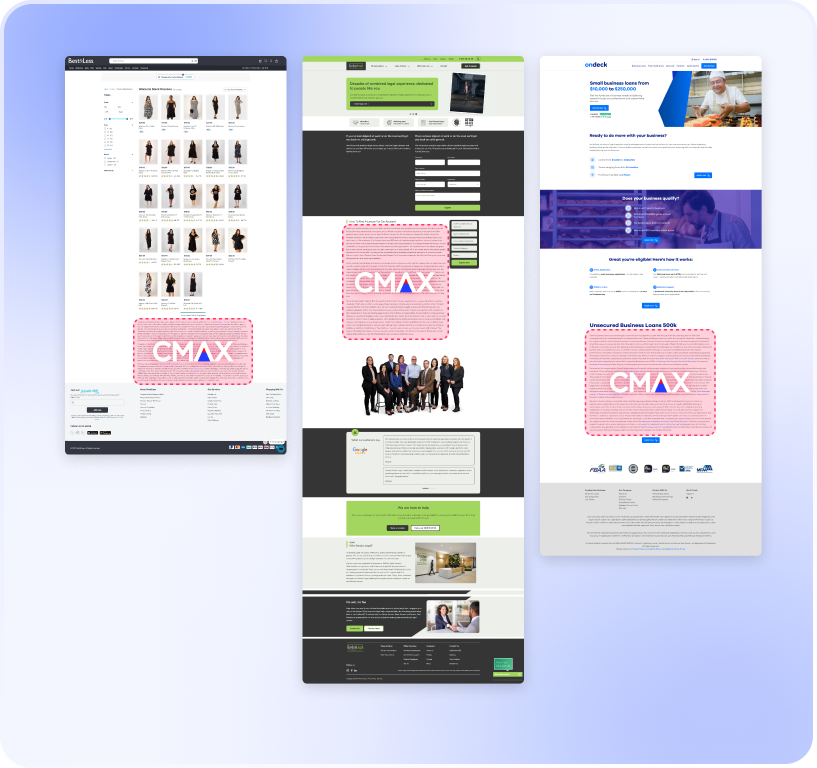
In one CMAX engagement, a B2B omnichannel hospitality retailer added 5,000 long-tail product pages and generated $1M+ per month in incremental SEO revenue within 8 months. That result follows a specific mechanism: broad service or category pages rarely cover the full range of high-intent searches buyers use when comparing specific options. Each long-tail page targets a query narrow enough to match a distinct purchase consideration, and the cluster as a whole captures demand that a single overview page would miss entirely. Enterprise SEO programmes that rely on a handful of pillar pages leave most of that demand unaddressed. The hospitality retailer case shows what happens when page volume is matched to actual search demand at scale.
Proving the impact of SEO content writing services increasingly means showing performance not just in traditional rankings but also in Google AI Search results, where featured placements and AI-generated summaries are becoming key visibility benchmarks.
Agency Selection Becomes Easier with a Checklist
What to Check Before Buying
Before signing with any SEO content agency, ask for six things: sample briefs, case-study methodology, named authors, update cadence, revision policy, and reporting tied to leads, assisted conversions, and target keyword clusters.
Each item reveals something the headline rate won’t. Sample briefs show whether the team fixes intent before drafting or retrofits it after. Case-study methodology tells you whether results are attributable or coincidental. Named authors confirm editorial accountability. Update cadence tells you whether pages get maintained or abandoned after publication. Revision policy defines how many rounds are included and who owns sign-off. Reporting against keyword clusters and assisted conversions shows whether the agency tracks what moves revenue, not just rankings.
For teams that need an SEO copywriter Australia, the checklist above applies regardless of location. If a vendor can’t produce these on request, that’s the answer. An SEO copywriter Melbourne businesses rely on will have every item ready before the first call.
The SEO copywriting Sydney agencies trust is backed by transparent case studies and named authors. Likewise, any credible SEO copywriting Melbourne provider will tie reporting to assisted conversions rather than vanity metrics. These checks turn buying SEO content writing services from a guess into a structured decision.
Programmatic Service Pages Module
This module is built for productized services, SaaS offers, and e-commerce categories that need many closely related landing pages fast. Each page targets a distinct long-tail query from a controlled template and approved inputs.
The structure runs four layers deep:
A canonical overview page opens with an answer-first structure, defines the service or category, names the audience need it addresses, and specifies the next action the visitor should take.
10 to 25 long-tail landing pages target closely related variants with distinct search intent. Each URL answers a query too narrow or too conversion-oriented for the overview page to handle without diluting its focus.
A content brief CSV maps target keywords, page purpose, CTAs, and internal link targets across the full cluster, giving production and QA one source of truth for what each page must cover.
An editorial QA checklist verifies factual accuracy, source use, on-page consistency, and duplication risk, critical when pages share a template but still need enough original value to justify separate URLs.
Does Google penalise AI-generated content?
Google does not ban content because AI helped produce it.[1] Pages underperform when they repeat generic wording, miss search intent, or publish claims without evidence, editorial review, or named ownership. The quality signal is the page, not the production method.
When evaluating SEO content writing services, it’s worth considering how features like AI Overview are reshaping how search results surface content and what that means for page structure and visibility.
How do you scale SEO content without losing quality?
Standardise briefs, assign clear QA checks, define approved sources, and review templates before expanding page volume. Scale comes from a repeatable process, not from publishing faster without controls. Teams that skip those steps typically spend more time cleaning up after publication than they saved during production.
What is the difference between programmatic and traditional SEO?
Traditional SEO creates pages one by one for broader topics. Programmatic SEO uses structured templates and data inputs to publish many pages for closely related long-tail searches, where each URL has a distinct query to answer and a defined internal linking role.
How long does it take for programmatic SEO to show results?
Initial movement can begin within weeks on well-clustered builds. CMAX reports results typically begin within 6 weeks. Actual timing depends on crawl frequency, site authority, internal linking, and how precisely the new pages match real search demand.
Can you actually rank for thousands of long-tail keywords?
Yes. When a site publishes pages that each answer a distinct long-tail query with enough specificity, evidence, and internal-link support, those pages earn visibility individually. Many niche searches are too narrow, too local, or too comparison-led to be served by one generic page, which is exactly where a structured cluster approach has an advantage.
As SEO content writing services evolve, teams increasingly need to account for how AI search engines index and prioritise content differently from traditional crawlers.
What is SEO content writing?
At its core, SEO content writing meaning refers to the practice of producing web pages, articles, and guides that are structured to rank in search engines while delivering genuine value to readers. An SEO content writing for beginners approach starts with keyword research, clear headings, and concise answers to the questions a target audience is already asking. For anyone asking what is SEO content writing, it is the discipline of aligning editorial quality with technical search requirements so that each published page attracts the right visitor and holds their attention.
Most SEO Content Writing Services Scale Words, CMAX Scales Results
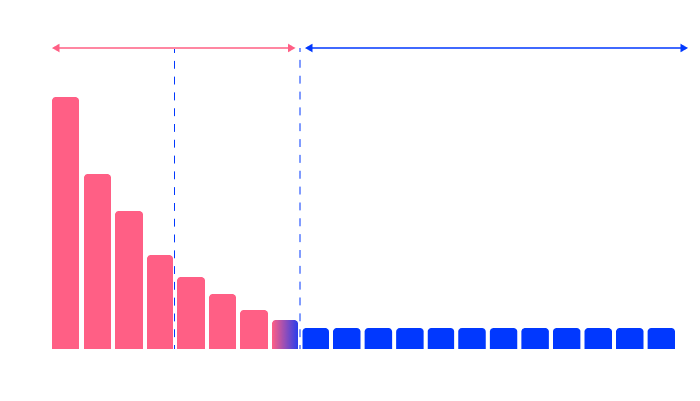
CMAX is the agentic SEO platform built to capture the 90% of search demand that lives in the long tail.
Where traditional SEO content writing services produce content in batches and hope it ranks, CMAX deploys AI-driven agents that create, publish, and continuously optimise thousands of pages, with just two lines of code. Every page targets a specific, high-intent keyword your buyers are already searching. Teams start seeing measurable organic traffic gains within six weeks of launch.
If your current approach has plateaued, the math has changed, and CMAX was built for the new math.
References [1] – https://developers.google.com/search/docs/essentials/spam-policies
Author
Jeremy Tang
Founder and CEO of CMAX
Jeremy Tang is the Founder and CEO of CMAX. With over 2 decades of experience in business consulting and digital marketing, he has successfully driven seven startup businesses, six of which achieved $1 million in revenue from zero in less than 16 months, 5 of which grew to multi-million dollar a year ventures without any external funding. Jeremy's expertise lies in streamlining business processes through technology and leveraging digital (in particular SEO) for business growth. He resides in Australia, travels extensively, and draws inspiration from his global experiences.