Most SaaS teams start SEO with blog content that ranks but never touches pipeline. SEO for SaaS works differently when you prioritise pages closest to a buying decision, score keywords by commercial value instead of volume, and measure results in trials and qualified leads rather than sessions. That shift changes which pages get built first, how keywords are selected, and what “working” actually looks like to a CFO. CMAX helps SaaS teams scale that kind of buyer-intent content programmatically, so organic growth ties back to revenue.
Buyer-Intent SEO Changes How SaaS Teams Prioritise Pages
Pages Closest to Trial Intent
The way SEO for saas differs from general SEO is that page priority starts with trial intent. Many SaaS SEO programmes tend to begin with blog content because it’s easier to produce at volume. The problem is that broad educational articles attract readers who are months away from a buying decision, if they ever make one.
Product, feature, comparison, and pricing pages map to a different kind of search. Someone querying “[your tool] vs [competitor]” or “[category] software pricing” is comparing options, validating fit, or checking whether a purchase can clear procurement. Those searches sit close to a trial or demo request. A strong SEO for saas companies programme builds those pages first.
This doesn’t mean educational content has no role. It means the pages with the clearest path to pipeline should come before the ones that serve general curiosity. For teams running SEO for B2B saas, this is especially critical because buying committees need product-specific evidence at each stage of their evaluation.
Keyword Value Beyond Search Volume
Search volume is a weak proxy for keyword value in SaaS. A term pulling 200 searches a month can outperform one pulling 2,000 if it reflects a real product use case, signals where a buyer sits in their evaluation, and describes a problem a sales team can qualify.
The questions worth asking: Does this keyword connect to a specific feature, workflow, or integration the product solves? Does it suggest someone actively comparing, switching, or scoping an implementation? Could a sales rep use this conversation to move a deal forward?
When those answers are yes, the keyword earns a page regardless of its volume. That’s the core shift B2B saas SEO asks teams to make.
SEO for SaaS now extends beyond traditional ranking tactics, with forward-looking teams also exploring generative engine optimisation to ensure their product and feature pages are cited by AI-generated answers at the point of buyer evaluation.
A scoring model makes SaaS keywords worth pursuing.
Five-step keyword scorecard
Most SaaS teams waste crawl budget and editorial time on keywords that attract researchers who will never buy. A scoring model built for SEO for saas helps teams reject queries unlikely to influence pipeline, and a simple intent-value checklist keeps every keyword tied to a commercial page, a sales conversation, or a realistic conversion path.
Run each candidate term through four checks before committing to it.
Does the site have a direct answer? Match the query to a specific product, feature, integration, workflow, comparison, or pricing concern the site can address on a dedicated page. If the answer requires a generic blog post, the keyword is probably too early-stage.
Does the search signal active buying behaviour? Queries that suggest active evaluation, switching behaviour, procurement research, or implementation planning carry more pipeline weight than general curiosity. “Best project management software” is research. “[Your product] vs [competitor] migration” is a buying signal.
Can the page resolve a real sales question? A page earns its place when it answers something a sales rep, demo, security review, or onboarding call would otherwise have to handle. If a generic blog post could rank just as well, the page is not differentiated enough to convert.
Could this keyword start a commercial conversation? Estimate whether the term could lead to a trial start, demo request, MQL, or sales conversation. Pageviews are not the goal. A keyword that drives 200 monthly visits and produces three demo requests outperforms one that drives 2,000 visits and produces none.
Score each keyword against these four checks before it enters the content calendar. When building a keyword scorecard, many SaaS teams are now pairing their intent-value model with SEO AI tooling to automate scoring signals and surface commercial queries faster.
Prioritise terms the site can support with linked cluster pages, such as feature, use-case, integration, and comparison content, rather than publishing one-off articles with no internal context.
One-off articles with no internal linking path rarely move commercial metrics. A page about a use case or integration only earns ranking authority when it sits inside a cluster of related content that signals topical depth to search engines. Publish feature, use-case, integration, and comparison pages as a connected set, and each page reinforces the others. Publish them in isolation, and each one competes without support.
Keywords from customer conversations
Keyword tools surface what people type, but often miss the specific language buyers use when they’re close to a decision.
Sales calls, demo objections, onboarding questions, and support tickets are where that language lives. Terms like migration, seat limits, security, compliance, and onboarding show up repeatedly in those conversations because they reflect real procurement blockers, not general curiosity. A prospect asking about SSO support or data residency during a demo is signalling evaluation intent that a keyword tool may log as low volume or skip entirely.
Pulling those modifiers into keyword planning closes the gap between what tools report and what buyers actually search. Common saas examples, such as workflow automation platforms or subscription billing tools, generate high-intent modifiers like “HRIS integration compliance requirements” that may carry modest search volume but map directly to a question a sales rep fields on every enterprise call. That alignment between search query and sales conversation is what makes a page worth building.
Cross-referencing tool data with CRM notes, support ticket categories, and recorded demo calls gives SaaS teams a keyword list grounded in real buying behaviour rather than estimated demand.
SEO for SaaS content clusters built around real customer language are better positioned to appear in Google AI Search, where synthesised answers tend to draw from pages that demonstrate clear topical depth and commercial specificity.
Site structure determines whether buyer-intent pages can rank.
Product and feature content clusters
Buyer-intent pages do not rank in isolation. A pillar page built around a core product or feature theme creates the internal linking foundation that deeper use-case, integration, and workflow pages depend on. Without that structure, a standalone page on, say, a specific integration or workflow variant has no internal context to draw from, and search engines have less signal to connect it to the broader commercial topic.
Site architecture is what makes SEO for saas scalable across product and feature clusters. Build the pillar first, then publish the cluster pages with deliberate links back to it. Each cluster page reinforces the pillar’s topical authority, and the pillar passes relevance down to the pages closest to conversion.
Comparison and pricing page requirements
Feature grids alone rarely close the gap for buyers in late-stage evaluation. Comparison, alternative, and pricing-adjacent pages perform better when they address the questions that actually stall decisions: how difficult is migration, what does implementation involve, who needs to sign off internally, what do contract terms look like, and how does procurement typically handle this category of software.
SEO for SaaS depends heavily on sound website search optimisation across product, feature, and comparison page clusters so that internal linking and crawl paths reinforce commercial intent throughout the site.
A buyer comparing two platforms is often not looking for another feature checklist. They are trying to de-risk a decision they will have to defend to a CFO or procurement team. Pages that answer switching effort, stakeholder approval requirements, and contract structure directly give that buyer a reason to stay on the page and a reason to convert.
Revenue Measurement Makes SaaS SEO Comparable With Paid Channels
Metrics That Reflect Revenue Impact
Rankings and sessions tell you what happened in search. They do not tell you whether it mattered commercially. For SaaS teams reporting to a CFO or board, the metrics that hold up are trials started, MQLs generated, pipeline influenced, and payback period on acquisition cost.
These figures answer the question paid search already answers: is this channel producing qualified demand at a recoverable cost? An SEO agency for saas typically benchmarks organic against paid acquisition cost, giving SEO a seat at the same table as Google Ads with a comparable cost-per-acquisition story rather than a traffic report.
SEO for SaaS teams increasingly needs to account for how organic content surfaces inside an AI Overview, since these placements can influence trial-stage buyers before they ever click a traditional result.
Pipeline influence is worth measuring separately. A buyer who reads a comparison page, then a pricing page, then requests a demo may not convert on the first organic session. Assisted conversion tracking across those touchpoints shows the channel’s real contribution to revenue. When evaluating an SEO company for saas, ask whether their reporting connects organic sessions to pipeline stages rather than stopping at traffic.
SaaS Proof Point by Mechanism
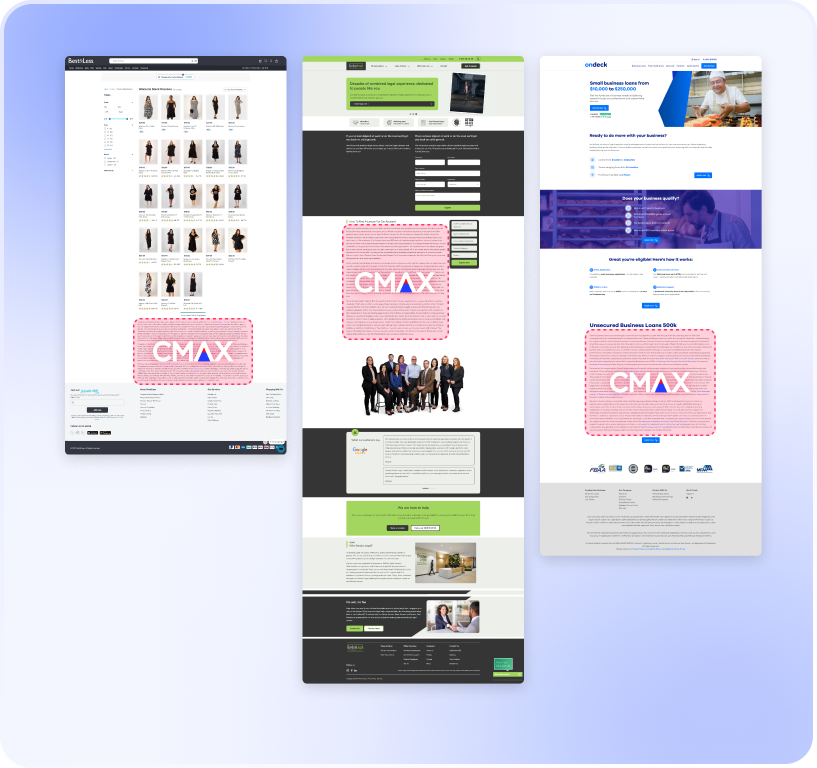
The scale dynamic is already proven in adjacent verticals. In one CMAX engagement, a fintech lender scaled from 1,000 to 15,000+ pages and gained 1,400+ new rankings within 6 weeks.
The same conditions that drove that result appear frequently in SaaS: paid search CPCs are high on core terms, branded and category keywords have plateaued, and long-tail commercial demand across use cases, integrations, and buyer roles remains largely uncovered. Scaling into that demand programmatically shifts acquisition cost in a way a handful of pillar pages cannot, which is why SEO for saas should be measured against pipeline, not pageviews.
Technical depth and links matter differently across SaaS page types.
Core technical needs for money pages
Product, feature, and pricing pages carry the most commercial weight on a SaaS site, so the technical bar for those pages is higher than for editorial content. Reliable indexation means search engines can consistently find and re-crawl the full commercial page set, not just the homepage or a handful of top-level categories. Strong internal linking connects those pages to supporting use-case, integration, and comparison content, giving crawlers a clear signal about topical relevance. Stable templates reduce the risk of structural changes that break schema markup or disrupt crawl patterns across large page sets. Appropriate schema on pricing and feature pages helps search engines interpret key elements, such as product names, pricing tiers, and feature sets, with less guesswork. For SaaS teams running programmatic page sets at scale, these foundations are what keep commercial pages ranking consistently rather than cycling in and out of the index.
As SEO for SaaS matures, technical teams are beginning to audit how product and feature pages are indexed and cited within AI search, where structured content and clear entity signals carry extra weight.
When backlinks matter more
Comparison and awareness pages tend to compete in broader SERPs where domain authority and third-party signals often carry more weight. A “best CRM for startups” or “[Competitor] alternative” page sits alongside established review sites and high-authority publishers, so backlinks from relevant sources help those pages compete. Long-tail commercial pages operate in a different environment. A query like “project management software for construction teams with compliance tracking” has fewer competing pages, and the ranking factors shift toward complete topic coverage, precise intent matching, and internal relevance from related commercial pages already on the site. Chasing links for every long-tail page misallocates effort. Prioritise link acquisition where the SERP demands it, and let content depth and internal structure do the work everywhere else.
How to scale SaaS SEO programmatically?
Teams new to SEO for saas often ask how to scale programmatically without sacrificing quality. Start with repeatable page types: integrations, use cases, industry variants, and comparison pages. Build shared templates, then feed each one genuinely distinct, query-specific inputs rather than swapping a single variable and republishing the same content. Pair that with controls for indexation, internal linking, and duplication from the outset. Scaling without those controls produces page bloat that search engines deprioritise.
How to target buyer-intent long-tail keywords?
Combine core product terms with modifiers that signal active evaluation or implementation: pricing, alternatives, migration, integration, compliance, onboarding, and team-specific workflows. A query like “[product] compliance onboarding for healthcare teams” carries far more commercial signal than a broad category term, even at a fraction of the search volume.
Is programmatic SEO effective for enterprise SaaS?
enterprise SEO at scale requires repeatable page types with genuinely distinct inputs covering product, use case, role, industry, integration, and geographic intent. It underperforms when pages do not answer a distinct buyer question. Coverage without specificity produces thin content that neither ranks nor converts.
SEO for SaaS is evolving quickly as AI search engines begin surfacing product comparisons and feature pages in ways that bypass conventional blue-link rankings entirely.
How to measure ROI for long-tail keywords?
Group keywords by landing page, then track assisted conversions, trial starts, qualified leads, influenced pipeline, and payback period. Judging individual queries in isolation misses how long-tail pages collectively move pipeline.
How to maintain content quality with programmatic SEO?
Limit templates to approved claims, require distinct inputs for each query, and review weaker page sets against conversion data, duplication risk, and indexation performance on a regular cadence.
SaaS SEO Demands Scale, CMAX Was Built for It
Most SaaS teams know they should prioritise buyer-intent keywords, build pillar pages, and measure by MQLs rather than vanity rankings.
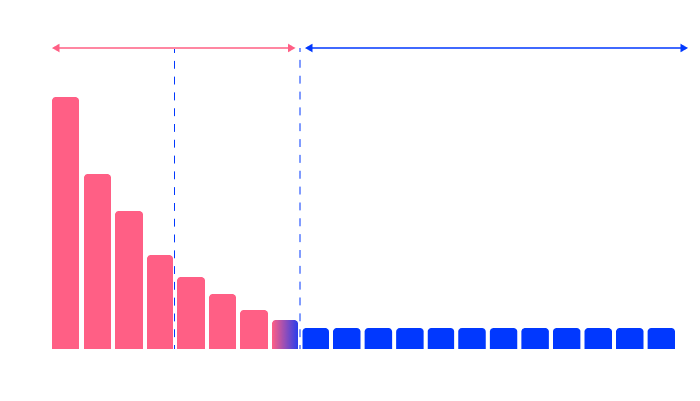
The problem isn’t strategy, it’s execution. Long-tail keywords drive over 90% of search and AI demand, but targeting thousands of them with a small team and conventional tools stalls fast. CMAX is an agentic SEO platform that deploys and continuously updates content across the full spread of ways prospects search for what you sell, with just two lines of code.
Results start showing in six weeks, not six months.
Author
Jeremy Tang
Founder and CEO of CMAX
Jeremy Tang is the Founder and CEO of CMAX. With over 2 decades of experience in business consulting and digital marketing, he has successfully driven seven startup businesses, six of which achieved $1 million in revenue from zero in less than 16 months, 5 of which grew to multi-million dollar a year ventures without any external funding. Jeremy's expertise lies in streamlining business processes through technology and leveraging digital (in particular SEO) for business growth. He resides in Australia, travels extensively, and draws inspiration from his global experiences.